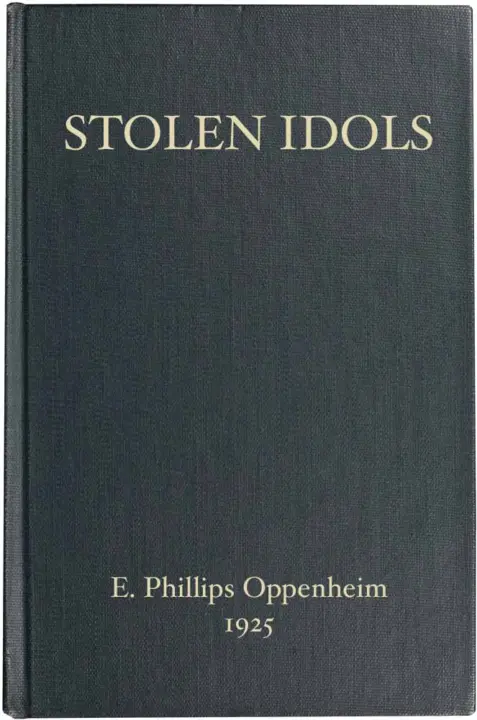
Stolen Idols
E. Phillips (Edward Phillips) Oppenheim
THE CLASSIC COLLECTION · 1921
"Jacob's Ladder" by E. Phillips Oppenheim is a novel written in the early 20th century. The story follows Jacob Pratt, a man who faces humiliation and financial ruin when he files for bankruptcy. Struggling with his disgrace, Jacob's life takes a dramatic turn two years later when he unexpectedly inherits a fortune, giving him the chance to reshape his identity and confront those who once looked down on him. At the start of the book, Jacob Pratt grapples with the aftermath of his bankruptcy, feeling unworthy and isolated from society. Despite a neat home and loyal landlady, he endures a painfully awkward commute to the city, where he faces the disdain of former acquaintances, including a creditor who publicly humiliates him. However, as the narrative unfolds, his fortunes change when he receives an unexpected inheritance, setting the stage for his journey of rediscovery and the ultimate quest to reclaim his dignity. The opening lays the groundwork for Jacob’s transformation and the complex social dynamics he navigates as he re-enters a world from which he had previously fallen.
Introduction adapted from the source catalogue; source summaries may be automatically generated.
Free to read · English · 62,698 words · No account needed
MAKE TIME FOR A GOOD BOOK
On by default. Untick to stop anonymous reading totals. Each page counts after 10 seconds in view. How this works.
Anonymous counting is on unless you have switched it off.
"Can't I be in this?" the third man, young Lord Felixstowe, suggested, leaning forward and dropping the eyeglass through which he had been staring at Jacob. "Seems to me I am as likely to land the fish as any of you."
Sybil thoroughly disliked the conversation and did not hesitate to
disclose her feelings.
"Mr. Pratt is only an acquaintance of mine," she declared, "and I do not wish to speak to him. If he has the temerity to accost me, I will introduce you all--not unless. It will serve him right then."
Mason looked at her reprovingly.
"My dear Miss Bultiwell," he said, "in the tortuous course of life, our daily life, an unpleasant action must sometimes be faced. If you remember, barely an hour ago, over our cocktails, we declared for a life of adventure. We paid tribute to the principle that the unworthy wealthy must support the worthy pauper. We are all worthy paupers."
Grace Powers laughed softly.
"I don't know about the worthiness," she murmured, "but you should see
my dressmaker's bill!"
"Useless, dear lady," Mason sighed. "We five are, alas! all in the same box. We must look outside for relief. Since I have studied your friend's physiognomy, Miss Bultiwell, I am convinced that an acquaintance with him is necessary to our future welfare. I can see philanthropy written all over his engaging countenance."
"Mr. Pratt isn't a fool," Sybil observed drily.
"Neither are we fools," Mason rejoined. "Besides," he went on, "you must remember that in any little exchange of wits which might take place between Mr. Pratt and ourselves, the conditions are scarcely equal. We have nothing to lose and he has everything. He has money--a very great deal of money--and we are paupers."
"There are other things to be lost besides money," Sybil reminded him.
"I guess not," Hartwell intervened, with real fervour,--"nothing else
that counts, anyway."
They watched Jacob longingly as he left the restaurant,--personable, self-possessed, and with the crudities of his too immaculate toilet subdued by experience. His almost wistful glance towards Sybil met with an unexpected reward. She bowed, if not with cordiality, at any rate without any desire to evade him. For a single moment he hesitated, as though about to stop, and the faces of her friends seemed to sharpen, as though the prey were already thrown to them. Perhaps it was instinct which induced him to reconsider his idea. At any rate he passed out, and Dauncey pressed his arm as they emerged into the street.
"I have never been favourably impressed with Miss Bultiwell," the latter observed, "but I like the look of her friends still less."
Your reading position is saved on this browser. Take it to another device with a library code. Reading pages adapt to text, rather than matching a printed edition.
E. Phillips (Edward Phillips) Oppenheim
E. Phillips (Edward Phillips) Oppenheim
E. Phillips (Edward Phillips) Oppenheim
E. Phillips (Edward Phillips) Oppenheim
BEHIND THE BOOK
This eBook is for the use of anyone anywhere in the United States and most other parts of the world at no cost and with almost no restrictions whatsoever. You may copy it, give it away or re-use it under the terms of the Project Gutenberg License included with this eBook or online at www.gutenberg.org. If you are not located in the United States, you will have to check the laws of the country where you are located before using this eBook. Read the source licence.
The original source file, including credits and licence, is retained by this library. Request an original-format copy at no charge. Please include the book title and Project Gutenberg identifier #32732.
KEEP YOUR CURIOSITY GOING
Coulson Kernahan

Maurice Baring
Frances Wright
Cécile Tormay

Frederic Jesup Stimson

W. H. P. (William Henry Pope) Jarvis