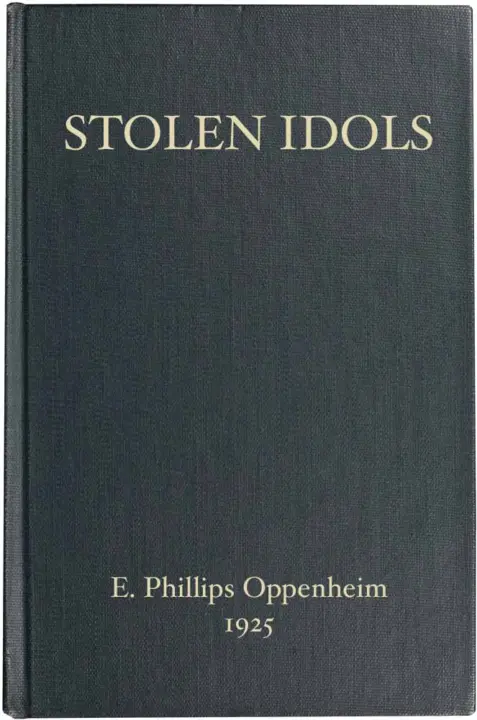
Stolen Idols
E. Phillips (Edward Phillips) Oppenheim
THE CLASSIC COLLECTION · 1921
"Jacob's Ladder" by E. Phillips Oppenheim is a novel written in the early 20th century. The story follows Jacob Pratt, a man who faces humiliation and financial ruin when he files for bankruptcy. Struggling with his disgrace, Jacob's life takes a dramatic turn two years later when he unexpectedly inherits a fortune, giving him the chance to reshape his identity and confront those who once looked down on him. At the start of the book, Jacob Pratt grapples with the aftermath of his bankruptcy, feeling unworthy and isolated from society. Despite a neat home and loyal landlady, he endures a painfully awkward commute to the city, where he faces the disdain of former acquaintances, including a creditor who publicly humiliates him. However, as the narrative unfolds, his fortunes change when he receives an unexpected inheritance, setting the stage for his journey of rediscovery and the ultimate quest to reclaim his dignity. The opening lays the groundwork for Jacob’s transformation and the complex social dynamics he navigates as he re-enters a world from which he had previously fallen.
Introduction adapted from the source catalogue; source summaries may be automatically generated.
Free to read · English · 62,698 words · No account needed
MAKE TIME FOR A GOOD BOOK
On by default. Untick to stop anonymous reading totals. Each page counts after 10 seconds in view. How this works.
Anonymous counting is on unless you have switched it off.
She treated him to one of her sudden vagaries. All the discontent seemed to fade in a moment from her face. Her eyes laughed into his, her mouth softened into a most attractive curve.
"Some day," she said, as she turned away, "I may find my palace, but I don't think that you will be the landlord, Mr. Pratt.--Bother!"
Her ill-temper suddenly returned. A tall, elderly lady had issued from the house and was leaning over the gate. She was of a severe type of countenance, and Jacob remembered with a shiver her demeanour on his visit to the Manor House in the days of the Bultiwell prosperity. She welcomed him now, however, with a most gracious smile, and beckoned him to advance.
"I am very glad to see you, Mr. Pratt," she said, as they shook hands. "I have not had an opportunity of congratulating you upon your access to fortune."
"Very good of you, I'm sure," Jacob murmured.
"We," Mrs. Bultiwell continued, "are progressing, as you perceive, in the opposite direction. I suppose it is an idea of mine, but I feel all the time as though I were living in a sort of glorified almshouse."
"It must seem very small to you after the Manor," Jacob replied politely, "but the feeling you have spoken of is entirely misplaced. The Estate is conducted as a business enterprise, and will, without doubt, show a profit."
"You are, I believe," Mrs. Bultiwell said, "connected with the
Estate?"
Jacob admitted the fact. Sybil, who had recommenced her watering, drew
a little closer.
"There are a few things," Mrs. Bultiwell observed, "to which I think the attention of the manager should be drawn. In the first place, the garden. It all requires digging up."
"Surely that is a matter for the tenants," Sybil intervened.
"Nothing of the sort," Jacob pronounced. "It is a very careless
omission on the part of the owners. I will give orders concerning it
to-morrow."
Mrs. Bultiwell inclined her head approvingly. Having once tasted blood, she was unwilling to let her victim go.
"If you will step inside for a moment, Mr. Pratt," she went on, "there are one or two little things I should like to point out to you. The cupboard in Sybil's room--"
"Mother," Sybil protested, "Mr. Pratt has nothing to do with these
matters."
"On the contrary," Jacob replied mildly, "I am just the person who has to do with them. You are paying a very good rent, Mrs. Bultiwell, and any little thing the Estate can do to make you more comfortable--"
"Come this way, Mr. Pratt," Mrs. Bultiwell interrupted firmly....
Your reading position is saved on this browser. Take it to another device with a library code. Reading pages adapt to text, rather than matching a printed edition.
E. Phillips (Edward Phillips) Oppenheim
E. Phillips (Edward Phillips) Oppenheim
E. Phillips (Edward Phillips) Oppenheim
E. Phillips (Edward Phillips) Oppenheim
BEHIND THE BOOK
This eBook is for the use of anyone anywhere in the United States and most other parts of the world at no cost and with almost no restrictions whatsoever. You may copy it, give it away or re-use it under the terms of the Project Gutenberg License included with this eBook or online at www.gutenberg.org. If you are not located in the United States, you will have to check the laws of the country where you are located before using this eBook. Read the source licence.
The original source file, including credits and licence, is retained by this library. Request an original-format copy at no charge. Please include the book title and Project Gutenberg identifier #32732.
KEEP YOUR CURIOSITY GOING
Coulson Kernahan

Maurice Baring
Frances Wright
Cécile Tormay

Frederic Jesup Stimson

W. H. P. (William Henry Pope) Jarvis