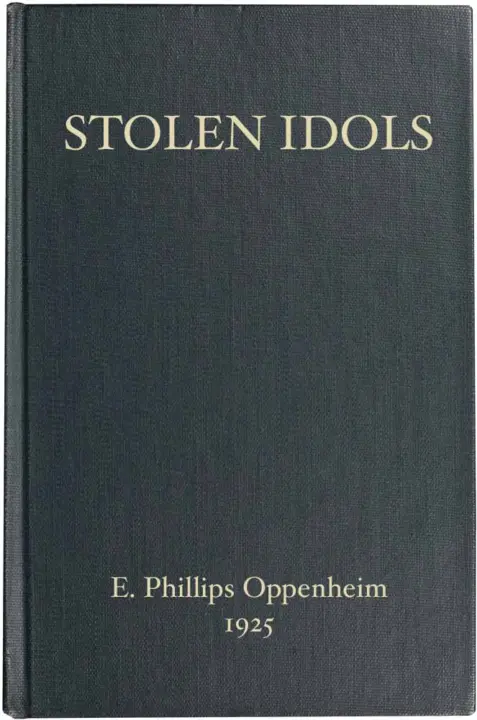
Stolen Idols
E. Phillips (Edward Phillips) Oppenheim
THE CLASSIC COLLECTION · 1921
"Jacob's Ladder" by E. Phillips Oppenheim is a novel written in the early 20th century. The story follows Jacob Pratt, a man who faces humiliation and financial ruin when he files for bankruptcy. Struggling with his disgrace, Jacob's life takes a dramatic turn two years later when he unexpectedly inherits a fortune, giving him the chance to reshape his identity and confront those who once looked down on him. At the start of the book, Jacob Pratt grapples with the aftermath of his bankruptcy, feeling unworthy and isolated from society. Despite a neat home and loyal landlady, he endures a painfully awkward commute to the city, where he faces the disdain of former acquaintances, including a creditor who publicly humiliates him. However, as the narrative unfolds, his fortunes change when he receives an unexpected inheritance, setting the stage for his journey of rediscovery and the ultimate quest to reclaim his dignity. The opening lays the groundwork for Jacob’s transformation and the complex social dynamics he navigates as he re-enters a world from which he had previously fallen.
Introduction adapted from the source catalogue; source summaries may be automatically generated.
Free to read · English · 62,698 words · No account needed
MAKE TIME FOR A GOOD BOOK
On by default. Untick to stop anonymous reading totals. Each page counts after 10 seconds in view. How this works.
Anonymous counting is on unless you have switched it off.
"My mother and I," she said, "have of course left the Manor House. We are in lodgings now and looking for a permanent abode near London. The idea of a residence at Cropstone Wood appeals to my mother. She has friends in the neighborhood."
Jacob inclined his head.
"I assure you the Estate is everything that we claim for it."
"Most of the enquiries I have made have been satisfactorily answered," she admitted. "I have found only one person who has had any criticism to make. He says that, before buying property there, one ought to have definite information about the water and lighting."
"He is a very sensible man," Jacob agreed.
"I have come here to ask about them."
"The water and lighting," Jacob announced, "will be undertaken by the Cropstone Wood, Water and Electric Light Company, a private enterprise close at hand. The charges will be normal and the supply adequate."
"Thank you," the girl said. "If you are sure of that it is all I came
to ascertain."
She rose to her feet. Jacob was desperately unwilling to let her go.
"Any direct transactions, of course, are undertaken with the city office," he explained, "but if you will accept a letter from me to the manager, he will see that your application is promptly dealt with, and that you have all the choice of site that is possible. There is, as you may know, a great demand for the land."
"Thank you," she replied, "I will not trouble you."
"Then again," he went on, "there is the question of whether you want simply to buy the land and employ your own builder, or place the contract with Littleham, who has an office on the Estate. My advice to you would be to go to Littleham. He can show you a dozen plans of various sized residences, he has a stock of material close at hand--"
"I am very much obliged," she interrupted. "My mother and I have already decided upon one of Mr. Littleham's cottages. It was simply because we found his answers as regards the water and electric lighting a little indefinite, that I decided to come to you."
"Indefinite?" Jacob murmured.
"Yes. He told us that the water and lighting were to be supplied by the private company you spoke of, but he seemed to have no idea as to what price they would be likely to charge."
Jacob inclined his head thoughtfully.
"I think you may rest assured," he told her, "that the charge will be
normal."
She turned away.
"You have given me the information I require," she said. "Thank you once more, and good morning."
Your reading position is saved on this browser. Take it to another device with a library code. Reading pages adapt to text, rather than matching a printed edition.
E. Phillips (Edward Phillips) Oppenheim
E. Phillips (Edward Phillips) Oppenheim
E. Phillips (Edward Phillips) Oppenheim
E. Phillips (Edward Phillips) Oppenheim
BEHIND THE BOOK
This eBook is for the use of anyone anywhere in the United States and most other parts of the world at no cost and with almost no restrictions whatsoever. You may copy it, give it away or re-use it under the terms of the Project Gutenberg License included with this eBook or online at www.gutenberg.org. If you are not located in the United States, you will have to check the laws of the country where you are located before using this eBook. Read the source licence.
The original source file, including credits and licence, is retained by this library. Request an original-format copy at no charge. Please include the book title and Project Gutenberg identifier #32732.
KEEP YOUR CURIOSITY GOING
Coulson Kernahan

Maurice Baring
Frances Wright
Cécile Tormay

Frederic Jesup Stimson

W. H. P. (William Henry Pope) Jarvis