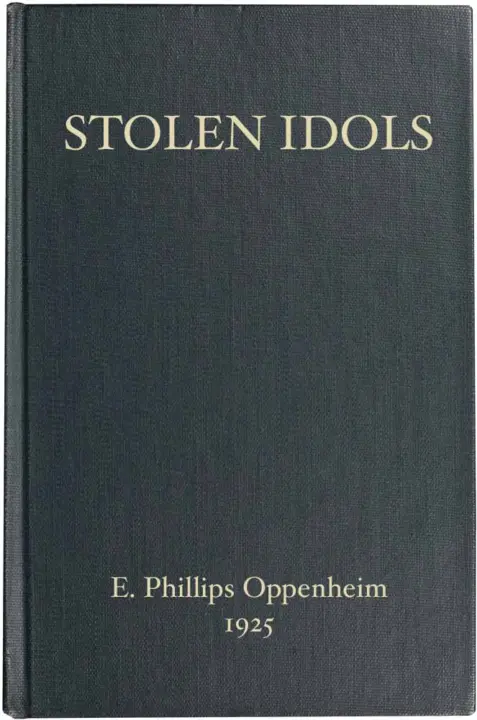
Stolen Idols
E. Phillips (Edward Phillips) Oppenheim
THE CLASSIC COLLECTION · 1921
"Jacob's Ladder" by E. Phillips Oppenheim is a novel written in the early 20th century. The story follows Jacob Pratt, a man who faces humiliation and financial ruin when he files for bankruptcy. Struggling with his disgrace, Jacob's life takes a dramatic turn two years later when he unexpectedly inherits a fortune, giving him the chance to reshape his identity and confront those who once looked down on him. At the start of the book, Jacob Pratt grapples with the aftermath of his bankruptcy, feeling unworthy and isolated from society. Despite a neat home and loyal landlady, he endures a painfully awkward commute to the city, where he faces the disdain of former acquaintances, including a creditor who publicly humiliates him. However, as the narrative unfolds, his fortunes change when he receives an unexpected inheritance, setting the stage for his journey of rediscovery and the ultimate quest to reclaim his dignity. The opening lays the groundwork for Jacob’s transformation and the complex social dynamics he navigates as he re-enters a world from which he had previously fallen.
Introduction adapted from the source catalogue; source summaries may be automatically generated.
Free to read · English · 62,698 words · No account needed
MAKE TIME FOR A GOOD BOOK
On by default. Untick to stop anonymous reading totals. Each page counts after 10 seconds in view. How this works.
Anonymous counting is on unless you have switched it off.
Then there was a little stir in the place. The two men left off dusting; the clerks in the counting-house raised their heads hopefully. Jacob Pratt arrived and was ushered into the presence of the head of the firm. It was a trying moment for Mr. Bultiwell, but he did his best. He wished to be patronising, kindly and gracious. He succeeded in being cringing.
"Glad to see you, Pratt. Glad to see you," he said. "Try that easy-chair. A cigar, eh? No? Quite right! Don't smoke much myself till after lunch. Seen Pedlar this morning?"
"I've just come from his office," Jacob replied.
Mr. Bultiwell thrust his hands into his trousers pockets and leaned
back in his chair.
"Clever fellow, Pedlar, but not so clever as he thinks himself. I don't mind telling you, Pratt, between ourselves, that it was entirely my idea that you should be approached with a view to your coming in here."
"Is that so?" Jacob observed quietly.
"I knew perfectly well that you wouldn't be content to do nothing, a young man like you, and if you're going to keep in the leather trade at all, why not become associated with a firm you know all about, eh? I don't want to flatter myself," Mr. Bultiwell proceeded, with a touch of his old arrogance, "but Bultiwell's, although we haven't been so energetic lately, is still pretty well at the top of the tree, eh?"
"Not quite where it was, I am afraid, Mr. Bultiwell," Jacob objected. "I've been looking through the figures, you know. Profits seem to have been going down a good deal."
"Pooh! That's nothing! Hides were ridiculously high all last year, but they're on the drop now. Besides, these accountants always have to make out balance sheets from a pessimistic point of view."
"The present capital of the firm," Jacob commented, "seems to me
astonishingly small."
"What's it figure out at?" Mr. Bultiwell enquired, with a fine show of carelessness. "Forty thousand pounds? Well, that is small--smaller than it's been at any time during the last ten years. Perhaps I have embarked in a few too many outside investments. They are all good 'uns, though. No use having money lying idle, Mr. Pratt, these days. Now my idea was," he went on, striving to hide a slight quaver in his voice, "that you put in, say, eighty thousand pounds, and take an equal partnership--a partnership, Pratt, remember, in Bultiwell's.... Eh? What's that?"
Mr. Bultiwell looked up with a well-assumed frown of annoyance. A very fashionably dressed young lady, attractive notwithstanding a certain sullenness of expression, had entered the room carrying a great bunch of roses.
Your reading position is saved on this browser. Take it to another device with a library code. Reading pages adapt to text, rather than matching a printed edition.
E. Phillips (Edward Phillips) Oppenheim
E. Phillips (Edward Phillips) Oppenheim
E. Phillips (Edward Phillips) Oppenheim
E. Phillips (Edward Phillips) Oppenheim
BEHIND THE BOOK
This eBook is for the use of anyone anywhere in the United States and most other parts of the world at no cost and with almost no restrictions whatsoever. You may copy it, give it away or re-use it under the terms of the Project Gutenberg License included with this eBook or online at www.gutenberg.org. If you are not located in the United States, you will have to check the laws of the country where you are located before using this eBook. Read the source licence.
The original source file, including credits and licence, is retained by this library. Request an original-format copy at no charge. Please include the book title and Project Gutenberg identifier #32732.
KEEP YOUR CURIOSITY GOING
Coulson Kernahan

Maurice Baring
Frances Wright
Cécile Tormay

Frederic Jesup Stimson

W. H. P. (William Henry Pope) Jarvis