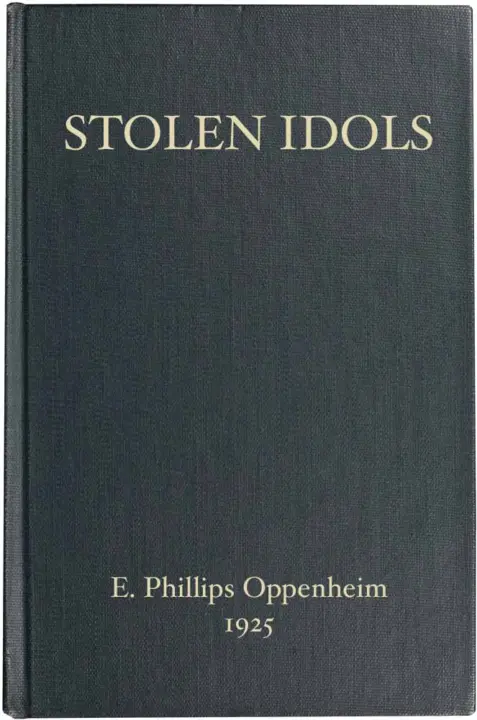
Stolen Idols
E. Phillips (Edward Phillips) Oppenheim
THE CLASSIC COLLECTION · 1921
"Jacob's Ladder" by E. Phillips Oppenheim is a novel written in the early 20th century. The story follows Jacob Pratt, a man who faces humiliation and financial ruin when he files for bankruptcy. Struggling with his disgrace, Jacob's life takes a dramatic turn two years later when he unexpectedly inherits a fortune, giving him the chance to reshape his identity and confront those who once looked down on him. At the start of the book, Jacob Pratt grapples with the aftermath of his bankruptcy, feeling unworthy and isolated from society. Despite a neat home and loyal landlady, he endures a painfully awkward commute to the city, where he faces the disdain of former acquaintances, including a creditor who publicly humiliates him. However, as the narrative unfolds, his fortunes change when he receives an unexpected inheritance, setting the stage for his journey of rediscovery and the ultimate quest to reclaim his dignity. The opening lays the groundwork for Jacob’s transformation and the complex social dynamics he navigates as he re-enters a world from which he had previously fallen.
Introduction adapted from the source catalogue; source summaries may be automatically generated.
Free to read · English · 62,698 words · No account needed
MAKE TIME FOR A GOOD BOOK
On by default. Untick to stop anonymous reading totals. Each page counts after 10 seconds in view. How this works.
Anonymous counting is on unless you have switched it off.
"Good heavens!" Jacob exclaimed. "Do you mean to say that you have asked your sister to drive that crazy old tin kettle of yours all the way down from London?"
"It's a damned nice little car, properly handled," its owner objected stiffly. "I'll lay odds that if Mary started we shall see her on the dock."
Notwithstanding his avowed disapproval, Jacob's interest in the landing perceptibly increased, and much of his depression had passed away when they recognised Lady Mary amongst the little crowd waiting on the dock. She was looking very smart and pretty in her simple motoring clothes, and Jacob realised, even as they shook hands, why his interest in the ladies of New York had lacked spontaneity. She chattered to them gaily enough as they stood waiting for their luggage, but Jacob fancied that there was a shade of reserve in her manner.
"I couldn't wait till you got to London to hear all about it," she declared. "I must have the whole story."
"At dinner time," Jacob suggested. "Only you must promise that you won't laugh too much at the poor guileless Britisher who would probably have been sharked of a hundred thousand pounds in New York, but for Felix."
The girl's eyes danced with pleasure.
"You really mean that he was useful?"
"I can assure you--"
"Chuck that," the young man interrupted gruffly. "Non-stop run down, I
suppose, Mary?"
His sister looked a little dubious.
"I had to stop a few times for repairs," she admitted, "and two policemen told me I should be summoned for making that awful noise."
"A wonderful engine," Felixstowe declared, "but it needs a master
hand."
"It needs a silencer more than anything," Jacob commented.
"Are you going to ride up with us in the dickey to-morrow?" Lady Mary
asked.
"I am not," Jacob replied firmly. "I have wired for my own car."
"Race you up for a tenner, old bean," Felixstowe suggested promptly.
"I wouldn't imperil Lady Mary's existence," Jacob replied,--"that is,
unless she rode with me."
"No fear," the young man scoffed. "Mary would never desert the old tin
kettle, as you call it."
"I rather like the smoothness of a Rolls-Royce," she murmured.
Over dinner that evening, their adventures in New York were recounted at length. It was not until her brother had wandered out to get some cigarettes, however, that Lady Mary referred to the subject which all three seemed to have been avoiding.
"It must have been rather a shock to you, I am afraid, to meet Captain and Mrs. Penhaven on the steamer," she remarked sympathetically.
"I thought it was going to be," he admitted. "It didn't turn out that
way."
Your reading position is saved on this browser. Take it to another device with a library code. Reading pages adapt to text, rather than matching a printed edition.
E. Phillips (Edward Phillips) Oppenheim
E. Phillips (Edward Phillips) Oppenheim
E. Phillips (Edward Phillips) Oppenheim
E. Phillips (Edward Phillips) Oppenheim
BEHIND THE BOOK
This eBook is for the use of anyone anywhere in the United States and most other parts of the world at no cost and with almost no restrictions whatsoever. You may copy it, give it away or re-use it under the terms of the Project Gutenberg License included with this eBook or online at www.gutenberg.org. If you are not located in the United States, you will have to check the laws of the country where you are located before using this eBook. Read the source licence.
The original source file, including credits and licence, is retained by this library. Request an original-format copy at no charge. Please include the book title and Project Gutenberg identifier #32732.
KEEP YOUR CURIOSITY GOING
Coulson Kernahan

Maurice Baring
Frances Wright
Cécile Tormay

Frederic Jesup Stimson

W. H. P. (William Henry Pope) Jarvis