Beyond the Old Frontier: Adventures of Indian-Fighters, Hunters, and Fur-Traders
George Bird Grinnell
THE CLASSIC COLLECTION · 1899
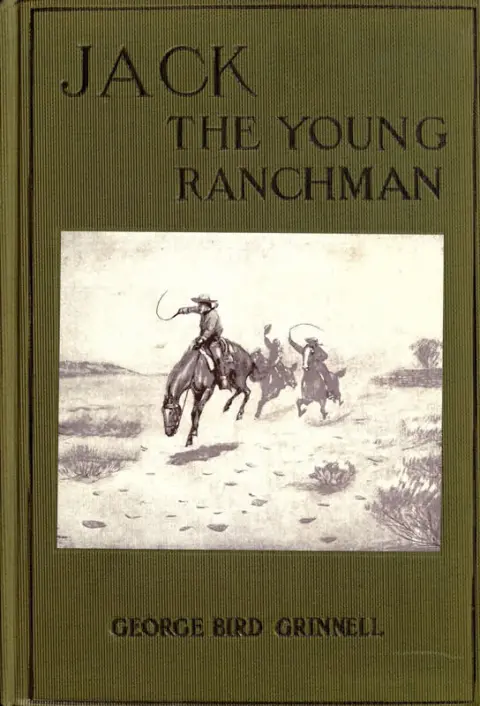
"Jack, the Young Ranchman: A Boy's Adventures in the Rockies" by George Bird Grinnell is a novel written in the late 19th century. The story centers around a young boy named Jack Danvers, who embarks on an adventure to his uncle's ranch in the Rockies, where he aspires to become a cowboy and learn about life in the wild. Through the experiences of Jack, the narrative offers a vivid depiction of ranch life and the challenges faced by those who inhabit the rugged landscapes of the American West. At the start of the novel, Jack, a pale and bookish fourteen-year-old from New York City, prepares to leave for his uncle Will Sturgis's ranch, following a physician’s advice for a healthier lifestyle. He expresses enthusiasm for the adventure ahead, despite acknowledging the hardships that come with ranch life, such as rough weather and physical labor. As he arrives at the ranch, he is introduced to the ways of cattle ranching, the beauty of the Rockies, and the animals that dwell there. The story sets the stage for Jack's growth and learning as he engages with nature, wildlife, and the skills necessary for survival, all while forming relationships with the ranch hands and understanding the intricacies of his new environment.
Introduction adapted from the source catalogue; source summaries may be automatically generated.
Free to read · English · 81,781 words · No account needed
MAKE TIME FOR A GOOD BOOK
On by default. Untick to stop anonymous reading totals. Each page counts after 10 seconds in view. How this works.
Anonymous counting is on unless you have switched it off.
Jack was a little shaken and bruised by his roll, but not hurt. He picked himself up and looked back at the way he had come, and congratulated himself that it had been no worse. He started to climb up the slope again to get his gun, but first it was necessary that he should get out of the brush into which he had rolled. To his right there seemed a place where the bushes were thinner than those over which he had passed on his way down, and he turned in this direction to make the ascent. He had gone only a few steps when he stopped, for there before him was a great dark hole in the side of the hill. It was shaped almost like a door, high, and not very wide, and within all seemed black. Grass and bushes grew up in the entrance, and there was no sign that anything ever passed in or out.
This hole looked rather mysterious to Jack, and he wondered what there could be in it. He walked up to it and looked as hard as he could into the blackness, but he could see nothing. He wanted very much to go in, yet it was useless to do so unless he could see something when he got there. "If I only had a lantern now," thought Jack, "or even a candle, I could go in and see what is there. I'll bet no one at the ranch knows of this cave, and I'd like to find out all about it and tell them. That would be a good story to take back." He thought for awhile, and decided that he must make a torch; but what could he make it of? For a little while he could think of nothing to use. He remembered that in the books that he had read, people had always had birch bark for torches, or fat with which to make candles, but he had neither. Then he thought of pine torches of which he had read. There were plenty of pines growing here on the mountain, but nothing that he could make a torch of. Suddenly he remembered that dried pine needles burn brightly, though only for a little while, and that on the ground not far from here he had seen a half dozen pine limbs, twisted off from one of the trees in some heavy wind storm. He thought if he could tie a good many bunches of these needles together, they would make a torch for him. He crept out of the underbrush and saw near by several of these pine limbs, with the dried red needles on them, and he picked a number of the bunches. Now he needed some string. "If I only had Pawnee here," he thought, "I could take the strings from my saddle;" but Pawnee was feeding far below him in the valley. As he cast his eye about him, in perplexity, he saw a yucca plant growing on the slope, and he remembered what Hugh had told him about using the fibre of this plant for thread. He climbed up to it, cut off a number of the long bayonet-shaped leaves, selected a straight dead stick, and went back to his pile of pine needles. Splitting the tough leaves of the yucca, he found that they could be used as strings, and with these strings he bound his bunches of pine needles, one beneath the other, to the stick, and soon had what he thought might perhaps serve him as a torch. Going back to the mouth of the cave, he again looked into it, and listened, but all was darkness and silence. He parted the low growing bushes at the entrance, and stepped in, and then, lighting a match, touched it to the top of his torch. The bunch of pine needles flared up for two or three seconds, and then went out, but the light was enough to show that for six or eight feet further in there was a smooth floor to the cave, paved with small stones. The walls above and on either side seemed high. A second match, touched to another bunch of pine needles, gave another flame, lasting only an instant. Plainly, the torch would not burn from the top downward. The only thing to do was to light it below, and let the flames run up the stick. Jack lighted another match, took two or three steps forward, and then touched the torch at its lower part. The pine needles flared up, the flame caught the next bunch above, and then the next. Jack could see on the ground before him some feathers, a half dozen slender sticks, and, far back, raised above the floor of the cave, was a pale, dim thing. There was a whirring sound, something struck his hat, something else struck the torch, he dropped it, and it went out.
Your reading position is saved on this browser. Take it to another device with a library code. Reading pages adapt to text, rather than matching a printed edition.
George Bird Grinnell
George Bird Grinnell

Caspar Whitney & George Bird Grinnell & Owen Wister
George Bird Grinnell
BEHIND THE BOOK
This eBook is for the use of anyone anywhere in the United States and most other parts of the world at no cost and with almost no restrictions whatsoever. You may copy it, give it away or re-use it under the terms of the Project Gutenberg License included with this eBook or online at www.gutenberg.org. If you are not located in the United States, you will have to check the laws of the country where you are located before using this eBook. Read the source licence.
The original source file, including credits and licence, is retained by this library. Request an original-format copy at no charge. Please include the book title and Project Gutenberg identifier #45720.
KEEP YOUR CURIOSITY GOING
Coulson Kernahan

Maurice Baring
Frances Wright
Cécile Tormay

Frederic Jesup Stimson

W. H. P. (William Henry Pope) Jarvis