THE CLASSIC COLLECTION✦Search-Light LettersCLASSIC FREE BOOKS
Search-Light Letters
Robert Grant
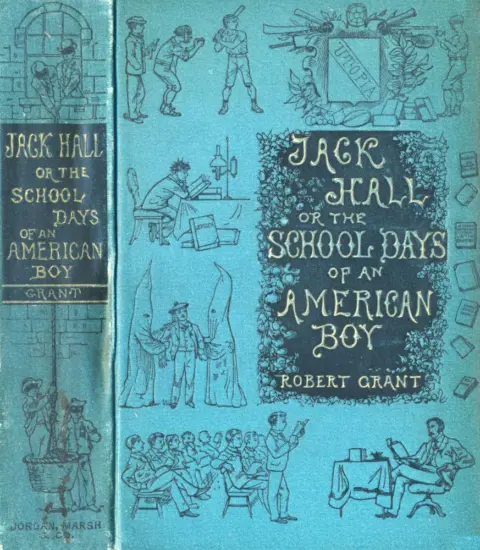
THE CLASSIC COLLECTION · 1887
Jack Hall by Robert Grant is a novel written in the late 19th century. It centers on the spirited schooldays of a Boston boy, Jack Hall, tracing his pranks, friendships, and formative scrapes as he inches toward greater responsibility. Expect brisk episodes of winter sport and street mischief, a tight-knit circle of boys, and the tension between boyish daring and a devoted mother’s guidance.
The opening of the novel drops us into Washington’s Birthday in Boston, where thirteen-year-old Jack revels in snowballing a grocer’s clerk, hitching behind sleighs, candy-shop indulgences, and headlong coasting that ends in a spill. He and his friends wage a raucous neighborhood snowball battle against “muckers,” with Jack toppling the feared Joe Herring before a policeman disperses the fray. That evening they feast at home and pull off nocturnal pranks—chalk “letters,” a bell-string trip that humiliates a stern neighbor—while Jack candidly admits to his mother that he tried smoking rattan. By morning he has measles, the grocer arrives to protest ongoing mischief and petty pilfering, and Jack’s mother reflects on his forebears, the limits of city boyhood, and whether a country school might better shape his character.
Introduction adapted from the source catalogue; source summaries may be automatically generated.
Free to read · English · 74,763 words · No account needed
MAKE TIME FOR A GOOD BOOK
On by default. Untick to stop anonymous reading totals. Each page counts after 10 seconds in view. How this works.
Anonymous counting is on unless you have switched it off.
“Your kids are all serene, Horace; I saw them aboard the train,” said a
boy in answer.
“Master Hall,――Master Haseltine?” inquired Horace, stepping forward as he caught sight of Jack and his friend.
“All right,” said Jack; “I’m Hall.”
“And I’m Haseltine.”
“Checks, please,” said Horace. Then pointing to a vehicle half-wagon, half-carryall, a few yards beyond, he told the two boys to get in while he looked after their baggage.
Before they had well seated themselves, the barge, filled almost to overflowing with its noisy freight, started off at a goodly pace to the accompaniment of fish-horns and fiendish cat-calls. As it swept by the smaller conveyance a shower of beans fell rattling about the ears of the new-comers, which caused Jack instinctively to clap his hand on the side-pocket of his jacket in search of his catapult; but before he could get at it the grinning faces of his assailants were out of range.
“By gum!” Jack muttered belligerently.
“It’s no use, any way,” said Haseltine. “If you had hit them, it would have been all the worse for both of us afterwards. I expect to be half killed as it is.”
“What do you mean?” asked Jack.
“They’ll haze us, of course. I know a fellow who was made to jump into the river on a Christmas eve, and who, as the result of it, had pneumonia and nearly died.”
“At Utopia?”
“No, it wasn’t at this school; but they’re all alike. They make you stand on a table and recite poetry, and do all sorts of monkey tricks.”
“I wouldn’t.”
“You couldn’t help yourself; they’d stick pins into you if you refused, or burn you with a red-hot iron.”
“They should kill me before I’d do a thing,” said Jack stoutly, but, nevertheless, he continued contemplative until their conductor arrived with the trunks. A moment later they were off.
“That’s great,” Horace observed with gusto, after a period of reflective
silence.
“What is?” inquired Haseltine.
“The ball game. Them Stars has been all-fired cocky since way back, and boasting as how they couldn’t be beat. But they’re done for this time, sure. Fourteen to thirteen――tidy score, too; that home-run was what done it. Great boy, that Harry Ramsay.”
“He’s captain, isn’t he?” asked Jack.
“Yes, captain of the nine, and cute all round. I tell you, the Doctor’s proud of him, and’ll be mighty sorry when he goes to Harvard next year. He is smart at his books, too.”
“Tell us about some of the other players,” said Haseltine.
Your reading position is saved on this browser. Take it to another device with a library code. Reading pages adapt to text, rather than matching a printed edition.
Robert Grant
Robert Grant
Robert Grant
Robert Grant
BEHIND THE BOOK
This eBook is for the use of anyone anywhere in the United States and most other parts of the world at no cost and with almost no restrictions whatsoever. You may copy it, give it away or re-use it under the terms of the Project Gutenberg License included with this eBook or online at www.gutenberg.org. If you are not located in the United States, you will have to check the laws of the country where you are located before using this eBook. Read the source licence.
The original source file, including credits and licence, is retained by this library. Request an original-format copy at no charge. Please include the book title and Project Gutenberg identifier #77143.
KEEP YOUR CURIOSITY GOING
Coulson Kernahan

Maurice Baring
Frances Wright
Cécile Tormay

Frederic Jesup Stimson

W. H. P. (William Henry Pope) Jarvis