THE CLASSIC COLLECTION✦Search-Light LettersCLASSIC FREE BOOKS
Search-Light Letters
Robert Grant
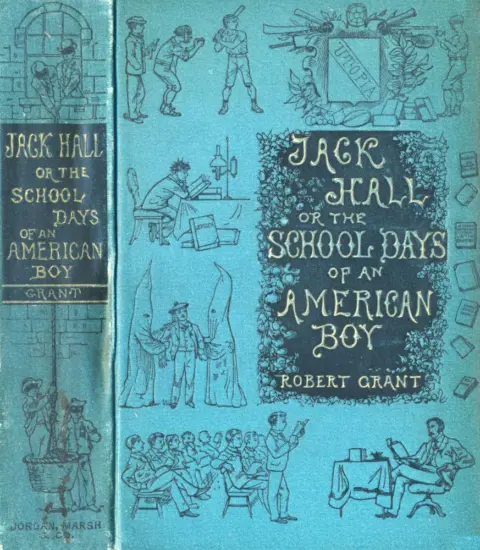
THE CLASSIC COLLECTION · 1887
Jack Hall by Robert Grant is a novel written in the late 19th century. It centers on the spirited schooldays of a Boston boy, Jack Hall, tracing his pranks, friendships, and formative scrapes as he inches toward greater responsibility. Expect brisk episodes of winter sport and street mischief, a tight-knit circle of boys, and the tension between boyish daring and a devoted mother’s guidance.
The opening of the novel drops us into Washington’s Birthday in Boston, where thirteen-year-old Jack revels in snowballing a grocer’s clerk, hitching behind sleighs, candy-shop indulgences, and headlong coasting that ends in a spill. He and his friends wage a raucous neighborhood snowball battle against “muckers,” with Jack toppling the feared Joe Herring before a policeman disperses the fray. That evening they feast at home and pull off nocturnal pranks—chalk “letters,” a bell-string trip that humiliates a stern neighbor—while Jack candidly admits to his mother that he tried smoking rattan. By morning he has measles, the grocer arrives to protest ongoing mischief and petty pilfering, and Jack’s mother reflects on his forebears, the limits of city boyhood, and whether a country school might better shape his character.
Introduction adapted from the source catalogue; source summaries may be automatically generated.
Free to read · English · 74,763 words · No account needed
MAKE TIME FOR A GOOD BOOK
On by default. Untick to stop anonymous reading totals. Each page counts after 10 seconds in view. How this works.
Anonymous counting is on unless you have switched it off.
“‘Contorqueo,’” cries a small lad, who has shot up his hand.
“Correct, Barrows. ‘Contorqueo.’ Go on, Hall.”
“And Palinurus was the first to turn the rudder”――
“Where do you find anything about rudder?” inquires Mr. Opdyke, with the irony of desperation.
“‘Rudentem.’”
“Indeed! Barrows, tell Hall what ‘rudentem’ means.”
“A rope,” suggests the youth named, too elated evidently by his first
success.
“Timmins?”
“Don’t know, sir.”
“Brown?”
“Roaring.”
“That’s right. What part of speech is it?”
“Present participle, accusative case, from ‘rudo.’”
“Correct,” says Mr. Opdyke. “‘Rudens’ means ‘a rope,’ Barrows. Some authorities ascribe its derivation to ‘rudo’ on account of the rattling noise made by a rope. Conjugate ‘rudo,’ Barrows.”
“‘Rudo, rudire’”――
“Haseltine?”
“‘Rudo, rudare’”――
“Brown?”
“‘Rudo, rudere, rudivi, ruditum.’”
“Correct; ‘rudire, to roar, bellow, bray, rattle.’ ‘Rudentem proram, the hissing prow.’ Quite the other end of the ship to what you thought it, Hall. You may continue.”
There is an audible titter, which enrages poor Jack, who remembers that he had spent a good ten minutes the night before in trying to arrive at the meaning of “rudentem.” He staggers on through the next line by dint of Mr. Opdyke’s explanation that “remis ventisque” means “with oars and sails,” and is a regular phrase for “using every effort.” He gets a little heart by successfully conjugating “tollimur” and explaining the metaphorical use of “Manes,” his knowledge of which is directly traceable to study, if his master did but know. He gets a cropper, however, in endeavoring to struggle with “desedimus,” which he had looked for in vain under the heads of desedo, desedeo, and disedeo. When the omniscient Brown tells him that it is the preterit of desido, Jack is ready to kick himself in his disgust.
Only two more lines remain, over which Mr. Opdyke, believing, perhaps, that the context is a little difficult to master, is disposed to assist him, as, for instance, by explaining that “cava saxa” refers to “the rocks at the bottom of the sea,” and that “ter spumam elisam,” which Jack has not incorrectly rendered “the foam thrice dashed to pieces,” is significant of the mariners’ seeing the sky through a curtain of foam.
“By the way, Hall, give the principal parts of elisam.”
Jack flushes proudly. Again hard work is its own reward.
“Elido, elidere, elisi, elisum.”
Mr. Opdyke may be surprised, but he does not show it. He is the sort of man who expects his pupils to know their lessons, and displays emotion only when they fail. Besides, “elisam,” though a revelation to Jack, had several times made its appearance before during the year. He merely says shortly,――
“Well, finish.”
Your reading position is saved on this browser. Take it to another device with a library code. Reading pages adapt to text, rather than matching a printed edition.
Robert Grant

Robert Grant
Robert Grant
Robert Grant
BEHIND THE BOOK
This eBook is for the use of anyone anywhere in the United States and most other parts of the world at no cost and with almost no restrictions whatsoever. You may copy it, give it away or re-use it under the terms of the Project Gutenberg License included with this eBook or online at www.gutenberg.org. If you are not located in the United States, you will have to check the laws of the country where you are located before using this eBook. Read the source licence.
The original source file, including credits and licence, is retained by this library. Request an original-format copy at no charge. Please include the book title and Project Gutenberg identifier #77143.
KEEP YOUR CURIOSITY GOING
Coulson Kernahan

Maurice Baring
Frances Wright
Cécile Tormay

Frederic Jesup Stimson

W. H. P. (William Henry Pope) Jarvis