THE CLASSIC COLLECTION✦Search-Light LettersCLASSIC FREE BOOKS
Search-Light Letters
Robert Grant
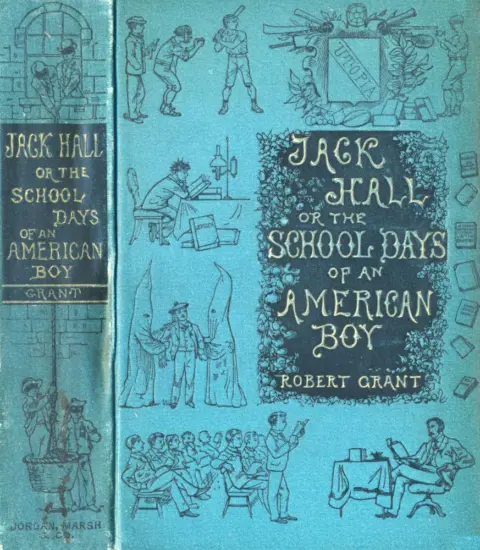
THE CLASSIC COLLECTION · 1887
Jack Hall by Robert Grant is a novel written in the late 19th century. It centers on the spirited schooldays of a Boston boy, Jack Hall, tracing his pranks, friendships, and formative scrapes as he inches toward greater responsibility. Expect brisk episodes of winter sport and street mischief, a tight-knit circle of boys, and the tension between boyish daring and a devoted mother’s guidance.
The opening of the novel drops us into Washington’s Birthday in Boston, where thirteen-year-old Jack revels in snowballing a grocer’s clerk, hitching behind sleighs, candy-shop indulgences, and headlong coasting that ends in a spill. He and his friends wage a raucous neighborhood snowball battle against “muckers,” with Jack toppling the feared Joe Herring before a policeman disperses the fray. That evening they feast at home and pull off nocturnal pranks—chalk “letters,” a bell-string trip that humiliates a stern neighbor—while Jack candidly admits to his mother that he tried smoking rattan. By morning he has measles, the grocer arrives to protest ongoing mischief and petty pilfering, and Jack’s mother reflects on his forebears, the limits of city boyhood, and whether a country school might better shape his character.
Introduction adapted from the source catalogue; source summaries may be automatically generated.
Free to read · English · 74,763 words · No account needed
MAKE TIME FOR A GOOD BOOK
On by default. Untick to stop anonymous reading totals. Each page counts after 10 seconds in view. How this works.
Anonymous counting is on unless you have switched it off.
The operation acted like a charm; Dubsy was enabled to emit a cloud of smoke which filled Jack’s doubting soul with envy. To be stumped by Dubsy was more than he could bear, though he felt very sure that his mother would disapprove of his smoking.
“It’s better’n hay-seed,” said Dubsy, who had seated himself on a ridge of the roof beside Bill, and was swinging his foot jubilantly.
“I never smoked hay-seed,” replied poor Jack. “Which end do you light?” he asked defiantly, taking up one of the pieces of rattan.
“It makes no difference,” said Bill. “Bully for you, Jack.”
A moment later they were all three seated side by side, puffing like
little Turks.
“Yesterday was my birthday,” continued Bill. “See what father gave me.” He drew out of his pocket an open-faced silver watch, which he exhibited with pride.
“My eye!” exclaimed Jack. “Does it really go?”
“Go? I guess she does. You ought to hear her tick at night. Father says I shall have a hunter when I’m fifteen, and a gold repeater when I’m twenty-one.”
The other boys were silent with envy.
“My father’s got lots of money,” went on Bill. “He could buy both your fathers out, I guess, and have a pile left.”
“My father’s dead, you know,” answered Jack.
“So he is; I wasn’t thinking. Well, then, he could buy your mother out.”
“Let’s see the works,” said Dubsy.
Bill opened the inside cover with his thumb nail in response to this request, and the three heads were immediately in close proximity studying the internal arrangements of the watch.
“That’s a jewel,” said Bill, indicating a colored spot among the cogs
and wheels.
The heads went lower in mute admiration.
“It isn’t a very big one, anyway,” said Jack, glad of what seemed an opportunity for criticism.
“There are fourteen, mostly rubies,” replied Bill. “Don’t breathe so hard, Dubsy. Father says it hurts the works to breathe on them.”
“Wind her up,” cried Jack.
Bill fumbled in his pocket and produced a key. “She’s mostly wound,” he said. “I wound her last night and again just after breakfast.” One or two turns was all the watch would stand at the moment without danger to the mainspring; so this exhibition was unsatisfactory.
“My father has a stem-winder,” said Dubsy, after a moment; “I’ve heard him say that a watch with a key was more bother than it was worth.”
“I shouldn’t care for one that wasn’t a stem-winder,” said Jack,
stoutly.
“Sour grapes,” said Bill, with a sneer.
Your reading position is saved on this browser. Take it to another device with a library code. Reading pages adapt to text, rather than matching a printed edition.
Robert Grant
Robert Grant
Robert Grant
Robert Grant
BEHIND THE BOOK
This eBook is for the use of anyone anywhere in the United States and most other parts of the world at no cost and with almost no restrictions whatsoever. You may copy it, give it away or re-use it under the terms of the Project Gutenberg License included with this eBook or online at www.gutenberg.org. If you are not located in the United States, you will have to check the laws of the country where you are located before using this eBook. Read the source licence.
The original source file, including credits and licence, is retained by this library. Request an original-format copy at no charge. Please include the book title and Project Gutenberg identifier #77143.
KEEP YOUR CURIOSITY GOING
Coulson Kernahan

Maurice Baring
Frances Wright
Cécile Tormay

Frederic Jesup Stimson

W. H. P. (William Henry Pope) Jarvis