
Canada, the Spellbinder
Lilian Whiting
THE CLASSIC COLLECTION · 1910
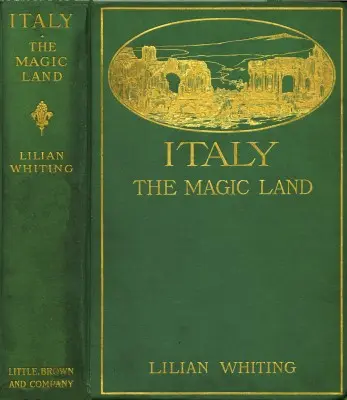
"Italy, the Magic Land" by Lilian Whiting is a travel narrative enriched with artistic and cultural observations written in the early 20th century. The book explores the enchanting landscapes and historical significance of Italy, while delving into the lives and works of various artists who flourished in the region. Whiting captures the essence of Italy as a source of inspiration and a sanctuary for creatives. The beginning of this work introduces the reader to the vibrant and picturesque Rome of the mid-19th century, known for its artistic community and rich cultural life. Whiting reflects on the idyllic atmosphere where artists and thinkers congregated, drawing from both the ancient and modern influences that characterized the city. Detailed images of social gatherings, art discussions, and the artistic ambiance convey a sense of nostalgia and appreciation for the artistic spirit that permeated the setting, setting the stage for a deeper exploration of Italy's artistic heritage in the chapters that follow.
Introduction adapted from the source catalogue; source summaries may be automatically generated.
Free to read · English · 90,356 words · No account needed
MAKE TIME FOR A GOOD BOOK
On by default. Untick to stop anonymous reading totals. Each page counts after 10 seconds in view. How this works.
Anonymous counting is on unless you have switched it off.
Mr. Simmons has been singularly fortunate in a wide American recognition, having received a liberal share of the more important commissions for great public works of sculpture. The splendid statue, al fresco, of the poet Longfellow for his native city, Portland, was appropriately the work of Mr. Simmons as a native of the same state; the portrait statues of General Grant, Gov. William King, Roger Williams, and Francis H. Pierrepont, all in Statuary Hall in the Capitol in Washington; the portrait busts of Grant, Sheridan, Porter, Hooker, Thomas, and other heroes of the Civil War; the colossal group of the Naval Monument at the head of Pennsylvania Avenue in Washington,--are all among the works of Mr. Simmons.
Like all artists who, like the poet, are born and not made, Mr. Simmons gave evidence of his artistic bent in his early childhood. After graduating from Bates College he modelled a bust of its president, and a little later, going to Washington (in the winter of 1865-66), many of the noted men of the time gave him sittings, and in a series of portrait busts his genius impressed itself by its dignity of conception and an unusual power of sympathetic interpretation. He modelled the bust of Grant while he was the General's guest in camp, taking advantage of whatever spare minutes General Grant could give for sittings in the midst of his pressing responsibilities; and it is perhaps due to this unusually intimate intercourse with the great hero, and the rapport, not difficult of establishment, between two men whose natures were akin in a certain noble sincerity and lofty devotion to the purest ideals, that Mr. Simmons owes the power with which he has absolutely interpreted the essential characteristics of General Grant in that immortal portrait statue in the Capitol.
Washington is, indeed, the place to especially study the earlier work of Franklin Simmons. An important one is the Logan memorial,--an equestrian statue which is considered the finest work in sculpture in the capital, and which is the only statue in the United States in which both the group and the pedestal are of bronze. The visitor in Washington who should be ignorant of the relative rank of the great men commemorated by the equestrian memorial monuments of the city might be justified in believing that General Logan was the most important man of his time, if he judged from the relative greatness of his statue. When Congress decided upon this group, Mr. Simmons was requested to prepare a model. This proving eminently acceptable, Mr. Simmons found himself, quite to his own surprise, fairly launched on this arduous work, involving years of intense concentration and labor. For this monumental work was to be not merely that of the brave and gallant military leader,--a single idea embodied, as in those of Generals Scott, Sheridan, Thomas, and others,--but it was to be a permanent interpretation of the soldier-statesman, mounted on his battle-horse; it was to be, in the comprehensive grasp of Mr. Simmons, the vital representation of the complex life and individuality of General Logan and, even more, it must reflect and suggest the complex spirit of his age. In this martial figure was thus embodied a manifold and mysterious relation, as one of the potent leaders and directive powers in an age of tumultuous activities; an age of strife and carnage, whose goal was peace; of adverse conditions and reactions, whose manifest outcome was yet prosperity and national greatness and splendid moral triumph. All these must be suggested in the atmosphere, so to speak, of the artist's work; and no sculptor who was not also an American--not merely by ancestry and activity, but one in mind and heart only; one who was an intense patriot and identified with national ideas--could ever have produced such a work as that of the Logan monument. So unrivalled does it stand, unique among all the equestrian art of this country, that it enchants the art student and lover with its indefinable spell. When this colossal work was cast in bronze, in Rome, the event was considered important. The king and the Royal family visited the studio of Mr. Simmons to see the great group, and so powerfully did its excellence appeal to King Umberto that he knighted Mr. Simmons, making him Cavaliere of the Crown of Italy. Nor was Mr. Simmons the prophet who was not without honor save in his own country, for his alma mater gave him the degree of M.A. in 1867; Colby College honored him with the Master's degree in 1885, and in 1888 Bowdoin bestowed upon this eminent Maine artist the same degree. In 1892 Mr. Simmons married the Baroness von Jeinsen, a brilliant and beautiful woman who, though a lady of foreign title, was an American by birth. An accomplished musician, a critical lover of art, and the most delightful of hostesses and friends, Mrs. Simmons drew around her a remarkable circle of charming people and made their home in the Palazzo Tamagno a notable centre of social life. No woman in the American colony of the Seven-hilled City was ever more beloved; and it was frequently noted by guests at her weekly receptions that Mrs. Simmons was as solicitous for the enjoyment of the most unknown stranger as for those of rank and title who frequented her house. Her grace and loveliness were fully equalled by her graciousness and that charm of personality peculiarly her own. Her death in Rome, on Christmas of 1905, left a vacant place, indeed, in many a home which had been gladdened by her radiant presence. One of the most beautiful works of Mr. Simmons is a portrait of his wife in bas-relief, representing her standing just at the opening of parted curtains, as if she were about to step behind and vanish. It is a very poetic conception. A bust of Mrs. Simmons, also, in his studio, is fairly a speaking likeness of this beautiful and distinguished woman. It is over her grave in the Protestant cemetery that Mr. Simmons has placed one of his noblest ideal statues, "The Angel of the Resurrection,"--a memorial monument that is one of the art features of Rome to the visitor in the Eternal City.
Your reading position is saved on this browser. Take it to another device with a library code. Reading pages adapt to text, rather than matching a printed edition.
Lilian Whiting

Lilian Whiting
Lilian Whiting
Lilian Whiting
BEHIND THE BOOK
This eBook is for the use of anyone anywhere in the United States and most other parts of the world at no cost and with almost no restrictions whatsoever. You may copy it, give it away or re-use it under the terms of the Project Gutenberg License included with this eBook or online at www.gutenberg.org. If you are not located in the United States, you will have to check the laws of the country where you are located before using this eBook. Read the source licence.
The original source file, including credits and licence, is retained by this library. Request an original-format copy at no charge. Please include the book title and Project Gutenberg identifier #29658.
KEEP YOUR CURIOSITY GOING
Wilfrid Scawen Blunt
Wilfrid Scawen Blunt

E. W. (Edgar Watson) Howe
Francis Greenleaf Allinson & Anne C. E. (Anne Crosby Emery) Allinson
Cyrenus Cole

John Martineau