
Canada, the Spellbinder
Lilian Whiting
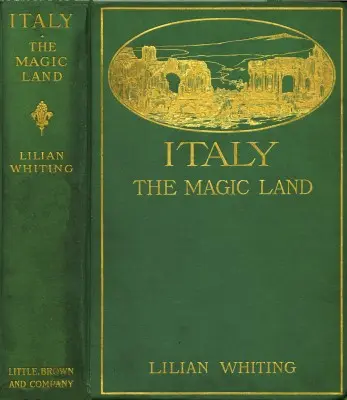
THE CLASSIC COLLECTION · 1910
"Italy, the Magic Land" by Lilian Whiting is a travel narrative enriched with artistic and cultural observations written in the early 20th century. The book explores the enchanting landscapes and historical significance of Italy, while delving into the lives and works of various artists who flourished in the region. Whiting captures the essence of Italy as a source of inspiration and a sanctuary for creatives. The beginning of this work introduces the reader to the vibrant and picturesque Rome of the mid-19th century, known for its artistic community and rich cultural life. Whiting reflects on the idyllic atmosphere where artists and thinkers congregated, drawing from both the ancient and modern influences that characterized the city. Detailed images of social gatherings, art discussions, and the artistic ambiance convey a sense of nostalgia and appreciation for the artistic spirit that permeated the setting, setting the stage for a deeper exploration of Italy's artistic heritage in the chapters that follow.
Introduction adapted from the source catalogue; source summaries may be automatically generated.
Free to read · English · 90,356 words · No account needed
MAKE TIME FOR A GOOD BOOK
On by default. Untick to stop anonymous reading totals. Each page counts after 10 seconds in view. How this works.
Anonymous counting is on unless you have switched it off.
"In another style, there was the grand, calm head of Milton, not copied from any one bust or picture, yet more authentic than any of them, because all known representations of the poet had been profoundly studied and solved in the artist's mind. The bust over the tomb in Greyfriar's Church, the original miniatures and pictures wherever to be found, had mingled each its special truth in this one work--wherein likewise by long perusal and deep love of 'Paradise Lost,' the 'Comus,' the 'Lycidas,' and 'L'Allegro,' the sculptor had succeeded even better than he knew in spiritualizing his marble with the poet's mighty genius. And this was a great thing to have achieved, such a length of time after the dry bones and dust of Milton were like those of any other dead man."
Richard Greenough and the painter, Mr. Haseltine, were prominent figures among the early American group of the nineteenth-century artists in Rome. There came Emma Stebbins, who modelled a fine portrait bust of Charlotte Cushman; and Anne Whitney, whose statues of Samuel Adams and of Leif Ericson adorn public grounds in Boston; whose life-size statue of Harriet Martineau is the possession of Wellesley College; and whose "Chaldean Astronomer," "Lotus-Eater," and "Roma"--a figure personifying the Rome of Pio Nono--reveal her power in ideal creation.
The name of Harriet Hosmer stands out in brilliant pre-eminence among those of all women who have followed the plastic art. Her infinite charm of personality seems to impart itself to her work, and she has the gift to make friends as well as to call forms out of clay--the success of friendship being one even more permanently satisfying. In her early life as a girl hardly more than twenty, she sought Rome, living with art as her chaperon. Her versatility, her picturesque individuality, and her imaginative power all combined to win sympathetic recognition. Gibson, whose guidance was particularly well adapted to develop her gifts, received her into his own studio and took a deep interest in her work. It was during the period of her early efforts that Hawthorne was in Rome, and she is graphically depicted in his notebooks in her boyish cap at work in the clay. Gibson was an artist, con amore, and Miss Hosmer's joyous abandon to her art captivated his sympathy. "In my art what do I find?" he questioned; "happiness; love which does not depress me; difficulties which I do not fear; resolution which never abates; flights which carry me above the ground; ambition which tramples no one down." Master and pupil were akin in their unwearied devotion to art. Of Gibson, whose absence of mind regarding all the details of life made him almost helpless in travel and affairs, Miss Hosmer used gleefully to say that he "was a god in his studio, but God help him out of it!" This glancing sprite of a girl, frightening her friends by her daring and venturous horseback riding; gravitating by instinct to offer some generous, tender aid to the sick, the destitute, or the helpless; the life and light of gay dinners and of social evenings; working from six in the morning till night in her studio, "with an absence of pretension," says Mrs. Browning, "and simplicity of manners which accord rather with the childish dimples in her rosy cheeks than with her broad forehead and high aims," had the magic gift that merged her visitors and patrons into enthusiastic friends; and Mrs. Browning has chronicled the pretty scene when Lady Marion Alford, the daughter of the Earl of Northumberland, knelt before the girl artist and slipped on her finger a ring--a precious ruby set with diamonds--as a token of her devotion. Reading Miss Hosmer's life still further backward, the reader is transported, as if on some magic carpet, to St. Louis, in the United States, where a noble and lofty man, Hon. Wayman Crow,--a generous friend, a liberal patron of the arts, a man of the most refined tastes and culture, whose great qualities were always used in high service,--first aided Miss Hosmer to the preliminary studies in her art, and whose accomplished and lovely daughters (now Mrs. Lucien Carr of Boston, Mrs. Edwin Cushman of Newport and Rome, and Mrs. Emmons of Leamington, England) were as a trio of sisters to the young artist. And "the flowing conditions of life" bear on this lifelong friendship until a fair young girl, Elise (the daughter of Mrs. Emmons), catches up this sweet tie and as an accomplished and lovely young woman in Roman society, when these "flowing conditions" had come down even into the season of 1906-7, Miss Emmons cherished the fame of Harriet Hosmer and enjoyed the privilege of a constant correspondence with the distinguished artist. So the past links itself again with the present; and who can tell where any story in life begins or ends in the constant evolutionary progress?
Your reading position is saved on this browser. Take it to another device with a library code. Reading pages adapt to text, rather than matching a printed edition.
Lilian Whiting
Lilian Whiting
Lilian Whiting
Lilian Whiting
BEHIND THE BOOK
This eBook is for the use of anyone anywhere in the United States and most other parts of the world at no cost and with almost no restrictions whatsoever. You may copy it, give it away or re-use it under the terms of the Project Gutenberg License included with this eBook or online at www.gutenberg.org. If you are not located in the United States, you will have to check the laws of the country where you are located before using this eBook. Read the source licence.
The original source file, including credits and licence, is retained by this library. Request an original-format copy at no charge. Please include the book title and Project Gutenberg identifier #29658.
KEEP YOUR CURIOSITY GOING
Wilfrid Scawen Blunt
Wilfrid Scawen Blunt

E. W. (Edgar Watson) Howe
Francis Greenleaf Allinson & Anne C. E. (Anne Crosby Emery) Allinson
Cyrenus Cole

John Martineau