Canada, the Spellbinder
Lilian Whiting
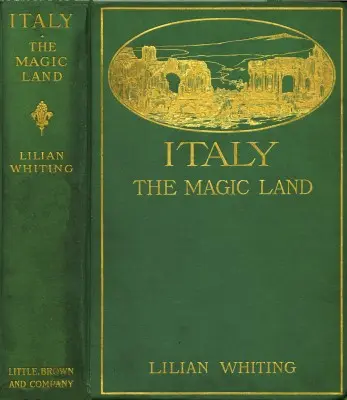
THE CLASSIC COLLECTION · 1910
"Italy, the Magic Land" by Lilian Whiting is a travel narrative enriched with artistic and cultural observations written in the early 20th century. The book explores the enchanting landscapes and historical significance of Italy, while delving into the lives and works of various artists who flourished in the region. Whiting captures the essence of Italy as a source of inspiration and a sanctuary for creatives. The beginning of this work introduces the reader to the vibrant and picturesque Rome of the mid-19th century, known for its artistic community and rich cultural life. Whiting reflects on the idyllic atmosphere where artists and thinkers congregated, drawing from both the ancient and modern influences that characterized the city. Detailed images of social gatherings, art discussions, and the artistic ambiance convey a sense of nostalgia and appreciation for the artistic spirit that permeated the setting, setting the stage for a deeper exploration of Italy's artistic heritage in the chapters that follow.
Introduction adapted from the source catalogue; source summaries may be automatically generated.
Free to read · English · 90,356 words · No account needed
MAKE TIME FOR A GOOD BOOK
On by default. Untick to stop anonymous reading totals. Each page counts after 10 seconds in view. How this works.
Anonymous counting is on unless you have switched it off.
page 148: gentilinomo, who is gorgeously arrayed in knee gentiluomo, who is gorgeously arrayed in knee
page 161: Jacomletti, and there is also a kneeling statue Jacometti, and there is also a kneeling statue
page 163: and the Via dell Quattro Fontane. The and the Via delle Quattro Fontane. The
page 163: for living purposes. The portere, the guards, for living purposes. The portiere, the guards,
page 170: and in the Vedder villa, Torre Quatro Venti and in the Vedder villa, Torre Quattro Venti
page 171: the American wife of Caviliere Cortesi, an the American wife of Cavaliere Cortesi, an
page 178: Peruzzi, and Annibale Caracci. Raphael is Peruzzi, and Annibale Carracci. Raphael is
page 185: that includes the "Ludovisi Mars;" Hercules," that includes the "Ludovisi Mars;" "Hercules,"
page 200: he may rest, mens conscia recta!
he may rest, mens conscia recti!
page 205: whose grand Roman palazzo is in the Boca di whose grand Roman palazzo is in the Bocca di
page 213: The Villa Falconicri, in Frascati, which was The Villa Falconieri, in Frascati, which was
page 234: Benvenuto Cellini at the Castel Sant Angelo; Benvenuto Cellini at the Castel Sant'Angelo;
page 237: of the street scenes of Naples; Camprani and of the street scenes of Naples; Campriani and
page 244: Forum, succeding Lanciani--believe that some Forum, succeeding Lanciani--believe that some
page 244: equestrian statue of Bulbi, in the Naples Museum, equestrian statue of Balbo, in the Naples Museum,
page 260: The cathedral at Revello has traces of the The cathedral at Ravello has traces of the
page 260: of the Palazzo Rufelo might enchant Hafiz himself. of the Palazzo Rufolo might enchant Hafiz himself.
page 272: Mignano (Ginodone Trieramosca) and also to Mignano (Guidone Fieramosca) and also to
page 272: are a series of fresco paintings by Luca Gindano, are a series of fresco paintings by Luca Giordano,
page 272: by Mazzarappi and Marco da Siena. Nothing by Mazzaroppi and Marco da Siena. Nothing
page 274: Terre di Lavorno region:--
Terra di Lavoro region:--
page 276: to be a "Monumento Nazionali," and it is now to be a "Monumento Nazionale," and it is now
page 286: in the "Inferno." The Colonna and the Orsino in the "Inferno." The Colonna and the Orsini
page 286: look down from Castel Gondolfo on the gloomy, look down from Castel Gandolfo on the gloomy,
page 287: Marino, Castel Gondolfo, and Frascati, with Marino, Castel Gandolfo, and Frascati, with
page 295: for the country they left Naples for Pietzalba for the country they left Naples for Pietralba
page 295: Musefico, il Givoio, and il Minturo. It was an Musefico, il Giovio, and il Minturno. It was an
page 297: Per te narrar tre quante dubbie voglie, Per te narrar tra quante dubbie voglie,
page 297: Fra quanti aspri martir, degliosa io vivo!" Fra quanti aspri martir, dogliosa io vivo!"
Your reading position is saved on this browser. Take it to another device with a library code. Reading pages adapt to text, rather than matching a printed edition.
Lilian Whiting
Lilian Whiting
Lilian Whiting
Lilian Whiting
BEHIND THE BOOK
This eBook is for the use of anyone anywhere in the United States and most other parts of the world at no cost and with almost no restrictions whatsoever. You may copy it, give it away or re-use it under the terms of the Project Gutenberg License included with this eBook or online at www.gutenberg.org. If you are not located in the United States, you will have to check the laws of the country where you are located before using this eBook. Read the source licence.
The original source file, including credits and licence, is retained by this library. Request an original-format copy at no charge. Please include the book title and Project Gutenberg identifier #29658.
KEEP YOUR CURIOSITY GOING
Wilfrid Scawen Blunt
Wilfrid Scawen Blunt

E. W. (Edgar Watson) Howe
Francis Greenleaf Allinson & Anne C. E. (Anne Crosby Emery) Allinson
Cyrenus Cole

John Martineau