
Canada, the Spellbinder
Lilian Whiting
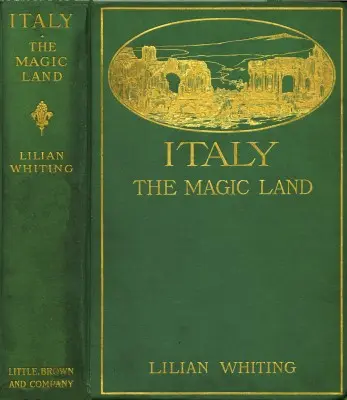
THE CLASSIC COLLECTION · 1910
"Italy, the Magic Land" by Lilian Whiting is a travel narrative enriched with artistic and cultural observations written in the early 20th century. The book explores the enchanting landscapes and historical significance of Italy, while delving into the lives and works of various artists who flourished in the region. Whiting captures the essence of Italy as a source of inspiration and a sanctuary for creatives. The beginning of this work introduces the reader to the vibrant and picturesque Rome of the mid-19th century, known for its artistic community and rich cultural life. Whiting reflects on the idyllic atmosphere where artists and thinkers congregated, drawing from both the ancient and modern influences that characterized the city. Detailed images of social gatherings, art discussions, and the artistic ambiance convey a sense of nostalgia and appreciation for the artistic spirit that permeated the setting, setting the stage for a deeper exploration of Italy's artistic heritage in the chapters that follow.
Introduction adapted from the source catalogue; source summaries may be automatically generated.
Free to read · English · 90,356 words · No account needed
MAKE TIME FOR A GOOD BOOK
On by default. Untick to stop anonymous reading totals. Each page counts after 10 seconds in view. How this works.
Anonymous counting is on unless you have switched it off.
The approach to Italy, by whatever direction, by land or by sea, one enters, is one of magical beauty. Whether one enters from the Mediterranean or from the Adriatic, or by means of the Mont Cenis, the Simplon, or the St. Gothard pass, through the sublime mountain wall, each gateway is marvellous in attraction. Approaching from the seas that completely surround Italy except on one side, the almost undreamed-of splendor of Naples, Genoa, and Venice, as seen from off the shore, exceeds all power of painter or poet to reproduce. The precipitous coast of Sicily; the picturesque city of Palermo; the wonderful ruins of the Greek theatre on the heights in Taormina,--all enchant the tourist. To anchor off Naples, in the beautiful bay, serves the purpose of an hotel out at sea. It is like living in Venice--only more so! By the little rowboats one may go, at any moment, to Naples, and it is more delightful than passing the days in the city itself. For at night as one strolls or sits on deck what a picture is before the eye! All Naples, on her semicircular shores, with her terraced heights rising above, defined in a blaze of electric lights! Genoa, la Superba, is still more magnificent when seen from the sea; and Venice, rising dream-enchanted, completes the wonders of the approach by water.
As the new Italy has not yet achieved any homogeneous unity, Naples, Rome, Florence, Venice, and Milan differ in their characteristics to such a degree that no general interpretation of the residents of any one would appropriately describe those of another. Paris and Vienna hardly differ as much as do Milan and Rome; and Venice, Florence, and Rome, each rich in art treasures, have little else in common. Certain characteristics of each of the large cities reveal themselves prominently, even to a superficial observer. Milan, as has been said, is a centre of activity, as Florence is of culture and accomplishments. Florence has the largest and the most choice circulating library in all Italy and one that ranks among the best on the Continent. Her galleries are treasure stores of art, and her social life is unsurpassed--one might almost say unrivalled--in its fine quality. Music, philosophic culture, learning in all lines of research characterize Florentine society. Education has always been regarded in Florence as a matter of prime importance, and when the government grant of funds is insufficient the sum is made up by private contributions, so that the Scuola del Popolo gives free instruction, yearly, to eighteen hundred pupils, in every branch of technical and art education. This fact alone offers its own explanation of that general intelligence of the people which so impresses the visitor in Florence. But this is a municipal rather than national fact. Every special development in any direction in Italy will always be found to be the characteristic of the city or locality, not of the country as a whole; and thus the unity of Italy is still a political expression rather than a political fact. It is a theory which is not yet developed into an experience. Italy is in the making. Practically, she is the youngest of countries, with less than forty years of experimental attempt at national life behind her. Not until 1919 will she have attained the first half century of her united life. Educational facilities, inclusive of schools, libraries, and museums; railroads, telegraph and telephone service, electric lighting and electric trams,--all the ways and means of the modern mechanism of life are, inevitably, in a nebulous state in Italy. The political situation is extremely interesting at the present time. That the "Blacks" and the "Whites" are diametrically opposed to each other is in the nature of history rather than that of contemporary record or of prophecy; and that this is a traditional attitude in this city of the Caesars is not a fact by any means unknown; but the situation is complicated by the third party--the Socialists--who, by allying themselves with either, would easily turn the scales and command the situation. If they were ardent Catholics and were advocates of the Papal supremacy, the temporal power of the Pope would be restored in less time almost than could be recorded, and Pius X would be in residence in the Palazzo Quirinale rather than Victor Emanuele III. But this great modern uprising in Italy--a movement that is gathering force and numbers so rapidly that no one can venture to prophesy results even in the comparatively immediate future--this great modern movement is neither for church nor state. The Socialist uprising is very strong in Milan and through Northern Italy. It is much in evidence in the Umbrian region--in Foligno, Spoleto, Nervi, and those towns; and from Frascati to Genzano and in the Lake Nemi chain of villages--Rocca di Papa, Castel Gandolpho, Ariccia, Albano--these villages within some fifteen miles of Rome. In these there is a veritable stronghold of Socialism, where its purposes and policy are entrenched. Yet when one alludes to its policy, the term is rather too definite. If it had a settled and well-formulated policy on which all its adherents were in absolute accord they would carry all before them. But Socialism is still a very elastic term and covers, if not a multitude of sins, at least a multitude of ideas and ideals. There is now a rumor that the situation is forcing the absolutely inconceivable union of church and state--of the Vatican and the Quirinale--that they may thus withstand their common foe. A more amazing and extraordinary turn of affairs could not be imagined; and if the rumor (which is now becoming more coherent in Rome) should prove to be the forerunner of any truth, the situation will be one of the most amazing in all history.
Your reading position is saved on this browser. Take it to another device with a library code. Reading pages adapt to text, rather than matching a printed edition.
Lilian Whiting
Lilian Whiting
Lilian Whiting
Lilian Whiting
BEHIND THE BOOK
This eBook is for the use of anyone anywhere in the United States and most other parts of the world at no cost and with almost no restrictions whatsoever. You may copy it, give it away or re-use it under the terms of the Project Gutenberg License included with this eBook or online at www.gutenberg.org. If you are not located in the United States, you will have to check the laws of the country where you are located before using this eBook. Read the source licence.
The original source file, including credits and licence, is retained by this library. Request an original-format copy at no charge. Please include the book title and Project Gutenberg identifier #29658.
KEEP YOUR CURIOSITY GOING
Wilfrid Scawen Blunt
Wilfrid Scawen Blunt

E. W. (Edgar Watson) Howe
Francis Greenleaf Allinson & Anne C. E. (Anne Crosby Emery) Allinson
Cyrenus Cole

John Martineau