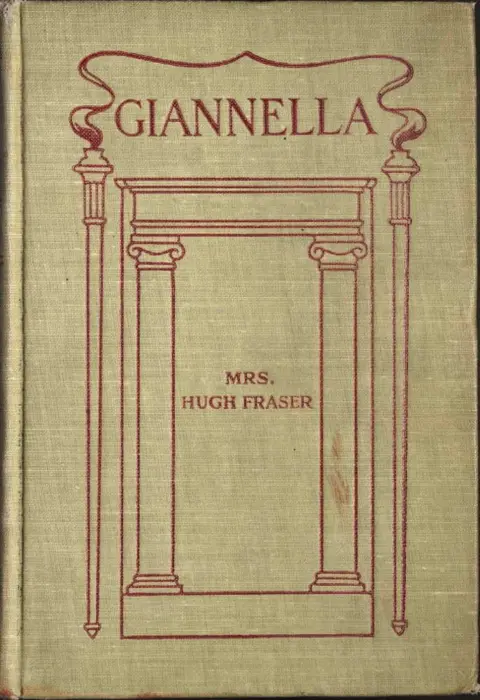
Giannella
Hugh, Mrs. Fraser

THE CLASSIC COLLECTION · 1913
"Italian Yesterdays, vol. 2" by Mrs. Hugh Fraser is a historical account written in the early 20th century. The book appears to explore tales from Italian history, particularly focusing on the lives and legacies of saints and historical figures from the Christian tradition. It delves into themes of spirituality and notable events that shaped the religious landscape of Italy. At the start of the book, the narrative introduces the friendship between the author and Mary Grace, who later travel to Rome to visit significant holy sites. The opening chapter recounts two stories of love and devotion: Aglaë and Boniface, who become Christians and endure personal sacrifices, and Alexis, a nobleman who renounces his family to live a life of pilgrimage and humility. Their stories are presented against the backdrop of early Christian Rome, highlighting their struggles and ultimate fates, as well as the transformation from worldly desires to spiritual commitments. The opening sets a rich historical and spiritual tone that invites readers to reflect on devotion and legacy.
Introduction adapted from the source catalogue; source summaries may be automatically generated.
Free to read · English · 106,707 words · No account needed
MAKE TIME FOR A GOOD BOOK
On by default. Untick to stop anonymous reading totals. Each page counts after 10 seconds in view. How this works.
Anonymous counting is on unless you have switched it off.
Witch and tyrant as she is—and perhaps for that very reason, since tyrants must know how to yield as well as how to rule—Venice will meet you in almost all your moods, and create new ones for you if you have none of your own.
I used to get dazzled with all the splendour of palaces and Churches; these last are so full of the glorification of great men—the monuments and ornamentation are so obtrusive that there seems scarcely any room for prayer. San Marco itself, dream of beauty as it is, inspires less devotion than many a humble country Church without a single work of art to recommend it. Without the ineffable Presence in the Tabernacle I should have felt more piously disposed at the foot of the lonely shrine out in the Lagoon, where the Blessed Madonna’s picture smiles down from its tall tarred post on the flowers that one or other of her children brings there every day. The water laps gently at her feet, the sky arches blue overhead, and one can dream very good and happy dreams as one gazes up at her. But in San Marco, just as in the Doges’ Palace, one is teased by two things—the necessity of thought and appreciation, and that horrid sense one has in so many places in Italy, of all the prying irreverence that expert—sceptic—heretics of the Ruskin tribe have brought to bear on it—as if the cleverest ant that ever crawled and builded underground could measure the courses of the stars!
To forget, and rest from, other people’s thoughts, I used to walk a good deal through those narrow, noiseless streets where never hoof or wheel comes to break the stillness, where old houses lean close to share old secrets, and the shadows lie clear and cool through most of the daylight hours. When the sun does strike down he turns the grey to gold, seems to gather up all the perfume of the small hidden gardens and fling it to you with a laugh on a spray of jessamine that has tossed itself over some ancient wall, or a tangle of red carnations spilling down through the scrollwork of a balcony projecting the wide curve of its iron bars far overhead, above the street. Through a half-open portone, dull green, like the narrow canals in the shade, you catch a glimpse of a courtyard deep sunk between high walls that are dimpled and lichened to indescribable richness of colour, and gleaming here and there with some lovely fragment of bas-relief. Cupid with one wing gone and half a bow—a row of bursting pomegranates trailing off into nothing—a few letters of some once pompous inscription—who knows, who cares? They served out their own uses centuries ago and were stuck in here to corner a window frame, to key an arch, to replace a brick, but the sun and the rain and the salt sweetness of Adriatic airs have fused and mellowed them to the gold-white tint of fresh curds, smoothed their marbled surface to the velvet uniformity of magnolia petals. There is a fountain in the courtyard, of course, a rough half shell of stone set into the wall, where a slow jet trickles all day long and is just now spilling over the brim of the red copper “conca” that some woman has set a-tilt below it—and forgotten, perhaps, to run upstairs and pull in the wire that dangles overhead between two windows, flapping with garments of many colours like a string of signals at sea. For there are windows that look into the courtyard, row above row—and there she is, looking out of one, a red-haired, brown-eyed young creature with broad shoulders and sunburnt throat, a strapping baby trying to wriggle out of its swaddling bands in her arms. In a minute she comes down, and clatters over the broad damp stones in her wooden clogs with yellow velvet toe-caps—and the sight of them sets me dreaming of the Venetian ladies three hundred years ago, picking their way to Mass through the narrow twisting “calle” on clogs, too, but such clogs! A narrow stein, twelve or fourteen inches high, resting on a base not more than two inches wide, and spreading at the top into a pretty little slipper, lined with velvet, and the whole thing was covered with crimson velvet and gold lace held in place by dozens of gold-headed nails! How any grown woman ever balanced herself on these stilts is a mystery to me still. My father at one time collected ancient footgear, and then forgot all about it; so it came to pass that in a corner of our old nursery at the Villa Negroni there lay the strangest heap of toys that any modern child ever had to play with—several pairs of these exquisitely ornamented “sabots” tumbled in with pink and scarlet silk slippers of the Watteau period—and later. One pair, I remember, with heels like knitting pins, so high that only the very point of the foot touched the ground at all. But, oh, how the little feet that wore them must have suffered! They had certainly walked in such shoes from childhood, for the foot had sunk down and lost shape until, pathetically small as the little slipper was, it was as lumpy and shapeless as a clenched fist and almost as broad as it was long.
Your reading position is saved on this browser. Take it to another device with a library code. Reading pages adapt to text, rather than matching a printed edition.
Hugh, Mrs. Fraser

Hugh, Mrs. Fraser
BEHIND THE BOOK
This eBook is for the use of anyone anywhere in the United States and most other parts of the world at no cost and with almost no restrictions whatsoever. You may copy it, give it away or re-use it under the terms of the Project Gutenberg License included with this eBook or online at www.gutenberg.org. If you are not located in the United States, you will have to check the laws of the country where you are located before using this eBook. Read the source licence.
The original source file, including credits and licence, is retained by this library. Request an original-format copy at no charge. Please include the book title and Project Gutenberg identifier #55239.
KEEP YOUR CURIOSITY GOING

David Patterson (Spirit) Hatch

David Patterson (Spirit) Hatch

David Patterson (Spirit) Hatch
Cécile Tormay

Moritz Busch
John L. Ransom