THE CLASSIC COLLECTION✦My diaries, being a personal narrative of events 1888-1914, Part 2 (1900-1914)CLASSIC FREE BOOKS
My diaries, being a personal narrative of events 1888-1914, Part 2 (1900-1914)
Wilfrid Scawen Blunt
THE CLASSIC COLLECTION · 1905
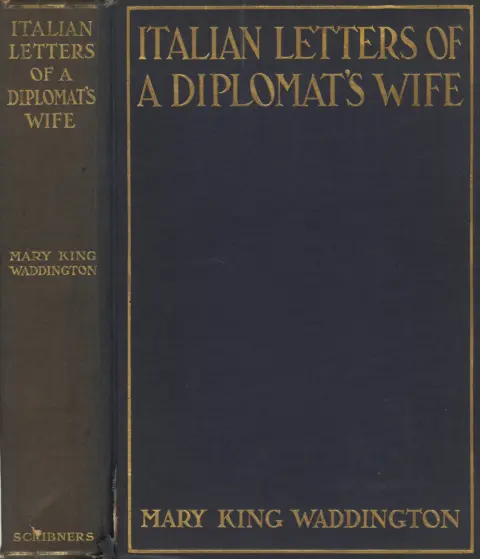
"Italian Letters of a Diplomat's Wife: January-May, 1880; February-April, 1904" by Mary King Waddington is a collection of personal letters written in the late 19th century. The work captures the author's experiences as the wife of a diplomat, detailing her travels and life in Italy, particularly her time spent in Rome during two distinct periods. The letters provide an intimate and engaging glimpse into the social and cultural milieu of the time, featuring characters such as her husband, William Henry Waddington, and various acquaintances from the diplomatic and cultural spheres. The opening portion of the book introduces Madame Waddington's life as she adjusts from being a public figure as the wife of the French Prime Minister to enjoying a more private existence after his resignation. As she describes her move from Paris to Italy, she provides rich details about their travel preparations and the reactions of family and friends. The letters are filled with her thoughts on returning to familiar places, her observations of daily life, and her anticipation for the adventures that await her in Italy. The vivid descriptions evoke a sense of nostalgia and foreshadow the delightful explorations and cultural encounters that characterize her time in Rome.
Introduction adapted from the source catalogue; source summaries may be automatically generated.
Free to read · English · 101,722 words · No account needed
MAKE TIME FOR A GOOD BOOK
On by default. Untick to stop anonymous reading totals. Each page counts after 10 seconds in view. How this works.
Anonymous counting is on unless you have switched it off.
We then had a most animated discussion as to how far it was possible for an intelligent man (or woman) to abdicate entirely his own judgment, and to accept a thing which he was not quite sure of because the church decided it must be. I think we should have gone on indefinitely with that conversation, never arriving at any solution, so it was just as well that breakfast put a stop to it.
We went for a lovely drive in the afternoon, out of the Porta del Popolo, across Ponte Molle, and then along the river until we came to that rough country road, or lane, leading across the fields where we have gone in so many times on horseback, to the Villa Madama. We drove as far as we could (almost to the gate) and then walked up the hill to the Villa itself. There everything was quite unchanged--the garden neglected, full of weeds, and grass growing high. The oval stone basin was there still, the sides covered with moss, and a few flowers coming quite promiscuously out of walls, stones, etc. We went into the loggia to see the paintings and frescoes, all in good condition, and then sat some time on the terrace looking at the view, which was divine--everything so soft in the distance, even the yellow Tiber looked silvery--at least I saw it so; I don't know that W. did. He generally finds it sluggish and muddy. We came home by the Porta Angelica and drove through the Square of St. Peter's. There are always people on the steps, not a crowd of course as on fete days, but enough to give animation, priests, beggars, and the people lounging and looking at whatever passes in the Square. It is so enormous, the Piazza, when one sees it empty, one can hardly realize what it used to be in the old days for the great Easter ceremony when the Pope gave his blessing from the balcony of St. Peter's. I can see it now, packed black with people, the French soldiers with their red caps and trousers making great patches of colour, and Montebello (who commanded the French Armee d'Occupation in Rome) with a brilliant staff in the centre of the Square--he and his black charger so absolutely motionless one might have thought both horse and rider were cast in bronze. There were all sorts of jokes and chattering in the crowd until the first glimpse of the waving peacock plumes, and banners, passing high, high up, and just visible through the arches, showed that the Pope's procession was arriving on the balcony; and when at last one saw distinctly the white figure as the old man was raised high in his chair there was an absolute stillness in all that great mass; every one knelt to receive the blessing, and the Pope's voice rang out clear and strong (one could hear every word). As soon as it was over cannon fired, bells rang, and there fluttered down over the crowd a quantity of little white papers (indulgences) which every one tried to grasp. It was a magnificent cadre for such a ceremony--the dome of St. Peter's towering above us straight up into the blue sky, the steps crowded with people, the red umbrellas of the peasants making a great show, and women of all conditions and all nationalities dressed in bright, gay colours; uniforms of all kinds, monks and priests of every order; the black of the priests rather lost in all the colour of uniforms, costumes, etc. The getting away was long--we might have had our carriage with the American cockade in one of the back courts of the Vatican, but we wanted to see everything and come home by the Ponte St. Angelo. It was a great show all the way--the long line of carriages and pedestrians streaming back to Rome, cut every now and then by a detachment of troops. Everybody was cheered, from Charette and his Zouaves to Montebello and his staff. The crowd was in a good humour--it was a splendid day, they had had a fine show, and politics and "foreign mercenaries" were forgotten for the moment. Everybody had a flower of some kind--the boys and young men in their hats, the girls in their hair. One heard on all sides "buona festa," "buona Pasqua." How we enjoyed it all, particularly the first time, when we were fresh from America and our principal idea of a fete was the 4th of July. That seemed a magnificent thing in our childish days, when we had friends on the lawn at Cherry Lawn, a torch-light procession with a band (such a band) from the town, and father's speech, standing at the top of the steps and telling the boys that if they worked hard and studied well, any one of them might become President of the United States, which statement of course was always received with roars of applause.
Your reading position is saved on this browser. Take it to another device with a library code. Reading pages adapt to text, rather than matching a printed edition.
BEHIND THE BOOK
This eBook is for the use of anyone anywhere in the United States and most other parts of the world at no cost and with almost no restrictions whatsoever. You may copy it, give it away or re-use it under the terms of the Project Gutenberg License included with this eBook or online at www.gutenberg.org. If you are not located in the United States, you will have to check the laws of the country where you are located before using this eBook. Read the source licence.
The original source file, including credits and licence, is retained by this library. Request an original-format copy at no charge. Please include the book title and Project Gutenberg identifier #37953.
KEEP YOUR CURIOSITY GOING
Wilfrid Scawen Blunt
Wilfrid Scawen Blunt

E. W. (Edgar Watson) Howe
Francis Greenleaf Allinson & Anne C. E. (Anne Crosby Emery) Allinson
Cyrenus Cole

John Martineau