THE CLASSIC COLLECTION✦My diaries, being a personal narrative of events 1888-1914, Part 2 (1900-1914)CLASSIC FREE BOOKS
My diaries, being a personal narrative of events 1888-1914, Part 2 (1900-1914)
Wilfrid Scawen Blunt
THE CLASSIC COLLECTION · 1905
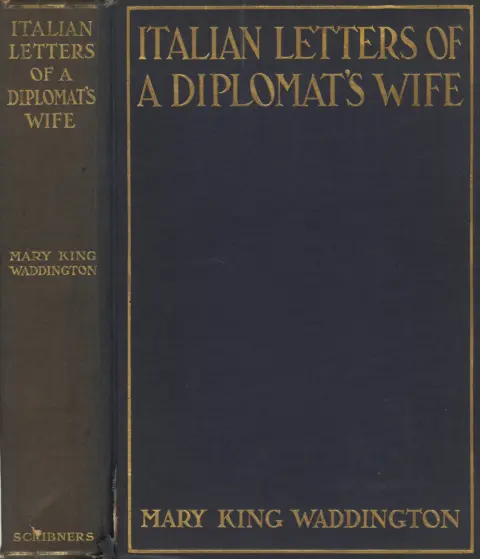
"Italian Letters of a Diplomat's Wife: January-May, 1880; February-April, 1904" by Mary King Waddington is a collection of personal letters written in the late 19th century. The work captures the author's experiences as the wife of a diplomat, detailing her travels and life in Italy, particularly her time spent in Rome during two distinct periods. The letters provide an intimate and engaging glimpse into the social and cultural milieu of the time, featuring characters such as her husband, William Henry Waddington, and various acquaintances from the diplomatic and cultural spheres. The opening portion of the book introduces Madame Waddington's life as she adjusts from being a public figure as the wife of the French Prime Minister to enjoying a more private existence after his resignation. As she describes her move from Paris to Italy, she provides rich details about their travel preparations and the reactions of family and friends. The letters are filled with her thoughts on returning to familiar places, her observations of daily life, and her anticipation for the adventures that await her in Italy. The vivid descriptions evoke a sense of nostalgia and foreshadow the delightful explorations and cultural encounters that characterize her time in Rome.
Introduction adapted from the source catalogue; source summaries may be automatically generated.
Free to read · English · 101,722 words · No account needed
MAKE TIME FOR A GOOD BOOK
On by default. Untick to stop anonymous reading totals. Each page counts after 10 seconds in view. How this works.
Anonymous counting is on unless you have switched it off.
Our dinner was charming. I was not a bit disappointed in the Princess. W. had talked so much about her that I had rather made up my mind I should find her very formal and German--and she isn't either one or the other. We left a little after seven (I wearing black satin). I am so bored with always wearing the same dresses. If I had had any idea we should go out every night I should have brought much more, but W. spoke of "a nice quiet month in Rome, sight-seeing and resting." We were the first to arrive. Keudell was at the door, introduced himself, and took us into the large salon, where Madame Keudell was waiting. She looked slight and rather delicate, and he really ill, so very white. He said he had had a long, sharp attack of gout--had not been out for some time, and was in the salon for the first time the day the Princess arrived. While we were waiting for the others to come he showed us the rooms and pictures. I recognised at once one of those pretty child's heads by Otto Brandt like the one we have. He was much interested in knowing that we had bought one so long ago, he thought Brandt had so much talent. There was a grand piano, of course, as he is a fine musician. The Pagets and Wimpffens came together almost, and as soon as they were there the Princess came in. She had one lady with her and a "chambellan"--Count Seckendorff. She was dressed in black, with a handsome string of pearls. She is short, and rather stout, carries herself very well and moves gracefully. We all made low curtseys--the men kissed her hand, Sir Augustus Paget just touching the floor with his knee, the first time I had seen a man kneel to any one in a salon. She received W. most charmingly, and was very gracious to me--asked me at once why I didn't accompany my husband to Berlin. I said, "Principally because he didn't want me," which was perfectly true. He said when he was named Plenipotentiary that it was all new ground to him, that he would have plenty to do, and didn't want to have a woman to look after. He rather protests now, but that is really what he said, and I certainly didn't go. The dinner was pleasant enough. The Princess talked a great deal, and as the party was small, general conversation was quite easy. The talk was all in French, which really was very amiable for us--we were the only foreigners present, and naturally if we hadn't been there every one would have spoken German. After dinner she made a short "cercle," standing in the middle of the room, all of us around her, then made a sign to W. to come and talk to her, sat down on the big sofa, he on a chair next, and they talked for about half an hour. We all remained standing. I asked Keudell about his piano. He told me that he liked the Erard grand very much, but that they didn't stand travelling well. In a few moments the Princess told us all to sit down, particularly Keudell, who looked quite white and exhausted. I sat by Madame Keudell, and as she is very fond of Italy, and Rome in particular, we got on very well. When the Princess had finished her talk with W. she came over and sat down by me--was most charming and easy. She has the Queen's beautiful smile, and such an expressive face. We spoke English; she asked me if I had become very French (I wonder?)--that she had always heard American women were so adaptable, taking at once their husband's nationality when they married foreigners. She had always remained very fond of England and English ways--the etiquette and formality of the German Court had tried her at first. She asked me, of course, how many children I had--said one was not enough. "If anything should happen to him, what would your life be?" and then spoke a great deal about the son she lost last summer by diphtheria, said he was the most promising of all her children, and she sometimes thought she never could be resigned. I said that her life was necessarily so full, she had so many obligations of all kinds, had so many to think about, that she would be taken out of herself. "Ah, yes, there is much to do, and one can't sit down with one's sorrow, but the mother who has lost her child carries a heavy heart all her life." It was all so simply said--so womanly. She said she was very glad to meet W. again, thought he looked very well--was sure the change and rest were doing him good. She regretted his departure from the Quai d'Orsay and public life generally. I told her he was still a Senator, and always interested in politics. I didn't think a few months' absence at this time would affect his political career much, and that he found so much to interest him that he really didn't miss the busy, agitated life he had been leading for so long. She said she intended to spend a quiet fortnight here as a tourist, seeing all she could. She then talked to all the other ladies, and about ten said she was tired and would go to her own rooms. She shook hands with the ladies, the men kissed her hand, and when she got to the door she turned and made a very pretty curtsey to us all. We stayed on about a quarter of an hour.
Your reading position is saved on this browser. Take it to another device with a library code. Reading pages adapt to text, rather than matching a printed edition.
BEHIND THE BOOK
This eBook is for the use of anyone anywhere in the United States and most other parts of the world at no cost and with almost no restrictions whatsoever. You may copy it, give it away or re-use it under the terms of the Project Gutenberg License included with this eBook or online at www.gutenberg.org. If you are not located in the United States, you will have to check the laws of the country where you are located before using this eBook. Read the source licence.
The original source file, including credits and licence, is retained by this library. Request an original-format copy at no charge. Please include the book title and Project Gutenberg identifier #37953.
KEEP YOUR CURIOSITY GOING
Wilfrid Scawen Blunt
Wilfrid Scawen Blunt

E. W. (Edgar Watson) Howe
Francis Greenleaf Allinson & Anne C. E. (Anne Crosby Emery) Allinson
Cyrenus Cole

John Martineau