THE CLASSIC COLLECTION✦My diaries, being a personal narrative of events 1888-1914, Part 2 (1900-1914)CLASSIC FREE BOOKS
My diaries, being a personal narrative of events 1888-1914, Part 2 (1900-1914)
Wilfrid Scawen Blunt
THE CLASSIC COLLECTION · 1905
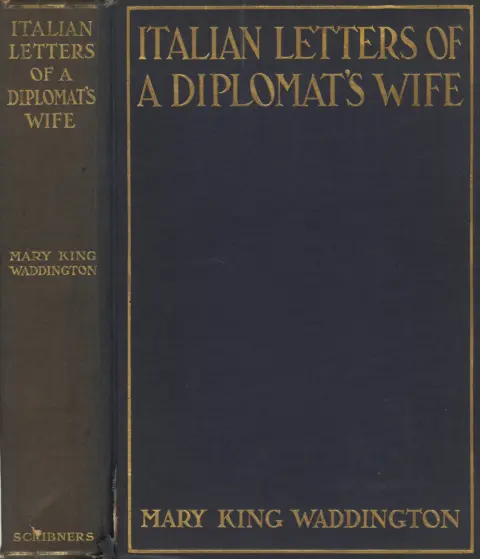
"Italian Letters of a Diplomat's Wife: January-May, 1880; February-April, 1904" by Mary King Waddington is a collection of personal letters written in the late 19th century. The work captures the author's experiences as the wife of a diplomat, detailing her travels and life in Italy, particularly her time spent in Rome during two distinct periods. The letters provide an intimate and engaging glimpse into the social and cultural milieu of the time, featuring characters such as her husband, William Henry Waddington, and various acquaintances from the diplomatic and cultural spheres. The opening portion of the book introduces Madame Waddington's life as she adjusts from being a public figure as the wife of the French Prime Minister to enjoying a more private existence after his resignation. As she describes her move from Paris to Italy, she provides rich details about their travel preparations and the reactions of family and friends. The letters are filled with her thoughts on returning to familiar places, her observations of daily life, and her anticipation for the adventures that await her in Italy. The vivid descriptions evoke a sense of nostalgia and foreshadow the delightful explorations and cultural encounters that characterize her time in Rome.
Introduction adapted from the source catalogue; source summaries may be automatically generated.
Free to read · English · 101,722 words · No account needed
MAKE TIME FOR A GOOD BOOK
On by default. Untick to stop anonymous reading totals. Each page counts after 10 seconds in view. How this works.
Anonymous counting is on unless you have switched it off.
I didn't find my tea quite so pleasant the other day. I was sitting in the little salon talking to one or two ladies, and receiving their congratulations at being no longer of the official world, and obliged to associate with the Government people, when the footman appeared with his eyes round, to announce that "La Presidente" (Madame Grevy) was coming upstairs to pay Madame a visit. I flew to the door and the top of the stairs (I couldn't get any further) and received "ma Presidente" in proper style. I ushered her into the salon where I had left my friends (mad Royalists both). They were much disgusted--however they were too well-bred to make things disagreeable for me in my own house--and rose when we came in. I named Madame Grevy--and as soon as she had taken her seat, and declined a cup of tea, they went away. Of course they hated getting up for Madame Grevy, but there was nothing else to be done as she and I were both standing. Happily no one else came in but Prince Orloff, Russian Ambassador, who of course knew Madame Grevy and talked easily enough. She didn't stay long--it was the classic "visite de condoleance" to the wife of the ex-Minister (if she only knew how glad this Ex was to return to private life and her own house, and to be no longer "logee par le gouvernement"). This is the second visit of condoleance I have had. When Marshal MacMahon dismissed (suddenly) all his cabinet presided by Jules Simon, 16th of May, 1877, Madame de MacMahon came also to see me--and at the same time--5 o'clock on my reception day--so I knew precisely what the conversation would be--and Madame Grevy and I both said exactly the same things that the Marechale and I had said two or three years ago. I suppose everybody does say the same thing on certain occasions. After she had gone Orloff asked me if I remembered those two ladies meeting (for the first time in their lives) at the Quai d'Orsay on one of my Fridays. Just after the Marshal resigned Madame de MacMahon came to see me. She was announced by all the servants and I had plenty of time to get to the door of the first drawing-room, not quite to the anteroom, to receive her. When her husband was President she was received always like Royalty--at the door of the apartment. She was very simple and easy, quite pleased evidently at still having all her honours. Prince Orloff came in to pay a visit, and we were having a very pleasant talk, when I heard quick footsteps in the second salon, and again appeared my faithful Gerard (I had also visions of numberless doors being opened all down the enfilade of salons) announcing Madame Grevy. I was embarrassed for a moment as I didn't like to leave the Marechale, and yet I knew I must go and meet Madame Grevy--all the ceremony of course was for the official position, and one Presidente was just the same as the other. Madame de MacMahon was most amiable--said at once--"Je vous en prie, Madame, ne pensez pas a moi"--and "au fond" was rather curious to see her successor. I went as quickly as I could (Orloff giving me a funny little smile, almost a wink, as I passed him) and got my other Presidente just at the door. She was rather astounded I think at her reception--she hadn't been long in her exalted position. We proceeded majestically through three or four salons, and when we arrived at my drawing-room Madame de MacMahon got up at once, saying quite simply "Voulez-vous me presenter, Madame, a Madame Grevy?" She was quite at her ease--Madame Grevy rather shy and embarrassed--however Madame de MacMahon talked at once about some of the great charities, artists, etc., and it really wasn't too stiff--Orloff of course always helping and making jokes with the two ladies. One or two visitors came in and gasped when they saw the situation--also one of the young men of the Cabinet, who instantly disappeared. I always thought he went to tell W. what was happening upstairs so that he might come to the rescue in case I wasn't up to the mark ... but he swears he didn't. When the Marechale got up to go there was again a complication as I wanted to accompany her to the door, and I didn't like to leave Madame Grevy. She wouldn't hear of my going through all the salons--took leave of me at the door--and then Orloff came to the rescue--gave her his arm and took her to her carriage. It was a curious meeting, and, as Orloff said just now, "je lui devais une fameuse chandelle."[7]
Your reading position is saved on this browser. Take it to another device with a library code. Reading pages adapt to text, rather than matching a printed edition.
BEHIND THE BOOK
This eBook is for the use of anyone anywhere in the United States and most other parts of the world at no cost and with almost no restrictions whatsoever. You may copy it, give it away or re-use it under the terms of the Project Gutenberg License included with this eBook or online at www.gutenberg.org. If you are not located in the United States, you will have to check the laws of the country where you are located before using this eBook. Read the source licence.
The original source file, including credits and licence, is retained by this library. Request an original-format copy at no charge. Please include the book title and Project Gutenberg identifier #37953.
KEEP YOUR CURIOSITY GOING
Wilfrid Scawen Blunt
Wilfrid Scawen Blunt

E. W. (Edgar Watson) Howe
Francis Greenleaf Allinson & Anne C. E. (Anne Crosby Emery) Allinson
Cyrenus Cole

John Martineau