THE CLASSIC COLLECTION✦My diaries, being a personal narrative of events 1888-1914, Part 2 (1900-1914)CLASSIC FREE BOOKS
My diaries, being a personal narrative of events 1888-1914, Part 2 (1900-1914)
Wilfrid Scawen Blunt
THE CLASSIC COLLECTION · 1905
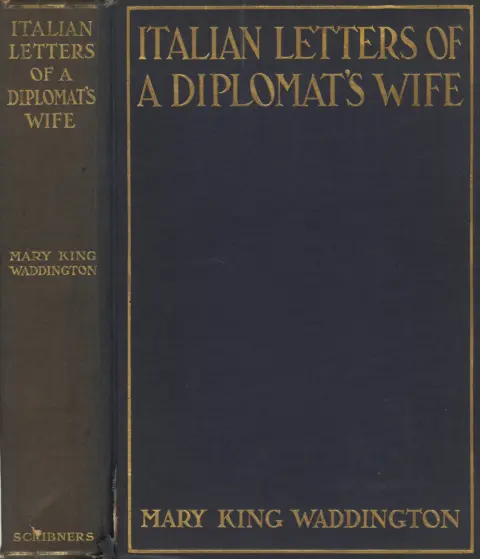
"Italian Letters of a Diplomat's Wife: January-May, 1880; February-April, 1904" by Mary King Waddington is a collection of personal letters written in the late 19th century. The work captures the author's experiences as the wife of a diplomat, detailing her travels and life in Italy, particularly her time spent in Rome during two distinct periods. The letters provide an intimate and engaging glimpse into the social and cultural milieu of the time, featuring characters such as her husband, William Henry Waddington, and various acquaintances from the diplomatic and cultural spheres. The opening portion of the book introduces Madame Waddington's life as she adjusts from being a public figure as the wife of the French Prime Minister to enjoying a more private existence after his resignation. As she describes her move from Paris to Italy, she provides rich details about their travel preparations and the reactions of family and friends. The letters are filled with her thoughts on returning to familiar places, her observations of daily life, and her anticipation for the adventures that await her in Italy. The vivid descriptions evoke a sense of nostalgia and foreshadow the delightful explorations and cultural encounters that characterize her time in Rome.
Introduction adapted from the source catalogue; source summaries may be automatically generated.
Free to read · English · 101,722 words · No account needed
MAKE TIME FOR A GOOD BOOK
On by default. Untick to stop anonymous reading totals. Each page counts after 10 seconds in view. How this works.
Anonymous counting is on unless you have switched it off.
I went out after all this afternoon with W. and Monsignor English to St. John Lateran, where they were singing a Miserere of Cappoci's. It is most strange, weird music, and the voices of the men are so unlike anything one hears elsewhere. There was always the same crowd. I will say Cook does his business thoroughly--wherever there is anything to see or hear he pilots all his band. After the Miserere was over we stood some time at the foot of the Scala Santa. It was black with people going up on their knees, saying a prayer at each step (I think there are 30) and some of them did look serious and absorbed. They were principally peasants--every now and then some well-dressed bourgeois. Monsignor English told us we would be surprised at the class of people (society) who come early, before the great crowd of sight-seers.
We went back to the Palazzo Altemps, picking up Count Palfy on the way, where Gert had promised us tea and hot cross buns from Spillman's (very good they were).
We found a note from the Quirinal when we came home saying the Queen would receive us to-morrow at 2.30. Desprez came and sat some time. He told W. all that was going on in Paris--the Ministry as usual struggling against the Radicals who are always wanting to suppress the French Embassy at the Vatican. It doesn't make the position of the Ambassador very pleasant, but Desprez is very wise, has had long training at the Foreign Office, and will certainly do all he can to conciliate and keep things straight.
To H. L. K.
Saturday, March 27, 1880.
It was raining this morning, and I was very glad. The dust was getting most disagreeable in one's eyes and throat, and covering everything. I am glad, too, that it is cool, decidedly, as I wanted to wear my blue velvet. If it had been a bright warm day it would have looked dark and heavy. It is four o'clock--we have just come in from our audience, and I will write at once while the impression is fresh. W. has a "rendezvous" with some of the French Institute people, and I shall not see him again until dinner time. We got to the palace (a great ugly yellow building, standing high) quickly enough, as there was no one in the streets at that hour, and drove into the court-yard to a handsome entrance and staircase. There were a few soldiers about, but not much movement. A carriage came in behind us, and just as we were going upstairs some one called my name. It was Bessie Brancaccio,[21] who had also an audience with the Queen. She had come to thank her for her appointment as dame de palais. I was glad to have just that glimpse of her, as they are not in Rome this winter. Their beautiful house is not ready for them, so they have been spending the winter in Nice. We walked through a large anteroom where there were three or four servants and an "ecuyer," and in the first salon we were received by the Comtesse Marcello, one of the Queen's ladies, a Venetian and a great friend of Mary's, and the gentleman-in-waiting, whose name I didn't master. We talked for a few minutes--she said a lady was with the Queen. The room was handsome, prettily furnished and opened into another--three or four, in fact, all communicating. After about ten minutes we saw a lady come out of the end room, the door of which was open, so Comtesse Marcello ushered us through the suite. We went to the corner room, quite at the end, where the Queen was waiting standing. We went through the usual ceremony. The Comtesse Marcello made a low curtsey on the threshold, saying, "I have the honour to present his Excellency, M. Waddington and Madame Waddington," and instantly retired. The Queen was standing quite at the end of the room (a lovely, bright corner room, with lots of windows and a magnificent view over Rome--even on a dull day it looked cheerful and spacious). I had ample time for my three curtseys. She let us come quite close up to her, and then shook hands with us both and made us sit down--I next to her on the sofa, W. in an arm-chair in front. I found her rather changed since I had seen her. She has lost the girlish appearance she had so long, and her manner was nervous, particularly at first. When she began to talk and was interested and animated she was more like what I remembered her as Princess Marguerite. She was dressed in bronze satin, with a flowered brocade "casaque," and one string of splendid pearls. She told W. she was very pleased to see him, remembered that I had lived in Rome before my marriage, and asked if I still sang, Vera had talked so much about the music in Casa Pierret, and the trios we used to sing there with Lovatelli and Malatesta. The talk was most easy, about everything, generally in French, but occasionally breaking into English, which she speaks quite well. W. was delighted with her--found her most interesting and "tres instruite"--not at all the banal talk one expects to have with sovereigns--in fact, I quite forgot we were having a royal audience. It was a very pleasant visit to a charming woman, in a pretty room with all sorts of beautiful pictures and "bibelots" about. While we were still there the Prince of Naples[22] came in. We both got up; she told him to shake hands with W. and to kiss me, and to ask me how old my little boy was, which he did quite simply and naturally. He told his mother he was going to ride. I asked him if he had a nice pony, to which he replied in English, "Oh, yes, jolly," and asked if my little boy rode. I said not yet; he was only two years old. The child looked intelligent, but delicate. They say his mother makes him work too much, is so ambitious for him; and he has rather that look. The Princes of Savoy have always been soldiers rather than scholars, but I suppose one could combine the two. The Queen also spoke about the Bunsens, and "little Beatrice";[23] said she was very fond of Mary. I was very sorry when the audience was over and she dismissed me, saying she had people waiting.
Your reading position is saved on this browser. Take it to another device with a library code. Reading pages adapt to text, rather than matching a printed edition.
BEHIND THE BOOK
This eBook is for the use of anyone anywhere in the United States and most other parts of the world at no cost and with almost no restrictions whatsoever. You may copy it, give it away or re-use it under the terms of the Project Gutenberg License included with this eBook or online at www.gutenberg.org. If you are not located in the United States, you will have to check the laws of the country where you are located before using this eBook. Read the source licence.
The original source file, including credits and licence, is retained by this library. Request an original-format copy at no charge. Please include the book title and Project Gutenberg identifier #37953.
KEEP YOUR CURIOSITY GOING
Wilfrid Scawen Blunt
Wilfrid Scawen Blunt

E. W. (Edgar Watson) Howe
Francis Greenleaf Allinson & Anne C. E. (Anne Crosby Emery) Allinson
Cyrenus Cole

John Martineau