THE CLASSIC COLLECTION✦My diaries, being a personal narrative of events 1888-1914, Part 2 (1900-1914)CLASSIC FREE BOOKS
My diaries, being a personal narrative of events 1888-1914, Part 2 (1900-1914)
Wilfrid Scawen Blunt
THE CLASSIC COLLECTION · 1905
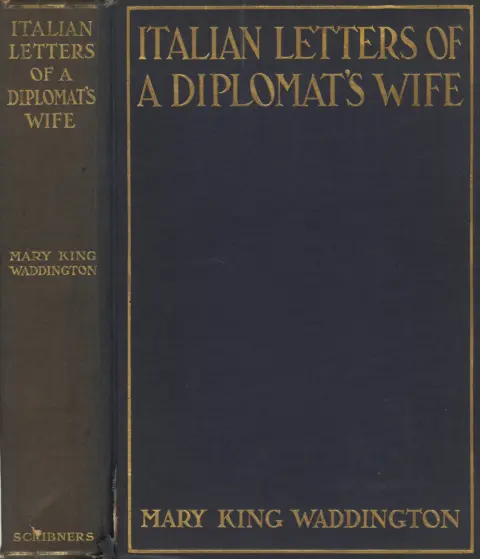
"Italian Letters of a Diplomat's Wife: January-May, 1880; February-April, 1904" by Mary King Waddington is a collection of personal letters written in the late 19th century. The work captures the author's experiences as the wife of a diplomat, detailing her travels and life in Italy, particularly her time spent in Rome during two distinct periods. The letters provide an intimate and engaging glimpse into the social and cultural milieu of the time, featuring characters such as her husband, William Henry Waddington, and various acquaintances from the diplomatic and cultural spheres. The opening portion of the book introduces Madame Waddington's life as she adjusts from being a public figure as the wife of the French Prime Minister to enjoying a more private existence after his resignation. As she describes her move from Paris to Italy, she provides rich details about their travel preparations and the reactions of family and friends. The letters are filled with her thoughts on returning to familiar places, her observations of daily life, and her anticipation for the adventures that await her in Italy. The vivid descriptions evoke a sense of nostalgia and foreshadow the delightful explorations and cultural encounters that characterize her time in Rome.
Introduction adapted from the source catalogue; source summaries may be automatically generated.
Free to read · English · 101,722 words · No account needed
MAKE TIME FOR A GOOD BOOK
On by default. Untick to stop anonymous reading totals. Each page counts after 10 seconds in view. How this works.
Anonymous counting is on unless you have switched it off.
Cannons are firing, drums beating, flags flying in all directions to-day, dear mother. It is King Humbert's birthday and there is to be a great revue on the Piazza dell' Indipendenza. We are invited to go and see it by Turkam Pacha, Turkish Minister, who has an apartment on the Piazza; but as he told us that we should meet Ismail Pacha (the ex-Khedive) we thought we had better remain at home. I hardly think it would be a pleasure to Ismail to meet the man who was one of the chief instruments in his downfall. My sympathies were rather with the Khedive--I never quite understood why France and England should have politely but forcibly insisted upon his leaving his throne and country--but whenever I raised the question I had always that inert force the "raison d'etat" opposed to me. We crossed him the other day driving. The carriage full of red-fezzed men attracted my attention, and our Giuseppe told us who they were. He looked very fat and smiling, evidently was not ronge by his disasters. Turkam suggested that I should come alone, but that of course I could not do.
Mrs. Bailey, who has also an apartment on the Piazza, has asked us to come to her, but I think I shall stay quietly at home and look out of the window. I see lots of officers and functionaries, in uniform, passing in fiacres and riding, and a general migration of the whole city including the beggars and flower girls of the Spanish Steps toward the Piazza. W. says he will smoke his cigar walking about in the crowd, and will see very well.
I was interrupted by a message from Gert begging me to come to her at once. Her maid was in such an extraordinary state of violence she thought she was crazy--and as Eugene was away for a day or two she was really afraid. I questioned the little footman who brought the note but he was very non-committal. W. was already off to see the review and I left him a note explaining where I was and asking him if I didn't get back to breakfast to come and get me at Gert's. I then started off with the little footman who had a fiacre waiting. As I entered the court of the Palazzo Altemps a glimpse of a white, frightened face at the window told me what Gert's state was. Poor dear, she was terribly upset, and Eugene's being away is a complication. Her two men-servants are very devoted, but they evidently feel uncomfortable. She asked me if I would go with her and see the woman. We found her sitting in a chair in Gert's dressing-room looking certainly most unpleasant, sullen, and an ugly look in her eyes. She is a great big Southern woman (French), could throw Gert out of the window if she wanted to. Gert spoke to her very gently, saying I had come to see her as I had heard she was not well. She didn't answer nor move but gave Gert a nasty look--she evidently has got something against her. I looked at her very steadily--said we were very sorry she was suffering, which was most evident, and that the best thing for her would be to rest, attempt no service of any kind and go to her own room--that we had sent for Dr. Valery who would certainly be able to relieve her. She didn't answer at first, and looked as if she would like to spring upon us both, then burst into screams of abuse--"She would go to her room of course--would leave the house at once and never come back, etc." I told her I should certainly advise Mrs. Schuyler to send her away--that evidently the climate did not suit her, and she would be happier in France. She didn't answer, relapsed into her sullen silence, and almost immediately Valery appeared. He insisted very quietly that she should go to her own room (at the other end of the apartment), and she went off with him, giving an ugly look at Gert as she passed. It seems she already had had such an attack, less violent, when they were at Birmingham, but once it was over went on quite peaceably and didn't seem to realize how ill she had been. Valery came back to tell us the result of his examination--said she had already calmed down and was anxious to beg her mistress's pardon, but that she was of a nervous, dangerous temperament, and at any moment might have a relapse. Of course she must go, but it is very uncomfortable. I took Gert out for a drive. W. sent me a line to say he was busy all the afternoon and would not come unless I wanted him. I think the air and distraction did her good. The streets had a decidedly festive appearance. There were a good many flags everywhere, and soldiers still passing on their way back to their various barracks. We were kept some time in the Corso seeing a battalion of "bersaglieri" pass. They had good music and looked very spirited as they moved along with all their feathers flying. They were rather small, but well set up, and marched in beautiful time with a light, quick step. We saw some cavalry too, but I didn't care so much for them. I thought the men looked too tall for the horses--their legs too near the ground.
Your reading position is saved on this browser. Take it to another device with a library code. Reading pages adapt to text, rather than matching a printed edition.
BEHIND THE BOOK
This eBook is for the use of anyone anywhere in the United States and most other parts of the world at no cost and with almost no restrictions whatsoever. You may copy it, give it away or re-use it under the terms of the Project Gutenberg License included with this eBook or online at www.gutenberg.org. If you are not located in the United States, you will have to check the laws of the country where you are located before using this eBook. Read the source licence.
The original source file, including credits and licence, is retained by this library. Request an original-format copy at no charge. Please include the book title and Project Gutenberg identifier #37953.
KEEP YOUR CURIOSITY GOING
Wilfrid Scawen Blunt
Wilfrid Scawen Blunt

E. W. (Edgar Watson) Howe
Francis Greenleaf Allinson & Anne C. E. (Anne Crosby Emery) Allinson
Cyrenus Cole

John Martineau