THE CLASSIC COLLECTION✦My diaries, being a personal narrative of events 1888-1914, Part 2 (1900-1914)CLASSIC FREE BOOKS
My diaries, being a personal narrative of events 1888-1914, Part 2 (1900-1914)
Wilfrid Scawen Blunt
THE CLASSIC COLLECTION · 1905
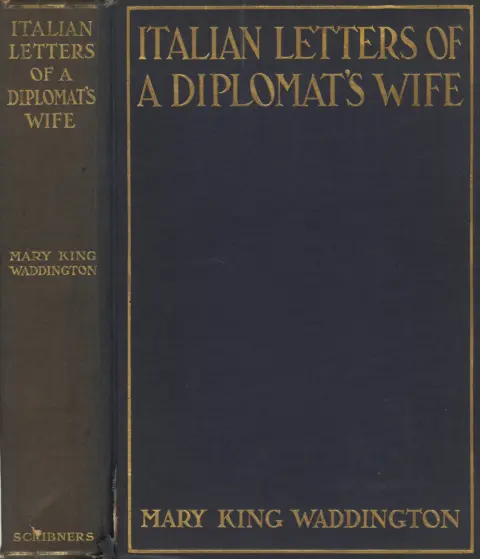
"Italian Letters of a Diplomat's Wife: January-May, 1880; February-April, 1904" by Mary King Waddington is a collection of personal letters written in the late 19th century. The work captures the author's experiences as the wife of a diplomat, detailing her travels and life in Italy, particularly her time spent in Rome during two distinct periods. The letters provide an intimate and engaging glimpse into the social and cultural milieu of the time, featuring characters such as her husband, William Henry Waddington, and various acquaintances from the diplomatic and cultural spheres. The opening portion of the book introduces Madame Waddington's life as she adjusts from being a public figure as the wife of the French Prime Minister to enjoying a more private existence after his resignation. As she describes her move from Paris to Italy, she provides rich details about their travel preparations and the reactions of family and friends. The letters are filled with her thoughts on returning to familiar places, her observations of daily life, and her anticipation for the adventures that await her in Italy. The vivid descriptions evoke a sense of nostalgia and foreshadow the delightful explorations and cultural encounters that characterize her time in Rome.
Introduction adapted from the source catalogue; source summaries may be automatically generated.
Free to read · English · 101,722 words · No account needed
MAKE TIME FOR A GOOD BOOK
On by default. Untick to stop anonymous reading totals. Each page counts after 10 seconds in view. How this works.
Anonymous counting is on unless you have switched it off.
W. and I went off to the Villa Albani--out of Porta Salara. We walked through the rooms--there are principally busts, statues, bas-reliefs, etc.--and then loitered about the gardens which are fine. Fountains, vases, and statues in every direction, and always that beautiful view of the hills in the soft afternoon light.
I will finish when I come home from our Black dinner. We are asked for seven, so of course will get back early, as we do not go anywhere afterward. I shall wear black, as I hear so many Princes of the church are to be there. Madame Hubert is very sorry I can't wear the long black veil that I did for the Pope--she found that most becoming.
Tuesday, March 12, 1880, 10.30 P.M.
We are just home from our dinner at the Portuguese Embassy, so I have got out of my gauds and into my tea-gown, and will finish this long letter. It was most interesting--a great deal of couleur locale. We arrived very punctually--three or four carriages driving up at the same time. There was of course a magnificent porter downstairs, and quantities of servants in handsome liveries; a good deal of red and powder. Two giants at the foot of the staircase, with the enormous tall candles which are de rigueur at a Black embassy when cardinals or ambassadors dine. They were just preparing to escort some swell up the staircase as we arrived; there was a moment's halt, and the swell turned out to be M. Desprez, the new French Ambassador to the Vatican (replacing the Marquis de Cabriac). He was half embarrassed when he recognised us; W. had so lately been his chef that he couldn't quite make up his mind to pass before him--especially under such novel and rather trying conditions. However, there was nothing to be done, and he started up the great staircase between the tall candles, W. and I followed modestly in his wake. We found several people, including two or three cardinals, already there. The apartment is very handsome. The Ambassador (Thomar) looked very well--"tres grand seigneur"--standing at the door of the first salon, and one saw quite a vista of large, brilliantly lighted rooms beyond. All the guests arrived very quickly--we had hardly time to exchange a word with any one. I saw the Sulmonas come in. I recognised her instantly, though I hadn't seen her for years. She was born Apponyi, and they were married when we were living in Rome. Also Marc Antonio Colonna and the d'Aulnays. Almost immediately dinner was announced. Sulmona took me in and I had a cardinal (Portuguese) on the other side. I didn't say much to the cardinal at first. He talked to his neighbour, and Sulmona and I plunged, of course, into old Roman days. He was much amused at the composition of the dinner, and wondered if it would interest W. He asked me if I remembered the fancy ball at the Palazzo Borghese. He had still the album with all the photos, and remembered me perfectly as "Folie" with short skirts, bells, mirror, etc. I remember it, of course, quite well. Some of the costumes were beautiful, particularly those copied from portraits. After a little while the cardinal turned his attention to me. He was a nice old man, speaking either French or Italian (both with a strong accent), and much interested in the guests. He asked me if I belonged to the corps diplomatique. I said no--we were merely strangers spending the winter in Rome. He thought there were a good many strangers at table--he didn't know half the people, not having been long in Rome; but he knew that there was one man dining whom he had a great desire to see, Waddington, the late French Premier; perhaps I knew him, and could point him out. He had always followed his career with great interest, but there were some things he couldn't understand, "par exemple son attitude dans la question--" Then as I didn't know what he might be going to say, I interrupted, and said no one could point out that gentleman as well as I, as I was Madame Waddington. He looked a little uncomfortable, so I remarked, "Il diavolo non e tanto nero quant e dipinto" (The devil is not so black as he is painted), to which he replied, "Eh, no punto diavolo" (no devil)--was rather amused, and asked me if I would introduce him to W. after dinner. We then, of course, talked a little about France, and how very difficult the religious question was. He asked me where I had learned Italian, so I told him how many years we had lived in Rome when my brother was the last Minister from the United States to the Vatican. Sulmona joined in the talk, and we rather amused ourselves. Sulmona, of course, knew everybody, and explained some of the people, including members of his own (Borghese) family, who were very Black and uncompromising. Still, as I told him, the younger generation is less narrow-minded, more modern. I don't think they mean to cut themselves off from all participation in the nation's history. After all, they are all Italians as well as Romans. The foreign marriages, too, make a difference. I don't think the sons of English and American mothers could settle down to that life of inaction and living on the past which the Black Party means in Rome.
Your reading position is saved on this browser. Take it to another device with a library code. Reading pages adapt to text, rather than matching a printed edition.
BEHIND THE BOOK
This eBook is for the use of anyone anywhere in the United States and most other parts of the world at no cost and with almost no restrictions whatsoever. You may copy it, give it away or re-use it under the terms of the Project Gutenberg License included with this eBook or online at www.gutenberg.org. If you are not located in the United States, you will have to check the laws of the country where you are located before using this eBook. Read the source licence.
The original source file, including credits and licence, is retained by this library. Request an original-format copy at no charge. Please include the book title and Project Gutenberg identifier #37953.
KEEP YOUR CURIOSITY GOING
Wilfrid Scawen Blunt
Wilfrid Scawen Blunt

E. W. (Edgar Watson) Howe
Francis Greenleaf Allinson & Anne C. E. (Anne Crosby Emery) Allinson
Cyrenus Cole

John Martineau