THE CLASSIC COLLECTION✦My diaries, being a personal narrative of events 1888-1914, Part 2 (1900-1914)CLASSIC FREE BOOKS
My diaries, being a personal narrative of events 1888-1914, Part 2 (1900-1914)
Wilfrid Scawen Blunt
THE CLASSIC COLLECTION · 1905
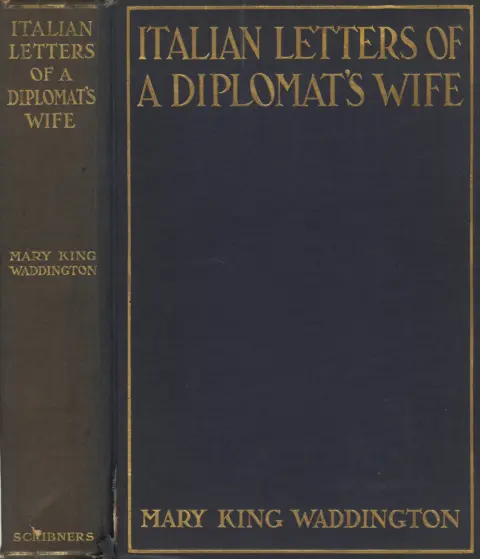
"Italian Letters of a Diplomat's Wife: January-May, 1880; February-April, 1904" by Mary King Waddington is a collection of personal letters written in the late 19th century. The work captures the author's experiences as the wife of a diplomat, detailing her travels and life in Italy, particularly her time spent in Rome during two distinct periods. The letters provide an intimate and engaging glimpse into the social and cultural milieu of the time, featuring characters such as her husband, William Henry Waddington, and various acquaintances from the diplomatic and cultural spheres. The opening portion of the book introduces Madame Waddington's life as she adjusts from being a public figure as the wife of the French Prime Minister to enjoying a more private existence after his resignation. As she describes her move from Paris to Italy, she provides rich details about their travel preparations and the reactions of family and friends. The letters are filled with her thoughts on returning to familiar places, her observations of daily life, and her anticipation for the adventures that await her in Italy. The vivid descriptions evoke a sense of nostalgia and foreshadow the delightful explorations and cultural encounters that characterize her time in Rome.
Introduction adapted from the source catalogue; source summaries may be automatically generated.
Free to read · English · 101,722 words · No account needed
MAKE TIME FOR A GOOD BOOK
On by default. Untick to stop anonymous reading totals. Each page counts after 10 seconds in view. How this works.
Anonymous counting is on unless you have switched it off.
This morning Josephine and I have been out to the new Benedictine Monastery of St. Anselmo, which stands high on a hill overlooking the Tiber. She had business with the Director, so I went into the chapel which is fine (quite modern with splendid marbles) and walked about a little in the garden (they wouldn't let me go far). We went afterward into the Villa Malta. There is an extraordinary view through the key-hole of the door--one looks straight down a long, narrow avenue with high trees on each side, to St. Peter's--a great blue dome at the end. We couldn't make out at first what the old woman meant who opened the door for us, she wouldn't let us come in, but pointed to the key-hole, mumbling something we couldn't understand. At last we heard "veduta" (view), and divined what she wanted us to do. It was most curious. The gardens are lovely still, green, cool. We went over the house, but there is nothing particularly interesting--portraits of all the "Grands Maitres de l'Ordre de Malte." It was so lovely that we didn't want to come home, so we drove out as far at St. Paul's Fuori le Mura, and walked around the church to the front where they are making a splendid portico--all marble and mosaic. I should have liked it better without the mosaic--merely the fine granite and marble columns.
Tuesday, April 12th.
Yesterday we had a splendid ceremony at St. Peter's, the 13th anniversary of Pope Gregorio Magno. We started early, Josephine and I leaving the house together at 8, dressed in the regulation black dress and veil. I had on a short cloth skirt, which I regretted afterward, but as we had asked for no particular places, and were going to take our chance in the church with all the ordinary sight-seers, I hadn't made a very elegante toilette. We got along pretty well, though there were streams of carriages and people all going in the same direction, until we got near the St. Angelo bridge--there we took the file, hardly advanced at all, and met quantities of empty carriages coming back. I fancy most people started much earlier than we did. The piazza was fairly crowded (but not the compact mass we used to see in the old days when the Pope gave the Easter blessing from the balcony), all the Colonnade guarded by Italian troops, carabinieri and bersaglieri. We went round to the Sagrestia, and found our way easily into the church, and into our Tribune A, but we might just as well have remained at home, if we had wanted to see anything. We were far back, low, and could have just seen perhaps the top of the Pope's tiara when he was carried in his high chair in procession--however it was our own fault, as we had asked too late for our tickets. I was interested all the same seeing the different people come in (the church was very full). We sat there some little time, rather disgusted au fond at having such bad places, particularly when we saw some people we knew being escorted with much pomp past our obscure little tribune, toward the centre of the church. Finally one of the camerieri segreti in his uniform--black velvet, ruff and chain--recognised Josephine, and insisted that she should come with him and he would give her a proper place. She rather demurred at leaving me, but I urged her going, as I was sure she would find a seat for me somewhere. In a few minutes the gentleman returned, and put me first in the same tribune with her, a little farther back, but eventually conducted me to the Diplomatic Tribune, d'Antas, the Doyen, Portuguese Ambassador to the Quirinal, and an old colleague of ours in London, having said he would gladly give a place in their box to an ancienne collegue. That was the moment in which I regretted my short skirt. I had to cross the red carpet between rows of gardes-nobles and gala uniforms of all kinds and colours, and I was quite conscious that my dress was not up to the mark, a sentiment which gathered strength as I got to the Diplomatic Tribune, and saw all the ladies beautifully dressed, with long lace and satin dresses, pearl necklaces, and their veils fastened with diamond stars. However, it was a momentary ennui, and I could only hope nobody looked at me. Wasn't it silly of me to wear a plain little skirt--I can't think why I did it. Almost all the bishops and sommites of the clerical world were already assembled and walking about in the great space at the back of the altar. Just opposite us was the Tribune of the patriciat Romain. All the tribunes and columns were covered with red and gold draperies. A detachment of gardes-nobles, splendid in their red coats, white culottes and white plumes, surrounded the altar. There were two silver thrones for the Pope, one at one side of the church where he sat first, directly opposite to us, another quite at the end of the long nave behind the high altar. The entrance of the cardinals was very effective. They all wore white cloaks trimmed with silver, and silver mitres, each one accompanied by an attendant priest, who helped them take off and put on their mitres, which they did several times during the ceremony. The costumes were splendid, some high prelates, I suppose, in red skirts with splendid old lace; some in white and gold brocaded cloaks, also grey fur cloaks; and an Eastern bishop with a long beard, in purple flowered robes, a pink sash worn like a grand cordon over his shoulder, and purple mitre. It was a gorgeous effect of colour, showing all the more between the rows of tribunes where every one was in black.
Your reading position is saved on this browser. Take it to another device with a library code. Reading pages adapt to text, rather than matching a printed edition.
BEHIND THE BOOK
This eBook is for the use of anyone anywhere in the United States and most other parts of the world at no cost and with almost no restrictions whatsoever. You may copy it, give it away or re-use it under the terms of the Project Gutenberg License included with this eBook or online at www.gutenberg.org. If you are not located in the United States, you will have to check the laws of the country where you are located before using this eBook. Read the source licence.
The original source file, including credits and licence, is retained by this library. Request an original-format copy at no charge. Please include the book title and Project Gutenberg identifier #37953.
KEEP YOUR CURIOSITY GOING
Wilfrid Scawen Blunt
Wilfrid Scawen Blunt

E. W. (Edgar Watson) Howe
Francis Greenleaf Allinson & Anne C. E. (Anne Crosby Emery) Allinson
Cyrenus Cole

John Martineau