THE CLASSIC COLLECTION✦My diaries, being a personal narrative of events 1888-1914, Part 2 (1900-1914)CLASSIC FREE BOOKS
My diaries, being a personal narrative of events 1888-1914, Part 2 (1900-1914)
Wilfrid Scawen Blunt
THE CLASSIC COLLECTION · 1905
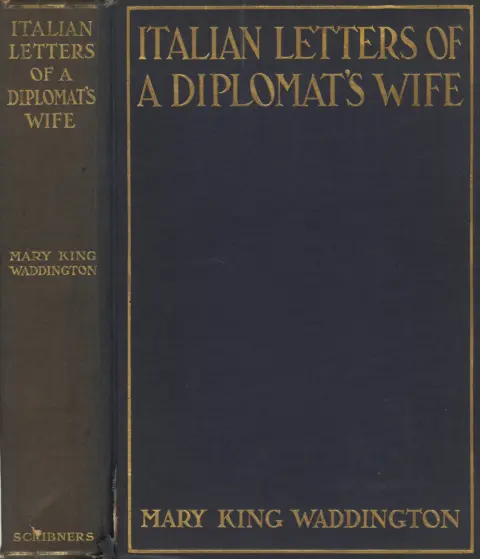
"Italian Letters of a Diplomat's Wife: January-May, 1880; February-April, 1904" by Mary King Waddington is a collection of personal letters written in the late 19th century. The work captures the author's experiences as the wife of a diplomat, detailing her travels and life in Italy, particularly her time spent in Rome during two distinct periods. The letters provide an intimate and engaging glimpse into the social and cultural milieu of the time, featuring characters such as her husband, William Henry Waddington, and various acquaintances from the diplomatic and cultural spheres. The opening portion of the book introduces Madame Waddington's life as she adjusts from being a public figure as the wife of the French Prime Minister to enjoying a more private existence after his resignation. As she describes her move from Paris to Italy, she provides rich details about their travel preparations and the reactions of family and friends. The letters are filled with her thoughts on returning to familiar places, her observations of daily life, and her anticipation for the adventures that await her in Italy. The vivid descriptions evoke a sense of nostalgia and foreshadow the delightful explorations and cultural encounters that characterize her time in Rome.
Introduction adapted from the source catalogue; source summaries may be automatically generated.
Free to read · English · 101,722 words · No account needed
MAKE TIME FOR A GOOD BOOK
On by default. Untick to stop anonymous reading totals. Each page counts after 10 seconds in view. How this works.
Anonymous counting is on unless you have switched it off.
We loitered about some time on the terrace after we came down, watching the lights fade and finally disappear--the mountains looking like great grey giants frowning down on the city. The air was decidedly cooler as we drove home, but it was a perfect summer evening. There were more people out as we got near Turin--all the workers getting a little breath of air after the toil of the day.
May 15th.
I will send this very long letter off this evening. Our trunks are packed and downstairs, and I will finish this while we are waiting for dinner. We have had a nice day. Madame Hubert and I strolled about this morning and went to see the house where Cavour was born, and also to the Giardino Pubblico. The grounds are handsome, but not particularly interesting at that hour in the morning, and there wasn't a creature there but ourselves. There are various monuments--one of Manin with a fine figure of the Republic of Venice.
I breakfasted as usual alone, and at 3 W. came in, having quite finished his work at the Museum. He had given rendezvous to Mr. Hoffman for 3.30, and while we were sitting talking waiting for him the padrone came up and said an officer "de la part du Duc d'Aoste" wanted to see us. We begged him of course to send him up, and in a few minutes a very good-looking young officer in uniform made his appearance. He named himself--Count Colobiano I think--but we didn't catch the name very distinctly; said he had had the honour of dining with us at the Quai d'Orsay with his Prince, and that the Prince was "desole" not to be in Turin these days and had sent him to put himself at our disposition. He proposed all sorts of things--the opera, a drive (or a ride if we preferred) to a sort of parade ground just outside the gates where we would see some cavalry manoeuvres. He knew I rode, and could give me a capital lady's hack. I was rather sorry he hadn't come before--it would have amused us to see the manoeuvres, and also to ride--but that would have been difficult as I had no habit with me. However, as we are leaving this evening there was nothing to be done. He was very civil and I think rather sorry not to do us the honours of his city. He said there were beautiful excursions to be made from Turin, and asked us if we had seen anything. We said only the Superga which he evidently didn't consider very interesting. He said the Duke was very sorry to have missed us, and that he thought I would have enjoyed an evening at the Palace, as the receptions were very gay and informal. I cannot imagine (I didn't tell him that) anything gay with the Duc d'Aoste. He is very sympathetic to me, but a type apart. A stern, almost ascetic appearance, very silent and shy, but a beautiful smile. He looks exactly as one would imagine a Prince of the House of Savoy would. We saw him often in Paris, and his face always interested me--so grave, and as if he were miles away from the ordinary modern world. It was just after he had given up his Spanish throne, and although I didn't think that crown weighed very heavily on his brow he must have had some curious experiences and seen human nature in perhaps not its best form. The young aide-de-camp paid us quite a visit, and we made him promise to come and see us if ever he came to Paris. We sent all sorts of messages and regrets to the Duke. Just as he was going out Mr. Hoffman appeared and he sat an hour with us. He was delightful, has lived almost all his life in and near Turin, and had all the history of Piedmont at his fingers' ends. He seems to have met W. years ago at a dinner in London and has always followed his career with much interest. It was most interesting to hear him talk. He admires Cavour immensely--said his death was a great calamity for Italy--that he hadn't given half of what he could, and that every year he lived he grew in intellect and knowledge of people. He also said (as they all do) that he mistrusted Louis Napoleon so intensely, and through all their negotiations and discussions as to Italy's future he was pursued by the idea that the Emperor would go back upon his word. He said the Piedmontese were a race apart--hardly considered themselves Italian, and that even now in the little hamlets in the mountains the peasants had vague ideas of nationality, and never spoke of themselves as Italians, or identified themselves with Italian interests and history--that in the upper classes traces of French occupation and education, superstition and priestly rule were just getting effaced. For years in the beginning of the century the priests (Jesuits) had it all their own way in Turin. The teaching in the schools was entirely in their hands, and most elementary; and numerous convents and monasteries were built. Cavour as a very young man soon emancipated himself from all those ideas, and if he had lived, Hoffman thinks, much trouble would have been averted, and that he would certainly have found some means of coming to a better understanding with the Vatican, "the most brilliant and far-seeing intellect I have ever met."
Your reading position is saved on this browser. Take it to another device with a library code. Reading pages adapt to text, rather than matching a printed edition.
BEHIND THE BOOK
This eBook is for the use of anyone anywhere in the United States and most other parts of the world at no cost and with almost no restrictions whatsoever. You may copy it, give it away or re-use it under the terms of the Project Gutenberg License included with this eBook or online at www.gutenberg.org. If you are not located in the United States, you will have to check the laws of the country where you are located before using this eBook. Read the source licence.
The original source file, including credits and licence, is retained by this library. Request an original-format copy at no charge. Please include the book title and Project Gutenberg identifier #37953.
KEEP YOUR CURIOSITY GOING
Wilfrid Scawen Blunt
Wilfrid Scawen Blunt

E. W. (Edgar Watson) Howe
Francis Greenleaf Allinson & Anne C. E. (Anne Crosby Emery) Allinson
Cyrenus Cole

John Martineau