THE CLASSIC COLLECTION✦My diaries, being a personal narrative of events 1888-1914, Part 2 (1900-1914)CLASSIC FREE BOOKS
My diaries, being a personal narrative of events 1888-1914, Part 2 (1900-1914)
Wilfrid Scawen Blunt
THE CLASSIC COLLECTION · 1905
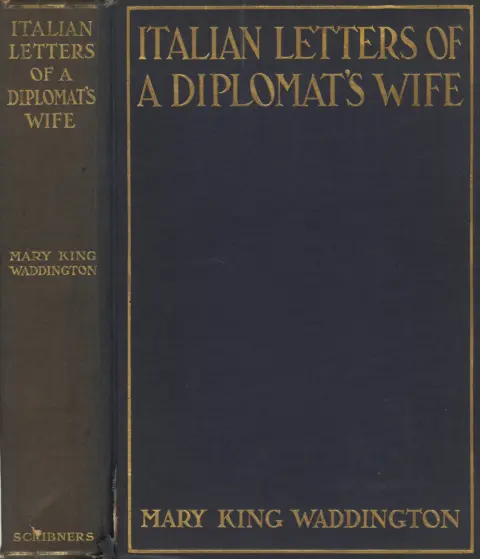
"Italian Letters of a Diplomat's Wife: January-May, 1880; February-April, 1904" by Mary King Waddington is a collection of personal letters written in the late 19th century. The work captures the author's experiences as the wife of a diplomat, detailing her travels and life in Italy, particularly her time spent in Rome during two distinct periods. The letters provide an intimate and engaging glimpse into the social and cultural milieu of the time, featuring characters such as her husband, William Henry Waddington, and various acquaintances from the diplomatic and cultural spheres. The opening portion of the book introduces Madame Waddington's life as she adjusts from being a public figure as the wife of the French Prime Minister to enjoying a more private existence after his resignation. As she describes her move from Paris to Italy, she provides rich details about their travel preparations and the reactions of family and friends. The letters are filled with her thoughts on returning to familiar places, her observations of daily life, and her anticipation for the adventures that await her in Italy. The vivid descriptions evoke a sense of nostalgia and foreshadow the delightful explorations and cultural encounters that characterize her time in Rome.
Introduction adapted from the source catalogue; source summaries may be automatically generated.
Free to read · English · 101,722 words · No account needed
MAKE TIME FOR A GOOD BOOK
On by default. Untick to stop anonymous reading totals. Each page counts after 10 seconds in view. How this works.
Anonymous counting is on unless you have switched it off.
I was lazy this morning, as we came in so late last night, so W. and I only went for a turn in the Boboli Gardens. The shade was so thick it was almost black--but it was resting to the eyes. There are very few flowers, one had a general impression of green. This afternoon we have been driving about leaving cards, and ending with a turn in the Cascine. There everything seemed exactly the same as when we lived there ten years ago. The same people driving about in the same carriages, and everybody drawing up on the Piazza, and talking to their neighbours. It amused me to drive down the Lungarno to our bridge. There were quantities of carriages and people lounging on the pavement, and looking at the river. The instant one crosses the bridge it is perfectly different--narrow streets, high walls, few carriages, no loiterers.
Our garden was beautiful to-night--a splendid moon just rising over the black trees, and a soft delicious air. We have had a quiet evening, talking and reading in the small salon. Charles was very interesting, talking about old Italy and their beginnings in Turin. It seems the etiquette of that Court was something awful. Mary told us that she was talking one day to the Marchesa S. (a lively little old lady who took snuff) who had been in her time a famous wit and beauty, dame d'honneur to the wife of Carlo Alberto. Mary was rather complaining of the inconvenience of going to the winter reception of the Duchess of Genoa (she had only one in the year) where all the ladies of the Corps Diplomatique were obliged to go in full dress decolletee at about 4 in the afternoon. "Ah, ma chere," said the old Marchesa, "what would you have said in our time?" She told her that when the Queen-Mother was ill in the winter at the Chateau of Stupinigi, some miles from Turin, all her ladies had to go and inquire for her in full dress and manteaux de cour, and that when they knew she was in bed, and could see no one. Mary has splendid Italian lace which she bought from one of the ladies of the old Queen after her death. It would cost a fortune now, and in fact could not be had unless some private individual in reduced circumstances was obliged to sell. I had a nice visit from Alberti to-day--just the same--gay, impossible, saying the most risque things in a perfectly natural way, so that you can hardly realize the enormities you are listening to. They don't sound so bad in Italian--I think the language veils and poetizes everything. He is very anxious we should go out and spend the day at Signa--his most lovely place--and I wish we could, I should like W. to see it--so much natural beauty--and, with our northern ideas, so absolutely neglected--splendid rooms, painted ceilings--no practical furniture of any kind, and a garden that was a dream of wild beauty--flowers everywhere, climbing up over the roof, around bits of grey wall, long grass that almost twisted around one's feet, and such a view from the terrace. I told W. afterward of our great day there long ago, when we started at 10 in the morning and got back at 2 A.M. I wonder if you remember the day? We were a large party--Van Schaicks, Maquays, Coxes, and others whose names I forget and pretty much every man in Florence (of all nationalities). We started by rail--the women all in light muslin dresses and hats. We were met by carriages of all kinds--Alberti's own little pony-trap--and a collection of remarkable vehicles from all the neighbouring villages. The drive was short, but straight up a steep hill--the villa most beautifully situated at the top, with a background of green hills. Two or three rooms had been arranged for us--so we took off cloaks--a nice, sympathetic Italian woman brushed off the dust--and we went at once to breakfast in the state dining-room--the big doors on the terrace open. Some of the men had their breakfast out there. After breakfast we all wandered about the garden--such thick shade that it was quite comfortable. It was pretty to see the white figures flitting in and out among the trees. About 3 I got into a riding skirt and loose jacket, and went for a ride with Alberti and a Frenchman, Brinquant, a friend of Alberti--very gay, and entrain, and perfectly amused at the entertainment--so sans facon and original. We had a lovely ride--through such narrow roads--branches of the orange trees and roses nearly coming into our faces as we cantered along the little steep paths. I had a pretty little mare--perfectly sure-footed, which was an absolute necessity as the hill paths were very steep, with many curves, and full of rolling stones. We pottered about for an hour, and when we got home I thought I would retire to one of the rooms and rest for half an hour before I got back into my afternoon dress, but that was a delusion. They all came clamouring at the door, and insisted upon my coming out at once, as the whole party were to be photographed. As I was perfectly confident that they would all come in if I didn't come out, there was nothing to be done, and I joined the group. It was rather a long affair, but at the end seemed satisfactory. Then we had tea on the terrace, and sat there watching the sun go down behind the Signa hills, leaving that beautiful afterglow which one only sees in Italy--the green tints particularly.
Your reading position is saved on this browser. Take it to another device with a library code. Reading pages adapt to text, rather than matching a printed edition.
BEHIND THE BOOK
This eBook is for the use of anyone anywhere in the United States and most other parts of the world at no cost and with almost no restrictions whatsoever. You may copy it, give it away or re-use it under the terms of the Project Gutenberg License included with this eBook or online at www.gutenberg.org. If you are not located in the United States, you will have to check the laws of the country where you are located before using this eBook. Read the source licence.
The original source file, including credits and licence, is retained by this library. Request an original-format copy at no charge. Please include the book title and Project Gutenberg identifier #37953.
KEEP YOUR CURIOSITY GOING
Wilfrid Scawen Blunt
Wilfrid Scawen Blunt

E. W. (Edgar Watson) Howe
Francis Greenleaf Allinson & Anne C. E. (Anne Crosby Emery) Allinson
Cyrenus Cole

John Martineau