THE CLASSIC COLLECTION✦An outlaw’s diary: the CommuneCLASSIC FREE BOOKS
An outlaw’s diary: the Commune
Cécile Tormay
THE CLASSIC COLLECTION · 1895
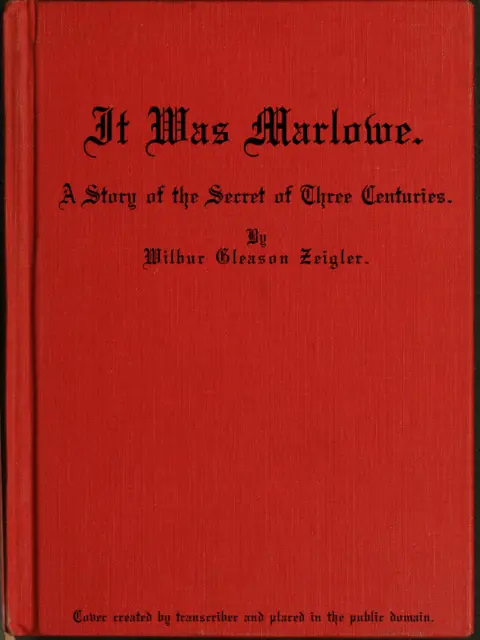
"It Was Marlowe: A Story of the Secret of Three Centuries" by Wilbur Gleason Zeigler is a historical novel written in the late 19th century. The narrative centers around the intriguing figure of Christopher Marlowe, a prominent playwright of the Elizabethan era, as it explores themes of authorship, scandal, and love, all set against the backdrop of the tumultuous societal changes of that time. At the start of the story, we meet Marlowe in the midst of the plague-stricken London of June 1593. A chance encounter with a youth named Tabbard leads to discussions regarding the Lady Anne and a potential romantic connection between them. Meanwhile, tensions brew as Marlowe navigates his professional life as a playwright and actor amid rumors of his controversial reputation and impending danger. Secrets unfold through Tabbard's news and Marlowe's upcoming clandestine meeting with Anne, setting the stage for a tale filled with intrigue, romance, and the shadow of Marlowe’s enigmatic past. This opening lays the groundwork for a plot that promises to delve into the complexities of Marlowe's life and the challenges he faces in a world rife with political and personal peril.
Introduction adapted from the source catalogue; source summaries may be automatically generated.
Free to read · English · 71,165 words · No account needed
MAKE TIME FOR A GOOD BOOK
On by default. Untick to stop anonymous reading totals. Each page counts after 10 seconds in view. How this works.
Anonymous counting is on unless you have switched it off.
He fell forward on the table with outstretched arms and clenched hands. Shakespere lifted him up; pityingly brushed back the hair from his face, and said: “Forget the matter for a moment.”
No other words were spoken; still the rain pattered on the window opening towards St. Michael’s, and no sounds came up from the narrow walks in Crooked Lane.
At length Tamworth broke the silence. “I do not doubt, dear Kit, that whatever may be thy aim, thy arrow will reach. But life can not be maintained without capital or revenue. Your design being linked with an ambition for personal immortality precludes the publication of thy productions till after thy death or when hope of life is gone. Now, where will come the fund for thy maintenance?”
“Thou canst not appear as an actor,” suggested Shakespere.
“And neither can the works you may produce be sold as thine,” said
Peele.
“Could they not be sold under some one else’s name?” asked Marlowe. “At the proper time their authorship could be confessed and established.”
“But in whose name?” queried Peele.
“Why not thine; at least temporarily?”
“Bah,” ejaculated Peele, “I could not pass thy dramas off as mine. The style, my dear fellow, the style. Henslowe would at once say, ‘What Peele, this thy drama? Marry, and where didst thou steal this new fire? Off with thee. It is none of thine. Leave it. I will look up the older dramatists, Greek and Latin, from which I ween thou hast taken its entire,’”
“Then why not as thine, Shakespere?”
“Mine,” exclaimed Shakespere, shaking with laughter which he could not control, “Greater objections than those stated by Peele would arise. Only a few years ago I held horses before the Curtain and Theater. I write a play; Ho! Ho!”
He laughed so heartily that Tamworth joined with him.
“Stop,” said Peele, endeavoring to interrupt the sudden mirth, “The suggestion is a good one. What does Henslowe know of your horseholding, friend Will?”
“But,” answered Shakespere, “he knoweth that I came from the miserable village of Stratford-on-Avon only six years ago, where there are few books and nothing better than a grammar school. [note 36] Although I can say ‘Stipendium peccati mors est,’ as being learned from thy Faustus, Marlowe, I would die in the attempt to give its meaning.”
“He surely will not question thee about thy Latin or thy Greek,” said Tamworth, joining in with the scheme, “and as thou hast never turned a hand at such work, there are not, as in Peele’s case, fair-skinned children of earlier birth to give the lie to the paternity of the later ones of different complexion.”
Your reading position is saved on this browser. Take it to another device with a library code. Reading pages adapt to text, rather than matching a printed edition.
BEHIND THE BOOK
This eBook is for the use of anyone anywhere in the United States and most other parts of the world at no cost and with almost no restrictions whatsoever. You may copy it, give it away or re-use it under the terms of the Project Gutenberg License included with this eBook or online at www.gutenberg.org. If you are not located in the United States, you will have to check the laws of the country where you are located before using this eBook. Read the source licence.
The original source file, including credits and licence, is retained by this library. Request an original-format copy at no charge. Please include the book title and Project Gutenberg identifier #57810.
KEEP YOUR CURIOSITY GOING
Cécile Tormay

Moritz Busch
Coulson Kernahan
John L. Ransom

Maurice Baring
Frances Wright