THE CLASSIC COLLECTION✦An outlaw’s diary: the CommuneCLASSIC FREE BOOKS
An outlaw’s diary: the Commune
Cécile Tormay
THE CLASSIC COLLECTION · 1895
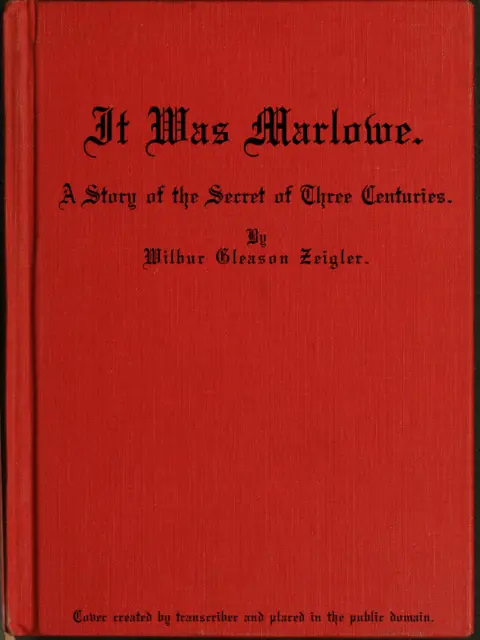
"It Was Marlowe: A Story of the Secret of Three Centuries" by Wilbur Gleason Zeigler is a historical novel written in the late 19th century. The narrative centers around the intriguing figure of Christopher Marlowe, a prominent playwright of the Elizabethan era, as it explores themes of authorship, scandal, and love, all set against the backdrop of the tumultuous societal changes of that time. At the start of the story, we meet Marlowe in the midst of the plague-stricken London of June 1593. A chance encounter with a youth named Tabbard leads to discussions regarding the Lady Anne and a potential romantic connection between them. Meanwhile, tensions brew as Marlowe navigates his professional life as a playwright and actor amid rumors of his controversial reputation and impending danger. Secrets unfold through Tabbard's news and Marlowe's upcoming clandestine meeting with Anne, setting the stage for a tale filled with intrigue, romance, and the shadow of Marlowe’s enigmatic past. This opening lays the groundwork for a plot that promises to delve into the complexities of Marlowe's life and the challenges he faces in a world rife with political and personal peril.
Introduction adapted from the source catalogue; source summaries may be automatically generated.
Free to read · English · 71,165 words · No account needed
MAKE TIME FOR A GOOD BOOK
On by default. Untick to stop anonymous reading totals. Each page counts after 10 seconds in view. How this works.
Anonymous counting is on unless you have switched it off.
The speaker had tossed his cloak over the back of a chair as he spoke and as hastily filled another. In impatience he drummed a tattoo with one of his feet on the smooth oaken floor; and, apparently without noting the freshness of the bare walls and the chimney in which no fire had ever burned, his eyes roamed around the room.
“Just built,” remarked Tabbard.
“Yes,” returned the hostess, setting the dishes called for before the two strangers and smiling as though she felt flattered over the knowledge that her house was the subject of observation and comment.
“Where went the old building?” asked Tabbard.
The hostess turned her hand with thumb pointing upwards and said, “In
smoke.”
“Yes,” said Marlowe, whose scarlet doublet and silver-corded belt had awakened the hostess’ admiration and almost hushed her into respectful awe, “I saw its blaze from as far south as the Standard in Cheap. The old tavern was twice as large as this, and being just outside the wall was greatly frequented by travelers approaching London late at night.”
“Do many stop here now?” inquired Tabbard.
“Not many at this season,” answered the hostess.
“The last one before you, kind sir,” she continued, now turning her attention to Marlowe and bowing so that her eyes caught only the sparkle of his rapier’s hilt, “left just as you entered. He acted strangely as he caught sight of you.”
“So, who was he?”
“He gave me no name, but as he went out I heard him say: ‘My chance to serve the church is ripe.’”
“How was he dressed?” asked Marlowe, suddenly setting down his half-raised mug, and fixing his eyes upon the hostess.
“Like a Puritan,” she answered.
“And what business have honest Puritans hanging around the bars of ordinaries and taverns?” exclaimed Marlowe, while Tabbard sneered audibly, and asked:
“And of what appearance was this man who was lounging here for the
service of God?”
“His long red beard was all I noted,” she replied.
“I know him not,” said Marlowe, shaking his head, and then he asked:
“Do you know his name?”
“Methinks that a man who was with him earlier called him Bame at times,
and again Richard.”
“Richard Bame!” exclaimed Marlowe, lifting his eyebrows and gazing fixedly at the woman. “And he said that his chance to serve the church was ripe?”
“True,” nodded the hostess, with her fists against her waist and continuing to look at her interlocutor as though in expectation that he would explain what interest he had in the man who had departed.
Your reading position is saved on this browser. Take it to another device with a library code. Reading pages adapt to text, rather than matching a printed edition.
BEHIND THE BOOK
This eBook is for the use of anyone anywhere in the United States and most other parts of the world at no cost and with almost no restrictions whatsoever. You may copy it, give it away or re-use it under the terms of the Project Gutenberg License included with this eBook or online at www.gutenberg.org. If you are not located in the United States, you will have to check the laws of the country where you are located before using this eBook. Read the source licence.
The original source file, including credits and licence, is retained by this library. Request an original-format copy at no charge. Please include the book title and Project Gutenberg identifier #57810.
KEEP YOUR CURIOSITY GOING
Cécile Tormay

Moritz Busch
Coulson Kernahan
John L. Ransom

Maurice Baring
Frances Wright