THE CLASSIC COLLECTION✦An outlaw’s diary: the CommuneCLASSIC FREE BOOKS
An outlaw’s diary: the Commune
Cécile Tormay
THE CLASSIC COLLECTION · 1895
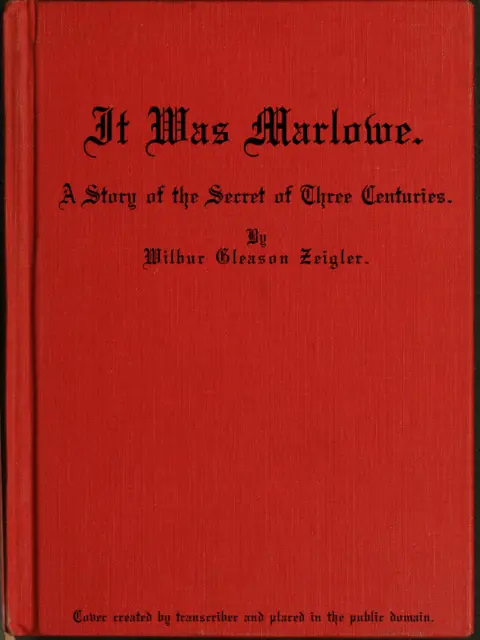
"It Was Marlowe: A Story of the Secret of Three Centuries" by Wilbur Gleason Zeigler is a historical novel written in the late 19th century. The narrative centers around the intriguing figure of Christopher Marlowe, a prominent playwright of the Elizabethan era, as it explores themes of authorship, scandal, and love, all set against the backdrop of the tumultuous societal changes of that time. At the start of the story, we meet Marlowe in the midst of the plague-stricken London of June 1593. A chance encounter with a youth named Tabbard leads to discussions regarding the Lady Anne and a potential romantic connection between them. Meanwhile, tensions brew as Marlowe navigates his professional life as a playwright and actor amid rumors of his controversial reputation and impending danger. Secrets unfold through Tabbard's news and Marlowe's upcoming clandestine meeting with Anne, setting the stage for a tale filled with intrigue, romance, and the shadow of Marlowe’s enigmatic past. This opening lays the groundwork for a plot that promises to delve into the complexities of Marlowe's life and the challenges he faces in a world rife with political and personal peril.
Introduction adapted from the source catalogue; source summaries may be automatically generated.
Free to read · English · 71,165 words · No account needed
MAKE TIME FOR A GOOD BOOK
On by default. Untick to stop anonymous reading totals. Each page counts after 10 seconds in view. How this works.
Anonymous counting is on unless you have switched it off.
“An apt parallelism,” remarked Jonson, and then slyly added, “But what think you of the lines put in the mouths of the players?”
“In Scene II of Act II, of this Hamlet?” inquired Nash.
“Yes, Æneas’ tale to Dido.”
“I know not what to think of them.”
“Did not Marlowe begin the drama of Dido?”
“He did.”
“And you completed it, did you not?” questioned Jonson.
“I did,” answered Nash [note 37].
“Now, is not this speech of the players in ridicule of thy work?”
“Possibly,” answered Nash, somewhat nettled by the question. “I had no love for the subject and pushed the work without inspiration; but no one but Marlowe, methinks, would have taken offense at my weak closing of his strong and poetic opening.”
“And the story of Troy was a fond one of his.”
“True, the famous Helen is the subject of conjuration in Faustus and is spoken of in Tamburlaine.”
“And is not the same fondness displayed in Titus Andronicus, The Merchant of Venice, King Henry IV, King Henry VI, Troilus and Cressida, and the Tempest?”
“It is.”
“Well, then if thy supposition is correct that Marlowe instead of Shakespere wrote this play of Hamlet, why is not my theory correct that he is holding up thy extravagant lines in Dido to ridicule?” [note 48]
“But, how can that be possible?” retorted Nash, “while I may be inclined to believe that Marlowe wrote this play, it could not have been since I completed his unfinished drama of Dido; for did he not die in 1593?”
“Is there not good reason to dispute that death?”
“By what?”
“The internal evidence of this play.”
“And by what else?”
“The contradictory reports of his death.”
“And to what conclusion does all this tend?”
“That Marlowe still lives, an outcast, a fugitive from justice.”
“But why an outcast; why a fugitive?”
“What else would cause him to keep concealed?”
“Thou hast not answered the question.”
“Did he not offend the church? Were not direct charges made against him? Was not the Queen apprised? Was not this but three days before his disappearance? You know the charge?”
“Aye, blasphemy.”
“And see what the play reveals, bitter remembrances, personal griefs and doubts, misanthropy in strongest sort. ‘The suits of woe,’ the ‘weary, stale, flat and unprofitable uses of this world,’ ‘contagious blastments,’ the losing of ‘all mirth,’ ‘we fools of nature,’ ‘the sleep of death,’ ‘the blister on the forehead of the once innocent love,’ These are but the outpourings of one sick of the vanities of life, hopeless of fame, bereft of all joys, and unsolaced by religion.”
“Bah! one in love can write of murder and madness.”
Your reading position is saved on this browser. Take it to another device with a library code. Reading pages adapt to text, rather than matching a printed edition.
BEHIND THE BOOK
This eBook is for the use of anyone anywhere in the United States and most other parts of the world at no cost and with almost no restrictions whatsoever. You may copy it, give it away or re-use it under the terms of the Project Gutenberg License included with this eBook or online at www.gutenberg.org. If you are not located in the United States, you will have to check the laws of the country where you are located before using this eBook. Read the source licence.
The original source file, including credits and licence, is retained by this library. Request an original-format copy at no charge. Please include the book title and Project Gutenberg identifier #57810.
KEEP YOUR CURIOSITY GOING
Cécile Tormay

Moritz Busch
Coulson Kernahan
John L. Ransom

Maurice Baring
Frances Wright