THE CLASSIC COLLECTION✦An outlaw’s diary: the CommuneCLASSIC FREE BOOKS
An outlaw’s diary: the Commune
Cécile Tormay
THE CLASSIC COLLECTION · 1895
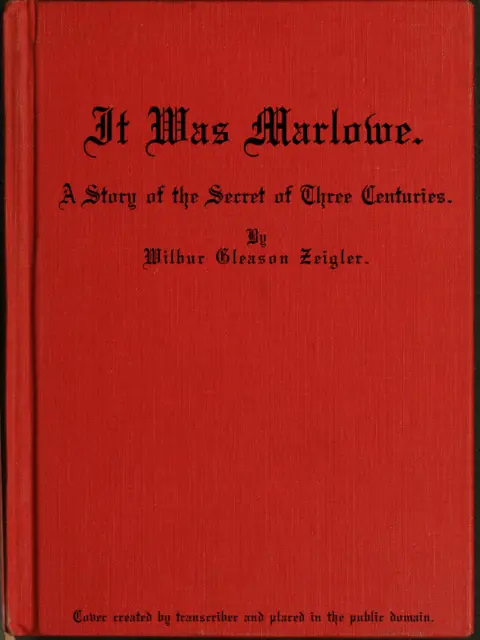
"It Was Marlowe: A Story of the Secret of Three Centuries" by Wilbur Gleason Zeigler is a historical novel written in the late 19th century. The narrative centers around the intriguing figure of Christopher Marlowe, a prominent playwright of the Elizabethan era, as it explores themes of authorship, scandal, and love, all set against the backdrop of the tumultuous societal changes of that time. At the start of the story, we meet Marlowe in the midst of the plague-stricken London of June 1593. A chance encounter with a youth named Tabbard leads to discussions regarding the Lady Anne and a potential romantic connection between them. Meanwhile, tensions brew as Marlowe navigates his professional life as a playwright and actor amid rumors of his controversial reputation and impending danger. Secrets unfold through Tabbard's news and Marlowe's upcoming clandestine meeting with Anne, setting the stage for a tale filled with intrigue, romance, and the shadow of Marlowe’s enigmatic past. This opening lays the groundwork for a plot that promises to delve into the complexities of Marlowe's life and the challenges he faces in a world rife with political and personal peril.
Introduction adapted from the source catalogue; source summaries may be automatically generated.
Free to read · English · 71,165 words · No account needed
MAKE TIME FOR A GOOD BOOK
On by default. Untick to stop anonymous reading totals. Each page counts after 10 seconds in view. How this works.
Anonymous counting is on unless you have switched it off.
“Who is the man who lives with you in the Prince’s Wardrobe?”
If a cocked pistol had been presented at the head of Tamworth by this man who sat opposite him across the narrow table, it would have created in his mind little, if any, more commotion. He lost his grasp on his knife and fork and gazed fixedly at his fellow barrister. The latter’s frame was joggled by a low explosion of satisfaction which sounded like “Huh!”
He returned Tamworth’s gaze, and asked: “Well?”
“Pardon me,” said Tamworth, “I failed to hear your remark or question. I just noticed the Duke of Essex drive by in his imported carriage. Hark the cries you now hear are from workingmen cursing the patronage of foreign manufacturers.”
“Are you sure it was not my question that disconcerted you?” asked
Eliot, with a smile.
“You are amusing,” returned Tamworth. “Do you not notice the open door behind you? Look, and you will see the link lights borne above the passing carriage.”
“That is of no importance,” responded Eliot. “There is little need to ask again who is with thee at the wardrobe, for thy face shows that the subject is of much concern.”
“There is no one with me there except on occasions when friends drop in,” answered Tamworth, who had not recovered from the effect of Eliot’s startling question. Then he asked with composure:
“Why do you ask?”
“Have you ever heard of Richard Bame?” returned Eliot.
“Yes,” answered Tamworth, feeling as though the table were sinking under his elbows, “as I have heard of his late trial in the Old Bailey. In what way is that name connected with the subject of our conversation?”
“I am his counsel,” answered Eliot.
“And!--” ejaculated Tamworth.
“As such I am looking for the sole witness who can testify to his
innocence.”
“From the report of the trial,” said Tamworth, “I suppose that the man you seek is the one who was within the lighted chantry, as seen by the boy witness. Is it not more than probable that he did not escape from the burning church?”
“He did escape,” interrupted Eliot, and with a face upon which a knowing expression was displayed, he continued looking at Tamworth.
“Then why did the police not capture him?” inquired Tamworth, as though the question were a poser.
“He did not pass out by the front entrance,” said Eliot.
“Ah, by a window, then? Or by the door into the church-yard.”
“Nay,” said Eliot, “his escape could possibly have been by such means of exit, but there was another avenue for flight and he used it.”
Your reading position is saved on this browser. Take it to another device with a library code. Reading pages adapt to text, rather than matching a printed edition.
BEHIND THE BOOK
This eBook is for the use of anyone anywhere in the United States and most other parts of the world at no cost and with almost no restrictions whatsoever. You may copy it, give it away or re-use it under the terms of the Project Gutenberg License included with this eBook or online at www.gutenberg.org. If you are not located in the United States, you will have to check the laws of the country where you are located before using this eBook. Read the source licence.
The original source file, including credits and licence, is retained by this library. Request an original-format copy at no charge. Please include the book title and Project Gutenberg identifier #57810.
KEEP YOUR CURIOSITY GOING
Cécile Tormay

Moritz Busch
Coulson Kernahan
John L. Ransom

Maurice Baring
Frances Wright