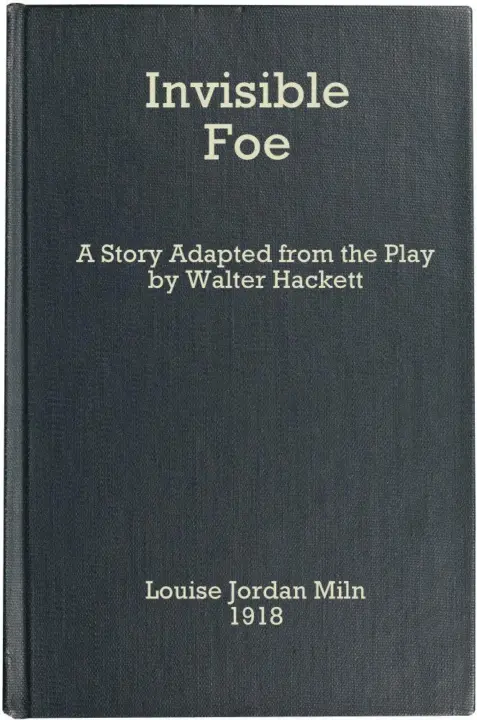
The Invisible Foe A Story Adapted from the Play by Walter Hackett
Louise Jordan Miln & Walter Hackett
THE CLASSIC COLLECTION · 1914
"It Pays to Advertise: A farcical fact in three acts" by Megrue and Hackett is a farce first presented in 1914. When an idle rich son announces his engagement, his disapproving father threatens disinheritance. The young man responds by launching a rival soap company to compete against his father's empire, armed only with borrowed money and a publicity agent's ambitious schemes. As advertising creates unexpected demand for a product that doesn't yet exist, debts mount and deceptions multiply, leading to surprising revelations about who's manipulating whom in this battle between father and son.
Introduction adapted from the source catalogue; source summaries may be automatically generated.
Free to read · English · 29,277 words · No account needed
MAKE TIME FOR A GOOD BOOK
On by default. Untick to stop anonymous reading totals. Each page counts after 10 seconds in view. How this works.
Anonymous counting is on unless you have switched it off.
RODNEY. Not a bit. (He starts signing a contract. MARTIN, who has risen, attempts to glance at it, and as he does so, RODNEY calmly turns it over and blots it. MARTIN turns away) There, that’s done! Now, father, what can I do for you?
MARTIN. Well, my boy—I just dropped in for a social call. The fact is, I’ve rather missed you.
RODNEY. I’ve missed you too, father.
MARTIN. (Abruptly) Thought I’d have a look in and find out how things were going. (Sits in arm-chair R.)
RODNEY. Fine—fine—everything’s breezing right along. Of course, I’m always glad to see you, but right now, father I’m pretty busy, so you’ll excuse me if—(He gets busy again with rubber-stamp)
MARTIN. (With a certain sarcasm) Well, if you can spare the time, I’d like a little business talk with you, Rodney.
RODNEY. Certainly, in just a minute. (Gets busy with papers. Pushes the
buzzer)
PEALE. (Entering) Oh, excuse me.
RODNEY. That’s all right, come right in. Father, you remember Mr. Peale—Peale, my father——
PEALE. Indeed yes, I recall very well——
MARTIN. (Gruffly cutting him off) How are you?
PEALE. (Sitting in chair left) A bit tired—just back from Buffalo where I’ve been conducting a big campaign.
MARTIN. Then it is to you I should address myself?
RODNEY. Either or both of us.
MARTIN. (Rises and goes to desk) Then both of you listen to me. You’ve got to cut out this nonsense you call advertising.
RODNEY. What nonsense?
PEALE. (Weakly) Yes, what?
MARTIN. This morning there was a parade of sandwich-men in front of my house for two hours. I had to have them arrested. I got to the office to find another bunch. It annoys me.
RODNEY. I’m sorry, father.
MARTIN. You’re trying to make a fool of me. I open a letter. It’s a circular for 13 Soap. I open my newspaper—you have a page ad. I look out of the window—there’s a billboard—I take a train, the damned porter apologizes because he’s all out of 13 Soap.
RODNEY. Well, of course, all that proves how wonderful our publicity is.
MARTIN. (Grimly) You’re a grand young bluff, my son.
RODNEY. Why, father, what do you mean?
Your reading position is saved on this browser. Take it to another device with a library code. Reading pages adapt to text, rather than matching a printed edition.
Louise Jordan Miln & Walter Hackett
BEHIND THE BOOK
This eBook is for the use of anyone anywhere in the United States and most other parts of the world at no cost and with almost no restrictions whatsoever. You may copy it, give it away or re-use it under the terms of the Project Gutenberg License included with this eBook or online at www.gutenberg.org. If you are not located in the United States, you will have to check the laws of the country where you are located before using this eBook. Read the source licence.
The original source file, including credits and licence, is retained by this library. Request an original-format copy at no charge. Please include the book title and Project Gutenberg identifier #75246.
KEEP YOUR CURIOSITY GOING
Maurice Baring
W. B. (William Butler) Yeats
Edward Martyn

John Brougham & Charlotte Brontë
Marguerite Merington
Leonid Andreyev