THE CLASSIC COLLECTION✦A dead man’s diaryCLASSIC FREE BOOKS
A dead man’s diary
Coulson Kernahan
THE CLASSIC COLLECTION · 1907
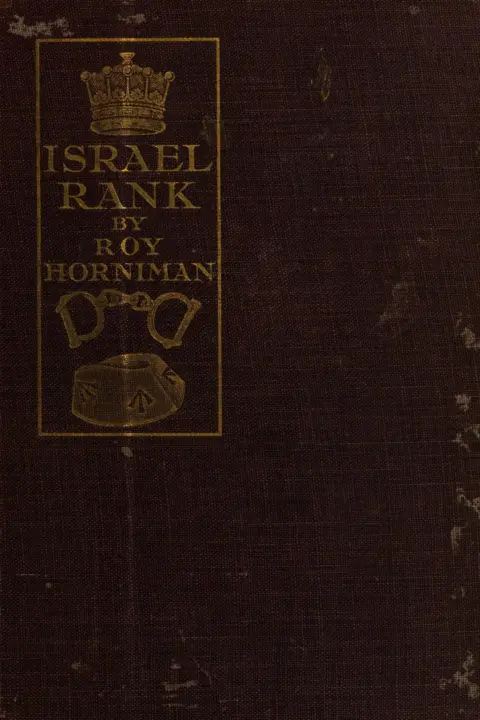
"Israel Rank: The Autobiography of a Criminal" by Roy Horniman is a novel written in the late 19th century. The narrative follows the life of Israel Rank, a character whose upbringing, social aspirations, and eventual criminality shape his journey through society, exploring themes of identity, ambition, and morality. The opening of the novel establishes a somber and reflective tone, introducing readers to Israel Rank’s childhood in a drab suburban setting. Through vivid descriptions, we gain insight into his family life and the dull, unremarkable environment that forms the backdrop to his early years. The narrative transitions into the events surrounding his birth, highlighting his Jewish heritage and the complexities of his family dynamics. As the protagonist reflects on his experiences and feelings, we sense a deep desire for significance and status, foreshadowing the moral deviations he may pursue in his quest for a more exalted life. The stage is set for a character who grapples with the tension between societal expectations and personal ambition, leaving readers intrigued about the choices that will ultimately define him.
Introduction adapted from the source catalogue; source summaries may be automatically generated.
Free to read · English · 114,553 words · No account needed
MAKE TIME FOR A GOOD BOOK
On by default. Untick to stop anonymous reading totals. Each page counts after 10 seconds in view. How this works.
Anonymous counting is on unless you have switched it off.
There was no time for her to evade me, but she shrank back into the
shadow as I approached her.
“Why are you watching me?” I said as gently as I could, putting out my
hands nervously.
She shrank back, thrusting me from her.
“Don’t touch me. Don’t touch me.”
Her voice was low, tense with a latent hysteria, which must have caused her an immense effort to control.
“Why are you watching me?” I asked again.
She looked at me silently, the terror in her eyes growing.
She began to give me a strangely uneasy feeling.
“Oh, it’s horrible, horrible,” she murmured, and then stole away, moving along the parapet like a ghost.
I was afraid of her, and of what she might do. She was evidently
losing her self-control fast. That she had guessed the truth was
obvious.
I went towards her rooms. They were dark. Perhaps she was still wandering on the battlements with her unquiet thoughts.
I found my wife sitting up when I returned. She had been with Lady
Gascoyne.
“Such an utter loneliness, Israel. It is terrible. She seems to have lost all interest in life. I have never seen such desolation.”
People have a way of being superlative when talking of those in grief. I, too, was very sorry for Lady Gascoyne, but though she had no children, she had everything else in the world to console her.
I comforted my wife and took her in my arms, wondering curiously whether this would be the last night we should spend together, which, indeed, it turned out to be.
The next day the inquest was resumed. None of the ladies of the castle were present. Mr. Gascoyne—or Lord Gascoyne, as he was now called—looked haggard and worn, and, as I thought, avoided my eye. His manner, however, was extraordinarily kindly.
The servants were recalled and closely re-examined. They were still
quite consistent.
The bottle of claret had been opened and decanted by Waters. He had placed it on the sideboard. No one else had touched it. The servants were all devoted to their master. There was not the slightest reason or motive for foul play on their part.
I noticed the detective sitting with the representatives of the county police, the chief constable himself being present. I smiled grimly as I surveyed all the materials for a very dramatic arrest.
The coroner then called me.
“After the ladies had withdrawn from the dinner-table on the evening in question you were left alone with Lord Gascoyne?”
“That is so.”
“He was called out of the room and a servant entered whilst he was
away?”
“Yes.”
Your reading position is saved on this browser. Take it to another device with a library code. Reading pages adapt to text, rather than matching a printed edition.
BEHIND THE BOOK
This eBook is for the use of anyone anywhere in the United States and most other parts of the world at no cost and with almost no restrictions whatsoever. You may copy it, give it away or re-use it under the terms of the Project Gutenberg License included with this eBook or online at www.gutenberg.org. If you are not located in the United States, you will have to check the laws of the country where you are located before using this eBook. Read the source licence.
The original source file, including credits and licence, is retained by this library. Request an original-format copy at no charge. Please include the book title and Project Gutenberg identifier #73104.
KEEP YOUR CURIOSITY GOING
Coulson Kernahan

Maurice Baring
Frances Wright
Cécile Tormay

Frederic Jesup Stimson

W. H. P. (William Henry Pope) Jarvis