THE CLASSIC COLLECTION✦A dead man’s diaryCLASSIC FREE BOOKS
A dead man’s diary
Coulson Kernahan
THE CLASSIC COLLECTION · 1907
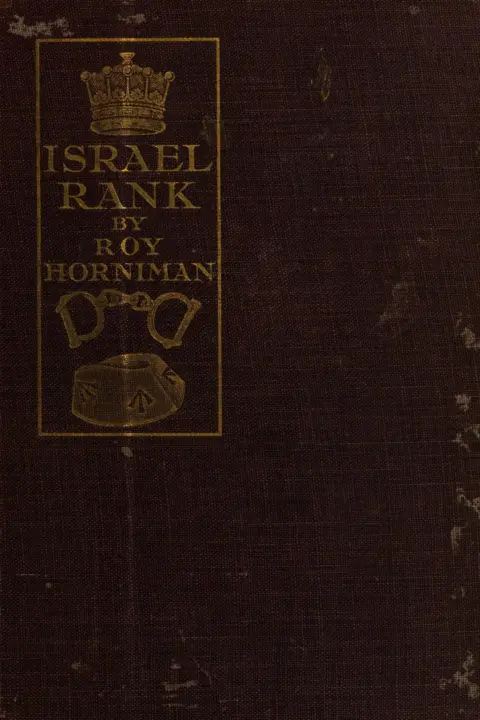
"Israel Rank: The Autobiography of a Criminal" by Roy Horniman is a novel written in the late 19th century. The narrative follows the life of Israel Rank, a character whose upbringing, social aspirations, and eventual criminality shape his journey through society, exploring themes of identity, ambition, and morality. The opening of the novel establishes a somber and reflective tone, introducing readers to Israel Rank’s childhood in a drab suburban setting. Through vivid descriptions, we gain insight into his family life and the dull, unremarkable environment that forms the backdrop to his early years. The narrative transitions into the events surrounding his birth, highlighting his Jewish heritage and the complexities of his family dynamics. As the protagonist reflects on his experiences and feelings, we sense a deep desire for significance and status, foreshadowing the moral deviations he may pursue in his quest for a more exalted life. The stage is set for a character who grapples with the tension between societal expectations and personal ambition, leaving readers intrigued about the choices that will ultimately define him.
Introduction adapted from the source catalogue; source summaries may be automatically generated.
Free to read · English · 114,553 words · No account needed
MAKE TIME FOR A GOOD BOOK
On by default. Untick to stop anonymous reading totals. Each page counts after 10 seconds in view. How this works.
Anonymous counting is on unless you have switched it off.
It would have been amusing, had the subject not possessed such grim significance for me, to notice how very deprecatingly the servants offered us wine.
The castle cellar itself had, of course, been placed under lock and key, and the detective seemed to have disappeared from the premises.
“Israel,” said Mr. Gascoyne seriously, “if poison was found in that bottle, someone must have put it there.”
“That seems very obvious.”
“I could have understood it had there only been a very little arsenic in the bottle, but that it should have contained the quantity it did is amazing.”
Why Mr. Gascoyne should have understood it better had there not been so much arsenic in the bottle was not very apparent, but he was in the sort of mood in which people are apt to talk nonsense.
“Have you the least suspicion as to who might have put the poison in
the bottle, Israel?”
He looked at me furtively.
“They might say that it was I, sir.”
I fancy that he gave almost a sigh of relief. He would never have dared to make such a suggestion himself, and I could see that he was thankful to me for giving him an opening.
“To tell you the truth, Israel, it has struck me that in the absence of anyone else being open to suspicion they might hint at such an absurdity.”
I laughed, a highly successful laugh.
“You see, sir, in my case there is motive.”
“I am almost afraid, Israel, that people may say unpleasant things. Reading the bare evidence, they may be tempted to come to ridiculous conclusions.”
I saw that it was time to affect a serious view of the matter. I kept a close watch on my tone of voice, however, and was most careful as to the light and shade of any expressions I used.
“You don’t mean to say, sir, that you seriously think anybody would connect me with the crime?”
“Seriously, no; but I think irresponsible gossip might make things
very unpleasant.”
“It certainly would be unpleasant.”
“You are my heir, Israel. Failing me, the title passes on to the
branch of Lord George Gascoyne, whose heir you are through your
mother.”
“Exactly, sir; as I said, in my case there is motive.” I looked a little grave, and continued slowly:
“Someone must have put the poison in the bottle.” I was deliberately allowing my gravity to increase in order to emphasise my growing apprehension.
“I notice the detective has left the house,” I said.
“Detective!” echoed Mr. Gascoyne in amazement.
“Surely, sir, you knew that there was a detective in the house?”
“My dear Israel, I knew nothing of the kind.”
Your reading position is saved on this browser. Take it to another device with a library code. Reading pages adapt to text, rather than matching a printed edition.
BEHIND THE BOOK
This eBook is for the use of anyone anywhere in the United States and most other parts of the world at no cost and with almost no restrictions whatsoever. You may copy it, give it away or re-use it under the terms of the Project Gutenberg License included with this eBook or online at www.gutenberg.org. If you are not located in the United States, you will have to check the laws of the country where you are located before using this eBook. Read the source licence.
The original source file, including credits and licence, is retained by this library. Request an original-format copy at no charge. Please include the book title and Project Gutenberg identifier #73104.
KEEP YOUR CURIOSITY GOING
Coulson Kernahan

Maurice Baring
Frances Wright
Cécile Tormay

Frederic Jesup Stimson

W. H. P. (William Henry Pope) Jarvis