THE CLASSIC COLLECTION✦A dead man’s diaryCLASSIC FREE BOOKS
A dead man’s diary
Coulson Kernahan
THE CLASSIC COLLECTION · 1907
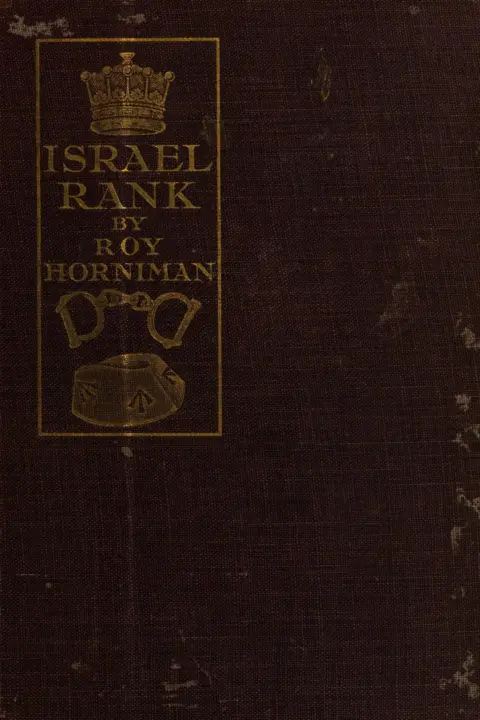
"Israel Rank: The Autobiography of a Criminal" by Roy Horniman is a novel written in the late 19th century. The narrative follows the life of Israel Rank, a character whose upbringing, social aspirations, and eventual criminality shape his journey through society, exploring themes of identity, ambition, and morality. The opening of the novel establishes a somber and reflective tone, introducing readers to Israel Rank’s childhood in a drab suburban setting. Through vivid descriptions, we gain insight into his family life and the dull, unremarkable environment that forms the backdrop to his early years. The narrative transitions into the events surrounding his birth, highlighting his Jewish heritage and the complexities of his family dynamics. As the protagonist reflects on his experiences and feelings, we sense a deep desire for significance and status, foreshadowing the moral deviations he may pursue in his quest for a more exalted life. The stage is set for a character who grapples with the tension between societal expectations and personal ambition, leaving readers intrigued about the choices that will ultimately define him.
Introduction adapted from the source catalogue; source summaries may be automatically generated.
Free to read · English · 114,553 words · No account needed
MAKE TIME FOR A GOOD BOOK
On by default. Untick to stop anonymous reading totals. Each page counts after 10 seconds in view. How this works.
Anonymous counting is on unless you have switched it off.
“Were the letters read in court?”
“No. They were considered unnecessary, and no one thought they bore on
the issue.”
“Do you think they did?”
“Decidedly I do,” answered Mr. Gascoyne. “Depend upon it, there was foul play. I talked to the doctor who would not admit the horse theory, after the case was over, and he was quite positive the injuries could not have been inflicted by a horse’s hoof.”
“Who was the girl?” I asked.
“Well, I do not think it is quite right to disclose her name. I had a talk with her father, who was very distant and said the matter would be best settled by saying nothing more about it. I don’t know what he meant.”
“Was the girl’s name by any chance Janet Gray?”
Mr. Gascoyne looked at me in surprise.
“That was her name, but how did you know?”
“Harry Gascoyne spoke to me once or twice about her, and I wondered at the time from something he said whether he had not made rather a mess of things.”
“Yes, I am afraid we men are very selfish, that is, until we have wives and daughters of our own. The possession of sisters does not seem to instil the same sense of responsibility to woman-kind.”
“Does Miss Gascoyne know of this?”
“No; unless the matter develops further I do not think it necessary to
inform her.”
“What did the police think of the affair?”
“I fancy they are quite prepared to accept the horse theory.”
“Then the matter is settled?”
“Except for the trouble of the poor girl. It appears that he actually promised to marry her.”
“He was generous-hearted enough for anything,” I answered, with
calculated impulsiveness.
“Her father asked me to give my word that the matter would not go any further, so you will remember that you hold a secret that affects three human beings at least.”
“I shall of course be as silent as the grave.”
He began to open his correspondence, and I rose to leave the room.
“Oh, by the way, my wife and my niece have struck up quite a friendship. My wife remains at the Grange, and I shall go down there again for a few days next week.”
I looked pleased.
“I believe,” he added, smiling, “you have been indulging in some diplomacy at our expense. Don’t you think my niece is a beautiful woman?”
“I think everyone would admit that.”
“I expect she will make a very brilliant match.”
Your reading position is saved on this browser. Take it to another device with a library code. Reading pages adapt to text, rather than matching a printed edition.
BEHIND THE BOOK
This eBook is for the use of anyone anywhere in the United States and most other parts of the world at no cost and with almost no restrictions whatsoever. You may copy it, give it away or re-use it under the terms of the Project Gutenberg License included with this eBook or online at www.gutenberg.org. If you are not located in the United States, you will have to check the laws of the country where you are located before using this eBook. Read the source licence.
The original source file, including credits and licence, is retained by this library. Request an original-format copy at no charge. Please include the book title and Project Gutenberg identifier #73104.
KEEP YOUR CURIOSITY GOING
Coulson Kernahan

Maurice Baring
Frances Wright
Cécile Tormay

Frederic Jesup Stimson

W. H. P. (William Henry Pope) Jarvis