THE CLASSIC COLLECTION✦A dead man’s diaryCLASSIC FREE BOOKS
A dead man’s diary
Coulson Kernahan
THE CLASSIC COLLECTION · 1907
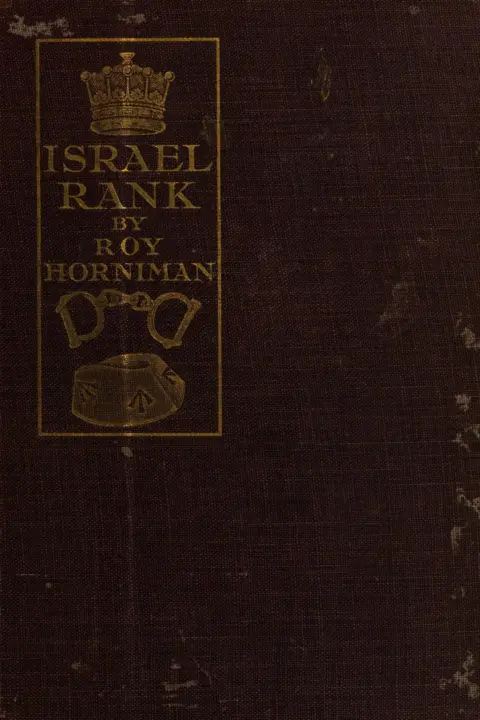
"Israel Rank: The Autobiography of a Criminal" by Roy Horniman is a novel written in the late 19th century. The narrative follows the life of Israel Rank, a character whose upbringing, social aspirations, and eventual criminality shape his journey through society, exploring themes of identity, ambition, and morality. The opening of the novel establishes a somber and reflective tone, introducing readers to Israel Rank’s childhood in a drab suburban setting. Through vivid descriptions, we gain insight into his family life and the dull, unremarkable environment that forms the backdrop to his early years. The narrative transitions into the events surrounding his birth, highlighting his Jewish heritage and the complexities of his family dynamics. As the protagonist reflects on his experiences and feelings, we sense a deep desire for significance and status, foreshadowing the moral deviations he may pursue in his quest for a more exalted life. The stage is set for a character who grapples with the tension between societal expectations and personal ambition, leaving readers intrigued about the choices that will ultimately define him.
Introduction adapted from the source catalogue; source summaries may be automatically generated.
Free to read · English · 114,553 words · No account needed
MAKE TIME FOR A GOOD BOOK
On by default. Untick to stop anonymous reading totals. Each page counts after 10 seconds in view. How this works.
Anonymous counting is on unless you have switched it off.
When I left her I went at once to the station, and, as the train was late, had some time to wait.
There were one or two yokels in the tiny waiting-room, and the station-master addressed one of them as he passed through from his little ivy-covered cottage to the ticket-office.
“Sad thing, this, about Mr. Gascoyne, Edward.”
The young man in question answered slowly:
“Yes. They say as ’is ’orse kicked him to death.”
“That’s strange—very strange. Was the horse bad-tempered?”
“Not that I know of, and I’ve shod the mare often enough.”
“They say as Miss Gascoyne is powerful cut up.”
“That’s very likely; yer see, she doted on him.”
I scrutinised young Gray, the last speaker, narrowly. His manner betrayed no indication that he was in any way aware of his sister’s condition.
As Mr. Gascoyne descended from the train he pressed my hand warmly.
“This is very terrible,” I said—“very terrible.”
“Tell me, how did it happen?”
As we drove towards the Grange I detailed the event as well as I
could.
“You think the horse kicked him to death—a horse that was fond of him? That is somewhat strange.”
“I don’t say it is so, sir. That is what has been surmised.”
“When do they hold the inquest?”
“To-morrow.”
“My wife is shocked beyond measure. If my niece had expressed the least wish for her to do so, she would have come too.”
I did not answer. I could not say how Miss Gascoyne would welcome the idea of her aunt assuming the role of a near relation.
“I am very touched at her sending for me—very touched indeed. Is the
body at the Grange?”
“No; it is at a farmhouse some miles off. It will be brought home
after the inquest.”
“Quite so.”
We reached the Grange.
“If you don’t mind, sir, I will get back to town. I would sooner. I don’t think I can be of any further use.”
He did not press me to remain, and I went back to town carrying messages for his managing clerk. I did not witness the meeting between Miss Gascoyne and himself, but it must have been quite satisfactory, for he stayed away over a week, and I learnt that Mrs. Gascoyne had joined them.
I fancied that Miss Gascoyne would be rather surprised at the dignity and well-bred restraint of the tradesman’s daughter, and would find it a little difficult to account for her father’s prejudice; in fact, his objection could not fail to strike her as having something in it of unreasoning snobbery.
Your reading position is saved on this browser. Take it to another device with a library code. Reading pages adapt to text, rather than matching a printed edition.
BEHIND THE BOOK
This eBook is for the use of anyone anywhere in the United States and most other parts of the world at no cost and with almost no restrictions whatsoever. You may copy it, give it away or re-use it under the terms of the Project Gutenberg License included with this eBook or online at www.gutenberg.org. If you are not located in the United States, you will have to check the laws of the country where you are located before using this eBook. Read the source licence.
The original source file, including credits and licence, is retained by this library. Request an original-format copy at no charge. Please include the book title and Project Gutenberg identifier #73104.
KEEP YOUR CURIOSITY GOING
Coulson Kernahan

Maurice Baring
Frances Wright
Cécile Tormay

Frederic Jesup Stimson

W. H. P. (William Henry Pope) Jarvis