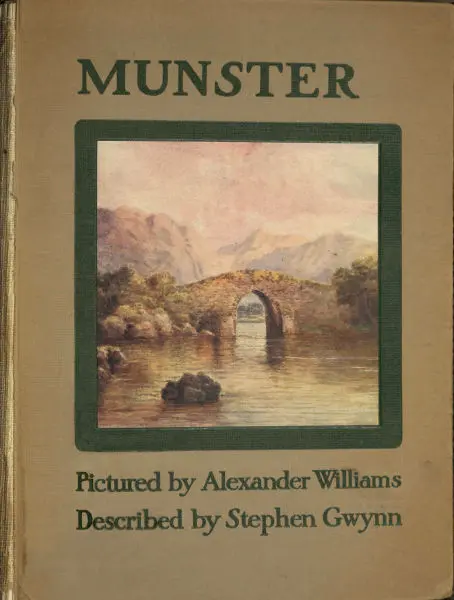
Munster
Stephen Lucius Gwynn
THE CLASSIC COLLECTION · 1919
"Irish Books and Irish People" by Stephen Lucius Gwynn is a collection of essays written in the early 20th century. The work discusses various aspects of Irish literature and culture, particularly focusing on the unique characteristics of Irish life, humor, and education during the 19th century. It provides a critical examination of notable Irish writers and movements, while reflecting on the broader implications of these contributions on national identity. The opening of the book highlights the author's reflections on the state of Irish literature and the cultural atmosphere of his time. Gwynn notes the significant changes in Ireland's literary landscape, influenced by movements such as the Gaelic revival and prominent figures like Yeats and Synge. He contrasts the aspirations of Irish writers with the realities of societal expectations, stressing the tension between artistic freedom and political sentiment. Throughout these opening thoughts, Gwynn sets the stage for a deeper exploration of Irish literature, Education, and character, offering insight into the evolving identity of the Irish people amidst their tumultuous historical context.
Introduction adapted from the source catalogue; source summaries may be automatically generated.
Free to read · English · 34,174 words · No account needed
MAKE TIME FOR A GOOD BOOK
On by default. Untick to stop anonymous reading totals. Each page counts after 10 seconds in view. How this works.
Anonymous counting is on unless you have switched it off.
I take first what is most difficult--the very heart of antagonism. Everyone who desires to understand Ireland to-day should read Patrick Pearse's posthumous book, called boldly The Story of a Success.[1] It is the spiritual history of Pearse's career as a schoolmaster, edited and completed by his pupil, Desmond Ryan; and it is a book by which no one can be justly offended--a book instinct with nobility, chivalry and high courtesy, free from all touch of bitterness; a book, too, shot through and slashed with that tragic irony which the Greeks knew to be the finest thrill in literature--the word spoken, to which the foreknown event gives an echo of double meaning. Pearse was concerned with Ireland's yesterday; he desired to bring the present and the future into organic rotation with the past. But his yesterday was not Miss Somerville's nor mine. The son of an English mechanic and a Galway woman, he was brought up in Connemara after the landlord power had ceased to exist. Ireland's past for him and Irish tradition were seen through the medium of an imagination in touch only with the peasant life, but inspired by books and literature, written and spoken. His yesterday was of no definite past, for he had been born in a revolution when the immediate past was obliterated. In his vision a thousand years were no more than the watch of some spellbound chivalry, waiting for the voice that should say, "It is the time." Cuchulain and Robert Emmet were his inspirations, but the champion of the legendary Red Branch cycle and the young revolutionary of Napoleon's days were near to him one as the other, in equally accessible communion. Going back easily to the heroic legends, on which, though blurred in their outline, his boyhood had been fostered by tellers of long-transmitted tales at a Connemara hearthside, he found the essential beauty and significance where more learned though less cultured readers have been bewildered by what seemed to them wild extravagances of barbarism. What he gathered from them did not lie inert, but quickened in him and in others, for he was the revolutionary as schoolmaster--the most drastic revolutionary of all. In the school review which was the first vehicle for these writings of his, he hoped to found "the rallying point for the thought and aspirations of all those who would bring back again in Ireland that Heroic Age which reserved its highest honour for the hero who had the most childlike heart, for the king who had the largest pity, and for the poet who visioned the truest image of beauty." All his theory of education was based on the old Irish institution of fosterage, which was no mere physical tie of the breast; the child sent to be fostered was sent to be bred and trained, and it was a tie stronger than that of its blood or of the breast. Irish Memories shows incidentally how great a part this fosterage played in the Ross of yesterday--that family with its multitude of children was bound to the countryside by all the "Nursies." But the Martin household, and all similar households were, in a less literal sense, fostered by the peasantry at large. The truest part of education should be to know your own country (a principle much neglected in Ireland), and which of us all, who had the good fortune to be brought up in touch with Irish peasant life, does not realise our debt? We received a devotion, an affection, for which no adequate return could be made--it is the nature of fosterage that the fosterer should give more than can ever be requited; but we gained also our real knowledge, in so far as we ever had it, of the countryside, the traditional wisdom, the inherited way of life. There was more to be got if we had the wit to assimilate it. Almost all of modern Irish literature that has lasting value is evoked from elements floating in peasant memory, in the peasant mind, and in the coloured peasant speech of an Ireland which keeps unbroken descent from a long line of yesterdays. Mr. Yeats is only the chief of those who draw from this source. Miss Somerville herself and her cousin must have known well that the real worth of their work lies in their instinct for the poetry which, more specially in Gaelic-speaking regions, sits in rags by roadside and chimney corner. Irish poetry is not only the tragic voice of the keene; Gaelic had its comic muse as well, a robust virago, of the breed which produced Aristophanes and Rabelais--and Slipper with his gift for epic narrative is a camp-follower of that regiment.
Your reading position is saved on this browser. Take it to another device with a library code. Reading pages adapt to text, rather than matching a printed edition.
Stephen Lucius Gwynn
Stephen Lucius Gwynn
Stephen Lucius Gwynn
Stephen Lucius Gwynn
BEHIND THE BOOK
This eBook is for the use of anyone anywhere in the United States and most other parts of the world at no cost and with almost no restrictions whatsoever. You may copy it, give it away or re-use it under the terms of the Project Gutenberg License included with this eBook or online at www.gutenberg.org. If you are not located in the United States, you will have to check the laws of the country where you are located before using this eBook. Read the source licence.
The original source file, including credits and licence, is retained by this library. Request an original-format copy at no charge. Please include the book title and Project Gutenberg identifier #22264.
KEEP YOUR CURIOSITY GOING

David Patterson (Spirit) Hatch

David Patterson (Spirit) Hatch

David Patterson (Spirit) Hatch
Cécile Tormay

Moritz Busch
John L. Ransom