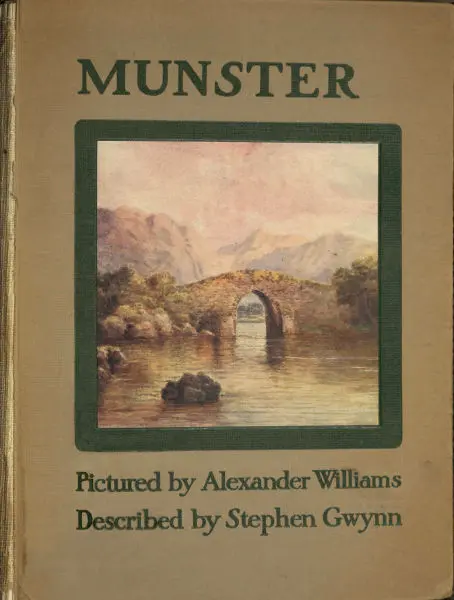
Munster
Stephen Lucius Gwynn
THE CLASSIC COLLECTION · 1919
"Irish Books and Irish People" by Stephen Lucius Gwynn is a collection of essays written in the early 20th century. The work discusses various aspects of Irish literature and culture, particularly focusing on the unique characteristics of Irish life, humor, and education during the 19th century. It provides a critical examination of notable Irish writers and movements, while reflecting on the broader implications of these contributions on national identity. The opening of the book highlights the author's reflections on the state of Irish literature and the cultural atmosphere of his time. Gwynn notes the significant changes in Ireland's literary landscape, influenced by movements such as the Gaelic revival and prominent figures like Yeats and Synge. He contrasts the aspirations of Irish writers with the realities of societal expectations, stressing the tension between artistic freedom and political sentiment. Throughout these opening thoughts, Gwynn sets the stage for a deeper exploration of Irish literature, Education, and character, offering insight into the evolving identity of the Irish people amidst their tumultuous historical context.
Introduction adapted from the source catalogue; source summaries may be automatically generated.
Free to read · English · 34,174 words · No account needed
MAKE TIME FOR A GOOD BOOK
On by default. Untick to stop anonymous reading totals. Each page counts after 10 seconds in view. How this works.
Anonymous counting is on unless you have switched it off.
Whatever the outcome, I take back nothing of what is written in these papers concerning the Gaelic revival. In a country governed against the will of its people, forces that, under normal and healthy conditions, would be purely beneficent, may easily grow explosive and disruptive. Yet I have not changed my mind on a critical question which led me to sever my connection with the work of the Gaelic League. When that body decided to rely on compulsion rather than persuasion, it took the wrong road, if its object was to endear the Irish language to all Ireland, and to induce all Irishmen to cherish it as part of the common national heritage. As a result Ulstermen have a perfect right to say that if they accepted Home Rule, one of the first steps of an Irish government formed under the present auspices would be to demand a knowledge of Gaelic as the necessary qualification for holding any public office.
I do not believe that this tribal idealism which is now so potent will endure. It is out of harmony with the world's development--a world which in order to preserve the very principle of small nationalities, is growing more and more international. America is not only a nation, but is the type of the modern nation--bound together less by what it inherits from the past, than by what it hopes from the future.
The other force which has been operating through these years is, in a sense, obliged to give the lie to the pretensions of the Gaelic League. Yeats and Synge have showed how completely it is possible to be Irish while using the English language. They have accepted the fact that Ireland to-day thinks in English, but they have endeavoured to give to Ireland a distinctively Irish thought, coloured by the whole racial tradition and temperament. With them has been allied a personality not less Irish, yet less obviously Irish--"A.E.," George Russell. Between them, these writers and thinkers have profoundly influenced the mind of the generation younger than themselves. It is not possible to deny that Ireland's literary output during those last twenty years is far more important and serious than that of the whole preceding century. The only part of it exempt from these influences is the work of Edith Somerville and Martin Ross; and even that is based on a closer study of distinctively Irish speech than had ever been attempted in earlier days. The propagandist work of Pearse and Arthur Griffiths--equal in merit to that of their forerunners, Davis and Mitchel--was Irish only in substance and spirit, not in form or accent--a thing the less surprising, since both men were only half Irish by parentage. But the whole group of writers, of whom it may be said that their writings are almost as unmistakably Irish as the work of Burns is Scotch, have followed Mr. Yeats and Synge in this, that in writing they assume an Irish public, not an English one; they make no explanations, they speak as to those who share their own inheritance. In this group has been fostered a spirit of the freedom which belongs properly to art. Thus the school, for it may justly be called a school, has created its own tradition, and it has been a tradition of freedom, not asserted but exercised: a freedom, not as against England, but as against all the world. Everywhere, but especially in countries undergoing revolutionary change, there is a tyranny of the crowd. When the Gaelic League decided to make the learning of Irish compulsory, it attorned to this tyranny. On the other hand, Mr. Yeats, at a moment when the Abbey Theatre seemed about to become popular, was threatened by a fiat of this mob-dictatorship; he was told that his theatre must become unpopular unless he would throw overboard most of Synge's work. By the stand which he then made he did a greater service to freedom of the mind in Ireland than has yet been at all recognised; he helped to make his country fearless and strong. Thanks mainly to him and to those who worked with him, Ireland's thought is freer and more outspoken; there is more thought in Ireland than there used to be. This does not make the country easier to govern, and just now, Ireland, if given the opportunity, would have a hard task to govern itself. But Ireland would not be the only country in the world in that predicament. The schoolmaster has been abroad, and where you have education without liberty there is bound to be trouble. The only cure is, not to suppress education, but to give the responsibility of freedom.
Your reading position is saved on this browser. Take it to another device with a library code. Reading pages adapt to text, rather than matching a printed edition.
Stephen Lucius Gwynn
Stephen Lucius Gwynn
Stephen Lucius Gwynn
Stephen Lucius Gwynn
BEHIND THE BOOK
This eBook is for the use of anyone anywhere in the United States and most other parts of the world at no cost and with almost no restrictions whatsoever. You may copy it, give it away or re-use it under the terms of the Project Gutenberg License included with this eBook or online at www.gutenberg.org. If you are not located in the United States, you will have to check the laws of the country where you are located before using this eBook. Read the source licence.
The original source file, including credits and licence, is retained by this library. Request an original-format copy at no charge. Please include the book title and Project Gutenberg identifier #22264.
KEEP YOUR CURIOSITY GOING

David Patterson (Spirit) Hatch

David Patterson (Spirit) Hatch

David Patterson (Spirit) Hatch
Cécile Tormay

Moritz Busch
John L. Ransom