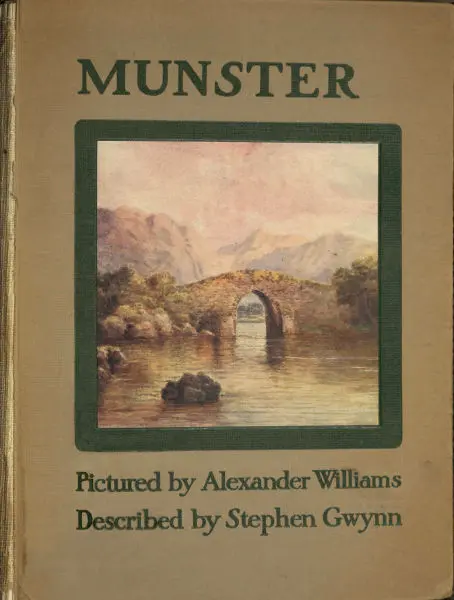
Munster
Stephen Lucius Gwynn
THE CLASSIC COLLECTION · 1919
"Irish Books and Irish People" by Stephen Lucius Gwynn is a collection of essays written in the early 20th century. The work discusses various aspects of Irish literature and culture, particularly focusing on the unique characteristics of Irish life, humor, and education during the 19th century. It provides a critical examination of notable Irish writers and movements, while reflecting on the broader implications of these contributions on national identity. The opening of the book highlights the author's reflections on the state of Irish literature and the cultural atmosphere of his time. Gwynn notes the significant changes in Ireland's literary landscape, influenced by movements such as the Gaelic revival and prominent figures like Yeats and Synge. He contrasts the aspirations of Irish writers with the realities of societal expectations, stressing the tension between artistic freedom and political sentiment. Throughout these opening thoughts, Gwynn sets the stage for a deeper exploration of Irish literature, Education, and character, offering insight into the evolving identity of the Irish people amidst their tumultuous historical context.
Introduction adapted from the source catalogue; source summaries may be automatically generated.
Free to read · English · 34,174 words · No account needed
MAKE TIME FOR A GOOD BOOK
On by default. Untick to stop anonymous reading totals. Each page counts after 10 seconds in view. How this works.
Anonymous counting is on unless you have switched it off.
There are brilliant exceptions in the century that lies between Sheridan and Mr. Bernard Shaw, between Maria Edgeworth and Miss Barlow. But serious art or serious thought in Ireland has always revealed itself to the English sooner or later as a species of sedition, and the Irish have with culpable folly allowed themselves to accept for characteristic excellences what were really the damning defects of their work--an easy fluency of wit, a careless spontaneity of laughter. They have taken Moore for a great poet, and Handy Andy for a humorist to be proud of. Yet an Irishman who wishes to speak dispassionately must find humour of a very different kind from that of Handy Andy or Harry Lorrequer either, to commend without reserve, as a thing that may be put forward to rank with what is best in other literatures.
Taking Sheridan and Miss Edgeworth as marking the point of departure, it becomes obvious that one is an end, the other at a beginning. Sheridan belongs body and soul to the eighteenth century; Miss Edgeworth, though her name sounds oddly in that context, is part and parcel of the romantic movement. The "postscript which ought to have been a preface" to Waverley declared, though after Scott's magnificent fashion, a real indebtedness. Sheridan's humour, essentially metropolitan, had found no use for local colour; Miss Edgeworth before Scott proved the artistic value that could be extracted from the characteristics of a special breed of people under special circumstances in a special place. Mr. Yeats, who, like all poets, is a most suggestive and a most misleading critic, has declared that modern Irish literature begins with Carleton. That is only true if we are determined to look in Irish literature for qualities that can be called Celtic--if we insist that the outlook on the world shall be the Catholic's or the peasant's. Miss Edgeworth had not a trace of the Celt--as I conceive that rather indefinite entity--about her; but she was as good an Irish woman as ever walked, and there are hundreds of Irish people of her class and creed looking at Irish life with kindly humorous Irish eyes, seeing pretty much what she saw, enjoying it as she enjoyed it, but with neither her power nor her will to set it down. Castle Rackrent is a masterpiece; and had Miss Edgeworth been constant to the dramatic method which she then struck out for herself, with all the fine reticences that it involved, her name might have stood high in literature. Unhappily, her too exemplary father repressed the artist in her, fostered the pedagogue, and in her later books she commits herself to an attitude in which she can moralise explicitly upon the ethical and social bearings of every word and action. The fine humour in Ormond is obscured by its setting; in Castle Rackrent the humour shines. Sir Condy and his lady we see none the less distinctly for seeing them through the eyes of old Thady, the retainer who narrates the Rackrent history; and in the process we have a vision of old Thady himself. Now and then the novelist reminds us of her presence by some extravagantly ironic touch, as when Thady describes Sir Condy's anger with the Government "about a place that was promised him and never given, after his supporting them against his conscience very honourably and being greatly abused for, he having the name of a great patriot in the country." Thady would hardly have been so ingenuous as that. But for the most part the humour is truly inherent in the situation, and you might look far for a better passage than the description of Sir Condy's parting with his lady. But it is better to illustrate from a scene perhaps less genuinely humorous, but more professedly so--Sir Condy's wake. Miss Edgeworth does not dwell on the broad farce of the entertainment; she does not make Thady eloquent over the whisky that was drunk and the fighting that began and so forth, as Lever or Carleton would certainly have been inclined to do. She fixes on the central comedy of the situation, Sir Condy's innocent vanity and its pitiable disappointment--is it necessary to recall that he had arranged for the wake himself, because he always wanted to see his own funeral? Poor Sir Condy!--even Thady, who was in the secret, had forgotten all about him, when he was startled by the sound of his master's voice from under the greatcoats thrown all atop.
Your reading position is saved on this browser. Take it to another device with a library code. Reading pages adapt to text, rather than matching a printed edition.
Stephen Lucius Gwynn
Stephen Lucius Gwynn
Stephen Lucius Gwynn
Stephen Lucius Gwynn
BEHIND THE BOOK
This eBook is for the use of anyone anywhere in the United States and most other parts of the world at no cost and with almost no restrictions whatsoever. You may copy it, give it away or re-use it under the terms of the Project Gutenberg License included with this eBook or online at www.gutenberg.org. If you are not located in the United States, you will have to check the laws of the country where you are located before using this eBook. Read the source licence.
The original source file, including credits and licence, is retained by this library. Request an original-format copy at no charge. Please include the book title and Project Gutenberg identifier #22264.
KEEP YOUR CURIOSITY GOING

David Patterson (Spirit) Hatch

David Patterson (Spirit) Hatch

David Patterson (Spirit) Hatch
Cécile Tormay

Moritz Busch
John L. Ransom