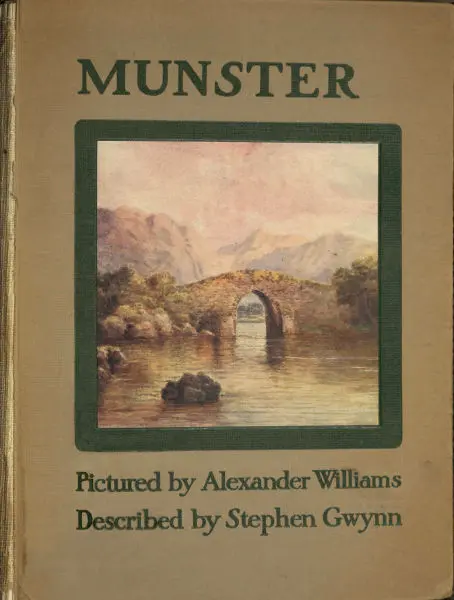
Munster
Stephen Lucius Gwynn
THE CLASSIC COLLECTION · 1919
"Irish Books and Irish People" by Stephen Lucius Gwynn is a collection of essays written in the early 20th century. The work discusses various aspects of Irish literature and culture, particularly focusing on the unique characteristics of Irish life, humor, and education during the 19th century. It provides a critical examination of notable Irish writers and movements, while reflecting on the broader implications of these contributions on national identity. The opening of the book highlights the author's reflections on the state of Irish literature and the cultural atmosphere of his time. Gwynn notes the significant changes in Ireland's literary landscape, influenced by movements such as the Gaelic revival and prominent figures like Yeats and Synge. He contrasts the aspirations of Irish writers with the realities of societal expectations, stressing the tension between artistic freedom and political sentiment. Throughout these opening thoughts, Gwynn sets the stage for a deeper exploration of Irish literature, Education, and character, offering insight into the evolving identity of the Irish people amidst their tumultuous historical context.
Introduction adapted from the source catalogue; source summaries may be automatically generated.
Free to read · English · 34,174 words · No account needed
MAKE TIME FOR A GOOD BOOK
On by default. Untick to stop anonymous reading totals. Each page counts after 10 seconds in view. How this works.
Anonymous counting is on unless you have switched it off.
Carleton does not stand by himself; he is the head and representative of a whole class of Irish novelists, among whom John Banim is the best known name. All of them were peasants who aimed at depicting scenes of peasant life from their own experience. What one may call the melodramatic Irish story, in which Lever was so brilliantly successful, has its first famous example in The Collegians of Gerald Griffin. The novel has no concern with college life, and is far better described by its stage-title, The Colleen Bawn. Here at least is a man with a story to tell and no object but to tell it. Griffin belonged to the lay order of Christian Brothers: his book deals principally with a society no more familiar to him than was the household of Mr. Rochester to Charlotte Bronte; and his method recalls the Brontes by its strenuous imagination and its vehement painting of passion. The tale was suggested by a murder which excited all Ireland. A young southern squire carried off a girl with some money, and procured her death by drowning. He was arrested at his mother's house and a terrible scene took place, terribly rendered in the book. Griffin, of course, changes the motive; the girl is carried off not for money but for love, and she is sacrificed to make way for a stronger passion. Eily O'Connor, the victim, is a pretty and pathetic figure; the hero-villain Hardress Cregan, and the mother who indirectly causes the crime, are effective though melodramatic; but the actual murderer, Danny the Lord, Hardress Cregan's familiar, is worthy of Scott or Hugo.
In his sketches of society, Hyland Creagh, the duellist, old Cregan, and the rest, Griffin is describing a state of affairs previous to his own experience, the Ireland of Sir Jonah Barrington's memoirs; he is not, as were Carleton and Miss Edgeworth, copying minutely from personal observation. Herein he resembles Lever who, when all is said and done, remains the chief, as he is the most Irish, of Irish novelists. It is true that Lever had two distinct manners: and in his later books he deals chiefly with contemporary society, drawing largely on his experiences of diplomatic life. Like most novelists he preferred his later work; but the books by which he is best known, Harry Lorrequer and the rest, are his earliest productions; and though his maturer skill was employed on different subjects, he formed his imagination in studies of the Napoleonic Wars and of a duelling, drinking, bailiff-beating Ireland. His point of view never altered, and the peculiar attraction of his writings is always the same. Lever's books have the quality rather of speech than of writing; wherever you open the pages there is always a witty, well-informed Irishman discoursing to you, who tells his story admirably, when he has one to tell, and, failing that, never fails to be pleasant. Irish talk is apt to be discursive; to rely upon a general charm diffused through the whole, rather than upon any quotable brilliancy; its very essence is spontaneity, high spirits, fertility of resource. That is a fair description of Lever. He is never at a loss. If his story hangs, off he goes at score with a perfectly irrelevant anecdote, but told with such enjoyment of the joke that you cannot resent the digression. Indeed the plots are left pretty much to take care of themselves; he positively preferred to write his stories in monthly instalments for a magazine; he is not a conscientious artist, but he lays himself out to amuse you, and he does it. If he advertises a character as a wit, he does not labour phrases to describe his brilliancy; he produces the witticisms. He has been accused of exaggeration. As regards the incidents, one can only say that the memoirs of Irish society at the beginning of this century furnish at least fair warranty for any of his inventions. In character-drawing he certainly overcharged the traits: but he did so with intention, and by consistently heightening the tones throughout obtained an artistic impression, which had life behind it, however ingeniously travestied. His stories have no unity of action, but through a great diversity of characters and incidents they maintain their unity of treatment. That is not the highest ideal of the novel, but it is an intelligible one, not lacking famous examples; and Lever perfectly understood it.
Your reading position is saved on this browser. Take it to another device with a library code. Reading pages adapt to text, rather than matching a printed edition.
Stephen Lucius Gwynn
Stephen Lucius Gwynn
Stephen Lucius Gwynn
Stephen Lucius Gwynn
BEHIND THE BOOK
This eBook is for the use of anyone anywhere in the United States and most other parts of the world at no cost and with almost no restrictions whatsoever. You may copy it, give it away or re-use it under the terms of the Project Gutenberg License included with this eBook or online at www.gutenberg.org. If you are not located in the United States, you will have to check the laws of the country where you are located before using this eBook. Read the source licence.
The original source file, including credits and licence, is retained by this library. Request an original-format copy at no charge. Please include the book title and Project Gutenberg identifier #22264.
KEEP YOUR CURIOSITY GOING

David Patterson (Spirit) Hatch

David Patterson (Spirit) Hatch

David Patterson (Spirit) Hatch
Cécile Tormay

Moritz Busch
John L. Ransom