THE CLASSIC COLLECTION✦An outlaw’s diary: the CommuneCLASSIC FREE BOOKS
An outlaw’s diary: the Commune
Cécile Tormay
THE CLASSIC COLLECTION · 1893
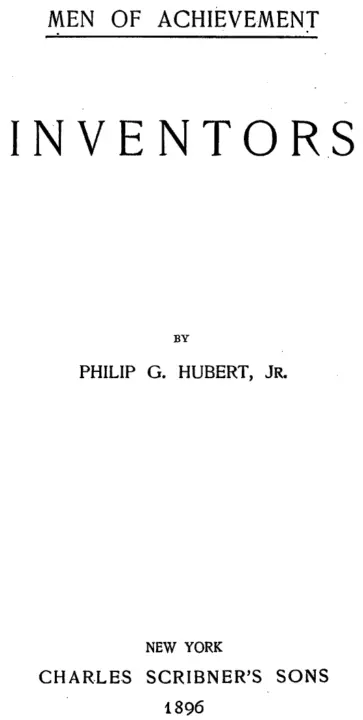
"Inventors" by Philip Gengembre Hubert is a historical account written in the late 19th century. This book delves into the lives and contributions of notable inventors, exploring their origins, aspirations, struggles, and the profound impact their inventions had on society. Through a blend of biographical sketches and lessons learned, the book sheds light on figures like Benjamin Franklin and Eli Whitney, illustrating their significant roles in technological advancement and societal change. The opening of "Inventors" offers an insightful preface, emphasizing the often-overlooked sacrifices made by inventors throughout history. It captures the essence of these pioneers, detailing not just their inventions but also the hardships they faced, from lack of public recognition to legal battles over patents. The narrative begins with Benjamin Franklin, showcasing his intellectual curiosity and numerous contributions, such as the lightning rod and Franklin stove, while hinting at the broader stories that will unfold in the chapters to come, including those of other significant figures in the world of invention.
Introduction adapted from the source catalogue; source summaries may be automatically generated.
Free to read · English · 64,858 words · No account needed
MAKE TIME FOR A GOOD BOOK
On by default. Untick to stop anonymous reading totals. Each page counts after 10 seconds in view. How this works.
Anonymous counting is on unless you have switched it off.
A trifling incident revealed to an Italian savant the fact that when two metals and the leg of a frog came into contact the muscles of the leg contracted. The galvanic battery resulted. Years later another observer discovered that if a wire carrying a current of electricity was wound around a piece of soft iron the latter became a magnet. Out of these simple discoveries have arisen the telegraph, the telephone, and a host of inventions depending upon electricity. And to-day, with all the wonders accomplished in this field, we are yet upon the threshold of the enchanted palace that electricity is about to open to us. Through its aid we shall one day enjoy light, heat, and power almost as freely as we now enjoy air. The crops will be planted, watered, cultivated, gathered, and transported to the uttermost ends of the earth by electricity. The steam-engine is said to do the work of two hundred million men, and to have been the chief agent in reducing the average working hours of men in the civilized world in this century from fourteen hours a day to ten. But electricity, according to even conservative judges, will accomplish infinitely more. It will make possible the harnessing of vast forces of nature, such as the falls of Niagara, because the electric current can be transported from place to place at small cost and it is easily transformed into light or power or heat. Within a few months we shall see the first results of the great work at Niagara. Before many years the power of the tides is certain to be used along the seaboard for producing electricity. Here is a force equal to that of a million Niagaras going to waste.
The late Clerk Maxwell, when asked by a distinguished scientist what was the greatest scientific discovery of the last half-century, replied: "That the Gramme machine is reversible." In other words, that power will not only produce electricity, but that electricity will produce power. By turning a big wheel at Niagara we can produce an electric current that will turn another wheel for us fifty, or perhaps five hundred miles away. The dynamo is one of the great achievements of the day to which Charles F. Brush, of Cleveland, O., has devoted himself with much signal success. Brush was born in March, 1849, in Euclid Township near Cleveland, and his early years were spent on his father's farm. When fourteen years old he went to the public school at Collamer, and later to the Cleveland High-school, and as early as 1862 distinguished himself by making magnetic machines and batteries for the high-school. During his senior year in the high-school, the chemical and physical apparatus of the laboratory of the school was placed under his charge. In this year he constructed an electric motor having its field magnets as well as its armature excited by the electric current. He also constructed a microscope and a telescope, making all the parts himself, down to the grinding of the lenses. He devised an apparatus for turning on the gas in the street-lamps of Cleveland, lighting it and turning it off again. When he was eighteen years of age he entered Michigan University at Ann Arbor, and, following his particular bent, was graduated as a mining engineer in 1869, one year ahead of his class. Returning to Cleveland he began work as an analytical chemist and soon became interested in the iron business. In 1875 Brush's attention was first called to electricity by George W. Stockly, who suggested that there was an immense field ready for a cheaper and more easily managed dynamo than the Gramme or Siemens, the best types then known. Stockly, who was interested in the Telegraph Supply Company, of Cleveland, agreed to undertake the manufacture of such a machine if one was devised. In two months Brush made a dynamo so perfect in every way that it was running until it was taken to the World's Fair in 1893. Having made a good dynamo, the next step was a better lamp than those in use. Six months of experimenting resulted in the Brush arc light. Stockly was so well satisfied with the commercial value of these inventions that the Telegraph Supply Company, a small concern then employing about twenty-five men, was reorganized in 1879, as the Brush Electric Company. In 1880 the Brush Company put its first lights into New York City, and it has since extended the system until there is scarcely a town in the country where the light may not be found. Besides dynamos and lamps, the immense establishment at Cleveland employs its twelve hundred men in making carbons, storage-batteries, and electro-plating apparatus. Mr. Brush is a self-taught mechanic, able to do any work of his shops in a manner equal to that of an expert. He is intensely practical, never over-sanguine, and an excellent business man. If a delicate piece of work is to be done for the first time, he will probably do it with his own hands. He is not fond of experiment for the experiment's sake; he wants to see the practical utility of the aim in view before devoting time to its attainment. Of the scores of patents he has taken out, two-thirds are said to pay him a revenue. In 1881, at the Paris Electrical Exposition, Brush received the ribbon of the Legion of Honor. In personal appearance there is nothing of the round-shouldered, impecunious, studious inventor about him. He is six feet or more in height, and so fine a specimen of manhood that Gambetta, the French statesman, once remarked that the man impressed him quite as much as the inventor.
Your reading position is saved on this browser. Take it to another device with a library code. Reading pages adapt to text, rather than matching a printed edition.
BEHIND THE BOOK
This eBook is for the use of anyone anywhere in the United States and most other parts of the world at no cost and with almost no restrictions whatsoever. You may copy it, give it away or re-use it under the terms of the Project Gutenberg License included with this eBook or online at www.gutenberg.org. If you are not located in the United States, you will have to check the laws of the country where you are located before using this eBook. Read the source licence.
The original source file, including credits and licence, is retained by this library. Request an original-format copy at no charge. Please include the book title and Project Gutenberg identifier #38782.
KEEP YOUR CURIOSITY GOING
Cécile Tormay

Moritz Busch
John L. Ransom
Frances Wright
Cécile Tormay

Mabel Potter Daggett