THE CLASSIC COLLECTION✦Little Masterpieces of Autobiography: ActorsCLASSIC FREE BOOKS
Little Masterpieces of Autobiography: Actors
George Iles
THE CLASSIC COLLECTION · 1906
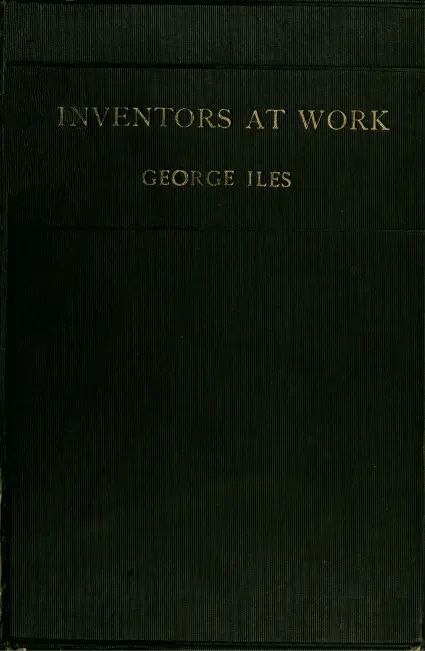
"Inventors at Work, with Chapters on Discovery" by George Iles is a historical account written in the early 20th century. This work delves into the lives and contributions of inventors and discoverers, exploring the principles behind their inventions and the impact these advancements have had on society. It serves as both an appreciation of their innovative spirit and a discussion of the scientific, mechanical, and structural principles that underlie their creations. The opening of the book introduces the theme of the vital role inventors play in elevating human existence by transforming old methods of labor into more efficient and practical solutions. Iles highlights the importance of understanding both form and substance in invention, suggesting that effective designs lead to greater efficiency and improved functionality in various structures and tools. The initial chapter sets the stage for examining how inventions have evolved, emphasizing observation, experimentation, and the interaction between materials and designs as crucial factors in the process of invention.
Introduction adapted from the source catalogue; source summaries may be automatically generated.
Free to read · English · 160,662 words · No account needed
MAKE TIME FOR A GOOD BOOK
On by default. Untick to stop anonymous reading totals. Each page counts after 10 seconds in view. How this works.
Anonymous counting is on unless you have switched it off.
Medicine, original research in, 269, 272, 273.
Mellor, J. W., “Crystallization iron and steel,” 178.
Memorial Bridge, Washington, D. C., 444.
Memory for observations, 293.
Mendenhall, T. C., designs pendulum, 224.
Mercer, John, and mercerization, 138.
Mercury thermometer, 225; vapor lamp, Hewitt, 161.
Mergenthaler linotype, 323.
Metal pressing, Bliss, 184-186.
Metallography, study of, J. W. Mellor, 177.
Metallurgical machinery, automatic, 332.
Metallurgie, Revue de, 179.
Metcalf, Wm., axe and its story, 377.
Meteorology, 338, 339.
Metre, origin, 210.
Metric system, 210, 211.
Michelson, A. A., portrait, facing 214; interferometer, 214-217.
Micrometer caliper, 236.
Microphone, origin of, 147.
Microscopy, Jena glass for, 182.
Mile, nautical, 211.
Mill, John Stuart, four methods experimental inquiry, 360; on sound
observation, 279.
Miller, Hugh, “My schools and schoolmasters” quoted, 307.
Milling cutters, 48, 98, 100, 101; tell story, 377; machine, 98, 100, likely to gain on planer, 173, cuts gears, 67.
Mining in Hartz mountains, 411; placer, 124; separations in, 126.
Mississippi mud, 123; jetties, J. B. Eads, 283.
Mitchell, Walter A., acknowledgment to, xxi.
Models and law of size, 126, 127.
Modernizing a plant, 243.
Moissan, Henri, artificial diamonds, 265.
Moisture necessary for combustion in oxygen, 338, 374.
Molding clay, 102, 103.
Molds, reinforced concrete, 438, 440.
Molecule, size, 130; as reservoir energy, 131.
Molitor, D. A., esthetic design of bridges, 38, foot-note.
Molybdenum in high-speed tool steel, 172.
Mond gas, 461.
Monier, Joseph, reinforces concrete, 435; netting, 437.
Monitor, Ericsson’s, 97, 98.
Montreal, Notre Dame de Bonsecours, 118.
Moon, size of, 121; motions observed by Chaldeans, 293.
Moor grass, section, 251.
Morris Building Co., Brooklyn, hot-water service, 485.
Morris, William, “Hopes and fears for art” quoted, 114.
Morse, Edward S., naturalist, archaeological observer, 287, 288; on
Japanese pottery, 113.
Morse signals on Burke system, 354.
Mortar, Roman, 139.
Mosquitos and malaria, 295.
Moth and hornet, resemblances, 288.
Motion may explain properties, 207.
Motive power produced with new economy, 446-477; of human body, 250.
Moulton, Sir John Fletcher, on coding in invention, 317.
Mower, Obed Hussey, 320.
Multiple drills, saws, punches, 290.
Murdock, Wm., introduces gas-lighting, 154, 280.
Murphy machine shears timber, 322.
Muscles, fibrils of, 258.
Mushet, R. F., high-speed tool steel, 171.
Musical instruments and their prototypes, 257.
Narwhal tusk, 259.
Nasmyth, Alexander, invented bow string bridge, 308.
Nasmyth, James, trained by Maudslay, 300; on drawing, 308.
National Museum, Washington, aboriginal art, 106.
Nature a drama, not a tableau, 355; as teacher, 245-266; unity of,
357.
Nebular theory illustrated, 149.
Needle for sewing-machine, 379.
Neon, 213.
Neptune, discovery of, 214, 378.
Newark Public Library, 487.
Newcomb, Simon, on original research, 269; on analysis and
generalization, 277.
Newton as a boy tireless in construction, 301; makes a sundial and a telescope, measures force of storm, 302; corpuscular theory of light, 203; discovery of law of gravitation, 211, 387; fails to observe black lines of solar spectrum, 284; on achromatism, 254; rings, 237, 238.
New Amsterdam Theater, New York, 119, facing 118.
New York Central R. R. Line, its course, 246.
New York Subway, reinforced concrete, 443.
Niagara Falls retiring, 123; turbines at, 70, 371.
Nichols, Ernest F., on pressure of light, 133; sensitive
thermometer, 226.
Nickel, how made malleable, 176.
Nickel-steel, 166, 167; of like expansibility with glass when heated, 170; which shrinks when heated, 170.
Nickelin, Weston’s, 234.
Nicolaysen, N., on Viking ship, 57.
Nitro-glycerine, 409, 410.
Nobel, Alfred, improves nitro-glycerine, 410; invents dynamite, 410; profits by accidental use of collodion, 411; invents smokeless powder, 412; character and benefactions, 413.
Your reading position is saved on this browser. Take it to another device with a library code. Reading pages adapt to text, rather than matching a printed edition.
BEHIND THE BOOK
This eBook is for the use of anyone anywhere in the United States and most other parts of the world at no cost and with almost no restrictions whatsoever. You may copy it, give it away or re-use it under the terms of the Project Gutenberg License included with this eBook or online at www.gutenberg.org. If you are not located in the United States, you will have to check the laws of the country where you are located before using this eBook. Read the source licence.
The original source file, including credits and licence, is retained by this library. Request an original-format copy at no charge. Please include the book title and Project Gutenberg identifier #48454.
KEEP YOUR CURIOSITY GOING
Cécile Tormay

Moritz Busch
John L. Ransom
Frances Wright
Cécile Tormay

Mabel Potter Daggett