Mechanics: The Science of Machinery
A. Russell (Alexander Russell) Bond
THE CLASSIC COLLECTION · 1918
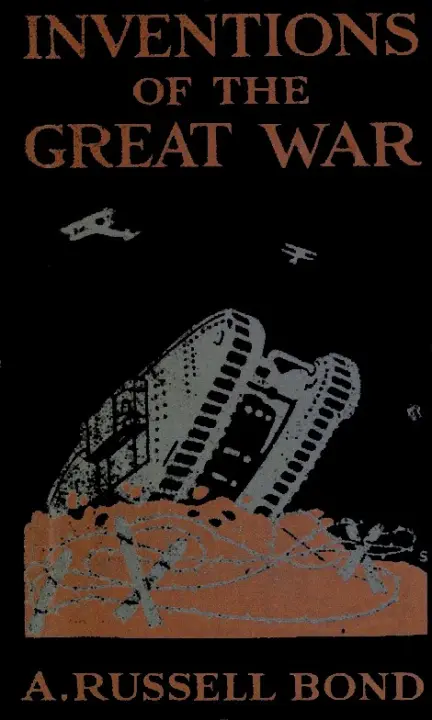
"Inventions of the Great War" by A. Russell Bond is a historical account written in the early 20th century. This work explores the significant inventions that emerged during World War I, particularly focusing on their impact on warfare and military strategy. Through a detailed examination, the author highlights inventions such as the airplane, submarine, machine-gun, and more, emphasizing the American contributions to these technological advancements. At the start of the narrative, the author sets the stage for understanding the technological landscape at the onset of the Great War. The opening portion discusses the unexpected preparedness of the German military, their rapid mobilization, and the subsequent transition to trench warfare, which drastically altered the nature of combat. It describes how both sides adapted to these new conditions, leading to innovations in defensive techniques, including elaborate trench systems and new weaponry designed to break the stalemate of trench warfare, highlighting the ingenuity and resourcefulness of the combatants involved.
Introduction adapted from the source catalogue; source summaries may be automatically generated.
Free to read · English · 66,547 words · No account needed
MAKE TIME FOR A GOOD BOOK
On by default. Untick to stop anonymous reading totals. Each page counts after 10 seconds in view. How this works.
Anonymous counting is on unless you have switched it off.
Summing up the situation, then, there are two serious bars to the successful salvage of ships sunk in the open sea--the wild fury of the waves on the surface; and the silent, remorseless pressure of the deep. The former is the more to be feared; and if the waves really can be calmed, considerably more than half the problem is solved. As for the pressure of the sea, it can be overcome, as we have seen, either by the use of special submarine mechanisms, or of man-operated manikins or even of unarmored divers. We have reached a very interesting stage in the science of salvage, with the promise of important developments. Fifty fathoms no longer seems a hopeless depth.
Even in times of peace the sea exacts a dreadful toll of lives and property. Before the war the annual loss by shipwreck around the British Isles alone was estimated at forty-five million dollars. But the war, although it was frightfully destructive to shipping, may in the long run save more vessels than it sank; for it has given us sound-detectors which should remove the danger of collisions in foggy weather, and the wireless compass, which should keep ships from running off the course and on the rocks. And now, if salvage engineering develops as it should, the sea will be made to give up not only much of the wealth it swallowed during the war, but also many of the rich cargoes of gold and silver it has been hoarding since the days of the Spanish galleon.
Air, fighting waves, 334
raising ship, on, 319
war in, 123
Airplane, ambulance, 146
armored, 139
artillery-spotting, 131
camera, 173
cartridges, 131
classes of work, 127
fighting among clouds, 137
flying boats, 144
gasolene tank, 130
giant, 132
hospital, 146
launching from ship, 303
Liberty motor, 142
scouting, 125
scouts, 128
speed of, 134
spotting, 177
training spotters, 180
wireless telephone, 194
See also Seaplane
Ambulance airplane, 146
Armored diving-suit, 330
Arms and armor, 111
Artillery, hand, 23
Atmosphere, shooting beyond, 64
Audion, 185
Balloon, Blimp, 260
helium, 164
historical, 148
hydrogen, 150
Balloon, kite, 174
principles, 150
record flight, 65
Barbed wire, 15
cylinders, 17
gate, trench, 9
gates through, 15
shelling, 16
Barge for towing seaplanes, 302
Barrage, grenade, 27
mine, 292
Battle-fields, miniature, 180
Blimp, 260
Blisters on ships, 307
Boats, electric, 308
Eagle, 301
flying, 144
surface, 298
Bombs to destroy barbed wire, 16
Breakwater, pneumatic, 335
Browning, John M., 56
Buildings, shadowless, 227
Caisson disease, 325
Caliber, 68
Camera, airplane, 173
Camouflage and camoufleurs, 211
buildings, 227
grass, 229
horse, 223
land, 222
roads, 225
Camouflage, ships, 211
Cartridges, aircraft guns, 131
Catapults, 36
Caterpillar tractor, 109
Caves, 8
Coffer-dam, salvage, 318
Color, analyzing, 229
screens, 229
Compass, wireless, 201
Convoy, 267
Countermines, 17
Deep sea, conditions in, 312
Deep water diving, 327
Depth bombs, 265
Devil's eggs, 276
Diesel engine, 240
Direction-finder, 205
Dirigible, see Balloon
Disease, caisson, 325
Diver, armored suit, 330
caisson disease, 325
rest chamber, 328
sled, 330
submarine torch, 329
suit, 324
Diving, deep, 324
record depth, 327
Duck-boards, 9
Dugouts, 7
Dummy heads of papier mâché, 13
Eagle boats, 301
Egg-laying submarines, 287
Eggs, Devil's, 276
Electric motor-boat, 308
Engine, Diesel, 240
Field-guns, 81
Fire broom, 105
liquid, 103
Your reading position is saved on this browser. Take it to another device with a library code. Reading pages adapt to text, rather than matching a printed edition.
A. Russell (Alexander Russell) Bond

A. Russell (Alexander Russell) Bond
BEHIND THE BOOK
This eBook is for the use of anyone anywhere in the United States and most other parts of the world at no cost and with almost no restrictions whatsoever. You may copy it, give it away or re-use it under the terms of the Project Gutenberg License included with this eBook or online at www.gutenberg.org. If you are not located in the United States, you will have to check the laws of the country where you are located before using this eBook. Read the source licence.
The original source file, including credits and licence, is retained by this library. Request an original-format copy at no charge. Please include the book title and Project Gutenberg identifier #45269.
KEEP YOUR CURIOSITY GOING
Cécile Tormay

Moritz Busch
John L. Ransom
Frances Wright
Cécile Tormay

Mabel Potter Daggett