
Subsidiary Notes as to the Introduction of Female Nursing into Military Hospitals in Peace and War
Florence Nightingale
THE CLASSIC COLLECTION · 1871
"Introductory Notes on Lying-In Institutions" by Florence Nightingale is a scientific publication written in the late 19th century. This work discusses the establishment and management of maternity hospitals, addressing issues such as mortality rates and their causes in lying-in institutions. Nightingale aims to propose solutions for training midwives and improving the conditions for delivering women, thereby enhancing maternal care. The opening of this work sets the stage for a critical examination of midwifery practices following concerning statistics regarding maternal mortality rates. Nightingale details her observations from a training institution that reported a significantly high death rate of women due to puerperal diseases during its operation, leading to the closure of its wards. She emphasizes the need for better training for midwives and evaluates the environmental and procedural factors contributing to fatalities, proposing that better management of lying-in institutions could drastically reduce risks associated with childbirth.
Introduction adapted from the source catalogue; source summaries may be automatically generated.
Free to read · English · 27,498 words · No account needed
MAKE TIME FOR A GOOD BOOK
On by default. Untick to stop anonymous reading totals. Each page counts after 10 seconds in view. How this works.
Anonymous counting is on unless you have switched it off.
Sad experience tells that this unprincipled practice has often proved fatal to many other inmates of the lying-in institution, turning an institution into a hospital.
Every sick case should therefore be completely isolated, in a separate sick ward, from the lying-in women. And if admitted before delivery, her delivery should take place in this separate ward.
N.B. The nurse’s dinner and meals may be prepared in the general kitchen and sent to her. The patient’s arrowroot, gruel, &c., must be made, and her beef-tea warmed, in the ‘sick or segregation’ building, and all linen must be sent to the ward well aired.
Is it desirable to connect the ‘segregation’ ward by any covered passage with the rest of the lying-in institution?
There is much to be said for and against.
The ward, it is to be hoped, will not often have to be used at all.
But small-pox has appeared after labour.
There might be danger in taking a patient from the institution to this ward through the open air, in all weathers, unprotected by any covered passage.
On the other hand, when once the patient is in the ward, complete isolation is by far the best, for the sake of all the others.
And there is by no means the same necessity for a passage as in the other parts of the institution where any night there may be three or four ordinary delivery cases to be conveyed through the passages.
A covered ambulance for sick cases is not, however, a nice thing, though
often suggested.[22]
3. The first two may be called universal and essential principles of good management in every lying-in institution, large or small, however perfectly constructed.
Here is a third, hardly less essential, wherever there is more than one bed to a ward, viz. to remove a lying-in woman three times during her stay in the institution.
The average course of an ordinary case may be reckoned thus:—
Seven or eight hours in the delivery ward. Five or six days in the lying-in ward. Nine or ten days in the convalescent ward.
The nearer wards to the delivery ward in use should always be made the wards for women immediately after delivery; the farther wards for the same women when removed for their convalescent stage.
In a single-bed ward the woman may remain in her own ward from after her delivery till her discharge; that is, no further removal after her delivery is necessary.
4. Cases of extreme exhaustion after delivery, which are better out of the delivery ward yet cannot be moved many yards, should be carried in their beds to the bye-ward adjoining the delivery ward, till they are somewhat recovered.
Your reading position is saved on this browser. Take it to another device with a library code. Reading pages adapt to text, rather than matching a printed edition.
Florence Nightingale
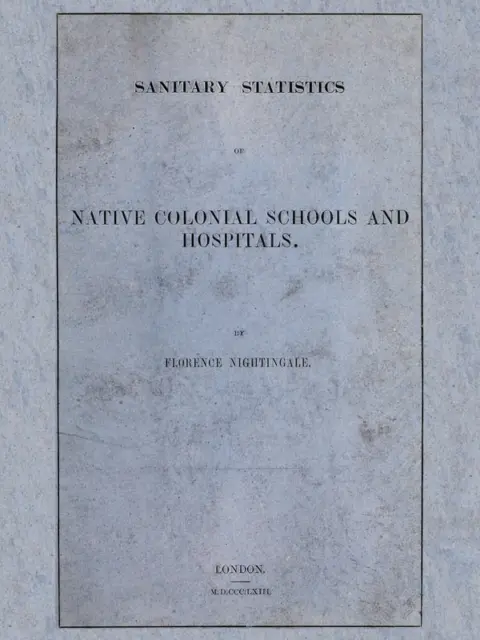
Florence Nightingale
Florence Nightingale
Florence Nightingale
BEHIND THE BOOK
This eBook is for the use of anyone anywhere in the United States and most other parts of the world at no cost and with almost no restrictions whatsoever. You may copy it, give it away or re-use it under the terms of the Project Gutenberg License included with this eBook or online at www.gutenberg.org. If you are not located in the United States, you will have to check the laws of the country where you are located before using this eBook. Read the source licence.
The original source file, including credits and licence, is retained by this library. Request an original-format copy at no charge. Please include the book title and Project Gutenberg identifier #73878.
KEEP YOUR CURIOSITY GOING

John Muir

Asa Gray
Asa Gray
Florence Nightingale
Elizabeth Robins Pennell
Denison Olmsted