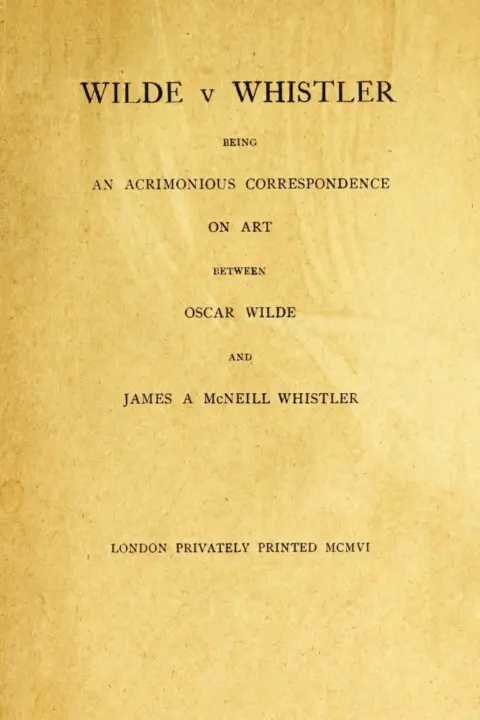
Wilde v Whistler Being an Acrimonious Correspondence on Art Between Oscar Wilde and James A McNeill Whistler
Oscar Wilde & James McNeill Whistler
THE CLASSIC COLLECTION · 1891
"Intentions" by Oscar Wilde is a collection of essays written in the late 19th century that delves into themes of art, morality, and aesthetics. The opening piece, "The Decay of Lying," is structured as a dialogue between two characters, Cyril and Vivian, who engage in a witty and philosophical examination of the nature of lying in art and literature. Wilde’s exploration indicates a belief in the transformative and essential role of art in society, while suggesting that modern realism diminishes creativity and beauty. The opening of "Intentions" presents a lively discussion between Cyril, who urges appreciation for nature, and Vivian, who dismisses it in favor of the comforts and creativity found indoors. Vivian argues that the decline of lying as an art form has led to the uninspired nature of contemporary literature, contending that art should reflect imagination rather than the mundane realities of life. Through sharp and humorous exchanges, Wilde sets the stage for a deeper critique of the societal values surrounding truth and beauty, ultimately championing the importance of artistic imagination over factual representation. This sets a thought-provoking tone for the essays that follow, inviting readers to reconsider their own understanding of art and its relationship with lies.
Introduction adapted from the source catalogue; source summaries may be automatically generated.
Free to read · English · 58,935 words · No account needed
MAKE TIME FOR A GOOD BOOK
On by default. Untick to stop anonymous reading totals. Each page counts after 10 seconds in view. How this works.
Anonymous counting is on unless you have switched it off.
‘In France, though nothing so deliberately tedious as Robert Elsmere has been produced, things are not much better. M. Guy de Maupassant, with his keen mordant irony and his hard vivid style, strips life of the few poor rags that still cover her, and shows us foul sore and festering wound. He writes lurid little tragedies in which everybody is ridiculous; bitter comedies at which one cannot laugh for very tears. M. Zola, true to the lofty principle that he lays down in one of his pronunciamientos on literature, “L’homme de génie n’a jamais d’esprit,” is determined to show that, if he has not got genius, he can at least be dull. And how well he succeeds! He is not without power. Indeed at times, as in Germinal, there is something almost epic in his work. But his work is entirely wrong from beginning to end, and wrong not on the ground of morals, but on the ground of art. From any ethical standpoint it is just what it should be. The author is perfectly truthful, and describes things exactly as they happen. What more can any moralist desire? We have no sympathy at all with the moral indignation of our time against M. Zola. It is simply the indignation of Tartuffe on being exposed. But from the standpoint of art, what can be said in favour of the author of L’Assommoir, Nana and Pot-Bouille? Nothing. Mr. Ruskin once described the characters in George Eliot’s novels as being like the sweepings of a Pentonville omnibus, but M. Zola’s characters are much worse. They have their dreary vices, and their drearier virtues. The record of their lives is absolutely without interest. Who cares what happens to them? In literature we require distinction, charm, beauty and imaginative power. We don’t want to be harrowed and disgusted with an account of the doings of the lower orders. M. Daudet is better. He has wit, a light touch and an amusing style. But he has lately committed literary suicide. Nobody can possibly care for Delobelle with his “Il faut lutter pour l’art,” or for Valmajour with his eternal refrain about the nightingale, or for the poet in Jack with his “mots cruels,” now that we have learned from Vingt Ans de ma Vie littéraire that these characters were taken directly from life. To us they seem to have suddenly lost all their vitality, all the few qualities they ever possessed. The only real people are the people who never existed, and if a novelist is base enough to go to life for his personages he should at least pretend that they are creations, and not boast of them as copies. The justification of a character in a novel is not that other persons are what they are, but that the author is what he is. Otherwise the novel is not a work of art. As for M. Paul Bourget, the master of the roman psychologique, he commits the error of imagining that the men and women of modern life are capable of being infinitely analysed for an innumerable series of chapters. In point of fact what is interesting about people in good society—and M. Bourget rarely moves out of the Faubourg St. Germain, except to come to London,—is the mask that each one of them wears, not the reality that lies behind the mask. It is a humiliating confession, but we are all of us made out of the same stuff. In Falstaff there is something of Hamlet, in Hamlet there is not a little of Falstaff. The fat knight has his moods of melancholy, and the young prince his moments of coarse humour. Where we differ from each other is purely in accidentals: in dress, manner, tone of voice, religious opinions, personal appearance, tricks of habit and the like. The more one analyses people, the more all reasons for analysis disappear. Sooner or later one comes to that dreadful universal thing called human nature. Indeed, as any one who has ever worked among the poor knows only too well, the brotherhood of man is no mere poet’s dream, it is a most depressing and humiliating reality; and if a writer insists upon analysing the upper classes, he might just as well write of match-girls and costermongers at once.’ However, my dear Cyril, I will not detain you any further just here. I quite admit that modern novels have many good points. All I insist on is that, as a class, they are quite unreadable.
Your reading position is saved on this browser. Take it to another device with a library code. Reading pages adapt to text, rather than matching a printed edition.
Oscar Wilde & James McNeill Whistler
Oscar Wilde
Oscar Wilde
Oscar Wilde
BEHIND THE BOOK
This eBook is for the use of anyone anywhere in the United States and most other parts of the world at no cost and with almost no restrictions whatsoever. You may copy it, give it away or re-use it under the terms of the Project Gutenberg License included with this eBook or online at www.gutenberg.org. If you are not located in the United States, you will have to check the laws of the country where you are located before using this eBook. Read the source licence.
The original source file, including credits and licence, is retained by this library. Request an original-format copy at no charge. Please include the book title and Project Gutenberg identifier #887.
KEEP YOUR CURIOSITY GOING

David Patterson (Spirit) Hatch

David Patterson (Spirit) Hatch

David Patterson (Spirit) Hatch
John L. Ransom

Ralph Waldo Emerson

Maurice Baring