THE CLASSIC COLLECTION✦Family names from the Irish, Anglo-Saxon, Anglo-Norman and ScotchCLASSIC FREE BOOKS
Family names from the Irish, Anglo-Saxon, Anglo-Norman and Scotch
Thomas G. (Thomas George) Gentry
THE CLASSIC COLLECTION · 1900
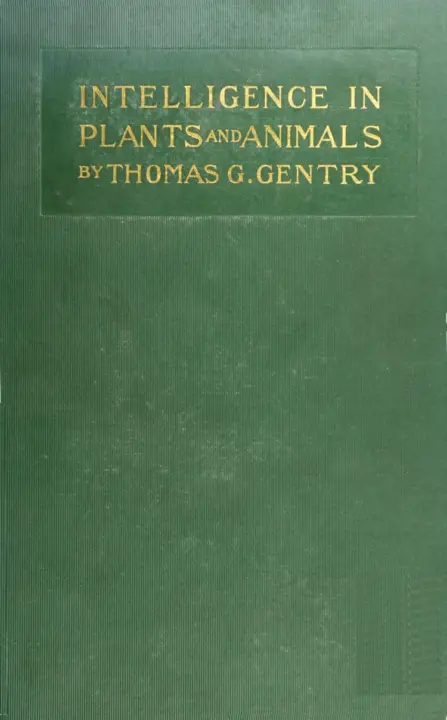
"Intelligence in Plants and Animals" by Thomas G. Gentry is a scientific publication likely written in the late 19th century. The work explores the characteristics and behaviors of various organisms within the plant and animal kingdoms, emphasizing the concept of intelligence and consciousness in both groups. Gentry's focus appears to extend to the philosophical implications of life and intelligence, suggesting a deep interconnection between all forms of life. At the start of the work, the author sets the stage for a comprehensive exploration of the nature of life by detailing the distinctions between minerals, plants, and animals. Gentry articulates the significance of understanding natural phenomena, positing that all living beings possess some form of intelligence or capability that should not be overlooked, including plants that display reactive behaviors. The opening chapters lay the groundwork for discussions on various species, outlining their unique characteristics and how they interact with the environment, setting an intriguing tone for the subsequent sections.
Introduction adapted from the source catalogue; source summaries may be automatically generated.
Free to read · English · 148,914 words · No account needed
MAKE TIME FOR A GOOD BOOK
On by default. Untick to stop anonymous reading totals. Each page counts after 10 seconds in view. How this works.
Anonymous counting is on unless you have switched it off.
As we pass from the older rocks into the newer, we not only find that the animals of each successive formation become gradually more and more like existing species upon the globe, but we also find that there has been a gradual progression and development in the types of animal life which characterize the geological ages. Taking the earliest-known and oldest examples of any given group, it can sometimes be shown that these primitive forms, even though they are highly organized themselves, possessed certain characters such as are now only to be met with in the young of their existing representatives. Such characters, which are technically called embryonic characters, do not prevent the frequent attainment by their possessors of sizes much more gigantic than those of their nearest living relatives. Moreover, these ancient forms of life represent what are called comprehensive types, or types that possess characters in combination such as are nowadays found separately developed in different groups of animals. Such permanent retention of embryonic characters and comprehensiveness of structural type are signs of what zoölogists consider to be comparatively low grades of organization, and their prevalence in the earlier forms of animals is a very astonishing phenomenon, though they are none the less perfectly organized so far as their peculiar type is concerned. As we ascend the geological scale, these features will be found to gradually disappear, higher and even higher forms will be introduced, and specialization of type take the place of the former comprehensiveness. That there has been in the past a general progression of organic types, and that the appearance of the lower forms of life has in the main preceded that of the higher forms in point of time, is a widely-accepted generalization of palæontology.
Now that it has been seen that there has been a gradual progression and development of animal types all through the ages up to the era of man, the question naturally occurs whether or not the changes are still going on which will result in a higher development. Man coexisted in Western Europe with several remarkable mammals in the later portion of the Post-Pliocene Period. While we do not know the causes which led to the extinction of the mammoth, woolly rhinoceros, cave-lion and others, yet we do know that scarcely any mammalian species have become extinct during the historical period. The species with which man coexisted are such that presumably required a very different climate to that now prevailing in Western Europe. Some of the deposits in which man’s remains have been found in association with the bones of extinct mammals incontestably show that great changes in the physiography and surface-configuration of the country had taken place since the period of their accumulation, the human implements themselves bearing evidence of an exceedingly barbarous condition of the human species. Post-Pliocene, or Palæolithic man, was clearly unacquainted with the use of the metals. Not only was this the case, but the workmanship of these ancient races was much inferior to that of the later tribes, who were also ignorant of the metals, and who also used nothing but weapons and tools of stone, bone, etc., in war, chase and domestic affairs. When first man spread over the earth, he had no domestic animals, perhaps not even the dog, and had no knowledge of agriculture. His weapons were of the rudest character, and his houses scarcely worthy of the name. No doubt can exist that his food, habits and entire manner of living have varied as he has passed from country to country, for he must then have been far more subject to the influence of external circumstances, and in all probability more susceptible of change. Moreover, his form, which is now stereotyped by long ages of repetition, may reasonably be presumed to have been more plastic than is now the case. As long as man led a mere animal existence, he would be subject to the same laws, and would vary in the same manner as the rest of his fellow-creatures. But when at last he had acquired the capacity of clothing himself, and of making weapons or tools, he has taken away from nature, in a great measure, that power of changing the external form and structure which she exercises over all other animals. From the time, then, when his social and sympathetic feelings came into active operation, and his intellectual and moral faculties became fairly developed, man’s physical form and structure would not be so much influenced by natural laws, and, therefore, as an animal, he would become almost stationary, his environment ceasing to have upon him that powerful modifying effect which it exercises over other parts of the organic world. But from the moment that his body became less subject to the changes of the surrounding universe, his mind would become acted upon by the influences which the body had escaped. Every slight variation in his mental and moral nature, which would consequently be brought about, and which would enable him better to guard against adverse circumstances, and league together for mutual comfort and protection, would be preserved and accumulated. The better and higher specimens of our race would therefore increase and diffuse themselves, while the lower and more brutal would succumb and successively die out, and that rapid advancement of mental organization would occur, which has raised the very lowest races of men, whose mentality was scarcely superior to the animal, to that high position which it has attained in the Germanic races. It would be too bold an assertion to say that man’s body has become stationary. Slow and gradual changes still take place, although his mere bodily structure long ago became of less importance to him than that subtle energy, which is termed mind. No one can doubt that this gave his naked and unprotected body clothing against the varying inclemencies of the seasons and enabled him to compete with the deer in swiftness and the wild bull in strength by giving him weapons wherewith to capture or subdue them both. Though less capable than most other animals of subsisting on the herbs and the fruits of unaided nature, it was this wonderful faculty that taught him to govern and direct nature to his own benefit, and compel her to produce food for him when and where he pleased. From the moment, then, when the first skin was used as a covering, the first rude spear fashioned to aid in the chase, and the first seed sown or shoot planted, a grand revolution was effected in nature, a revolution which had had no parallel in all the previous cycles of the world’s history, for a being had arisen who was no longer necessarily subject to a changing universe, a being who was in some degree superior to nature, inasmuch as he knew how to control and regulate her action, and could maintain himself in unison with her, not by a change brought about in the body, but by a growth and advance in mind. Therein are shadowed forth the true grandeur and dignity of man. Not only has he achieved for himself a great victory in this rising by the power of mind superior to nature in a sense, but he has also gained a directing influence over other existences, in that he has been able to grasp from nature some of that power which, before his appearance, she universally exercised. From all that man has accomplished in the past, it is easy to anticipate the time when only cultivated plants and domestic animals will be produced by the earth, and when the ocean, which, for countless cycles of ages ruled supreme over the globe, will be the only domain in which that power can be exercised.
Your reading position is saved on this browser. Take it to another device with a library code. Reading pages adapt to text, rather than matching a printed edition.
BEHIND THE BOOK
This eBook is for the use of anyone anywhere in the United States and most other parts of the world at no cost and with almost no restrictions whatsoever. You may copy it, give it away or re-use it under the terms of the Project Gutenberg License included with this eBook or online at www.gutenberg.org. If you are not located in the United States, you will have to check the laws of the country where you are located before using this eBook. Read the source licence.
The original source file, including credits and licence, is retained by this library. Request an original-format copy at no charge. Please include the book title and Project Gutenberg identifier #64550.
KEEP YOUR CURIOSITY GOING

David Patterson (Spirit) Hatch
Cécile Tormay

Moritz Busch
Coulson Kernahan
John L. Ransom

Ralph Waldo Emerson