THE CLASSIC COLLECTION✦Family names from the Irish, Anglo-Saxon, Anglo-Norman and ScotchCLASSIC FREE BOOKS
Family names from the Irish, Anglo-Saxon, Anglo-Norman and Scotch
Thomas G. (Thomas George) Gentry
THE CLASSIC COLLECTION · 1900
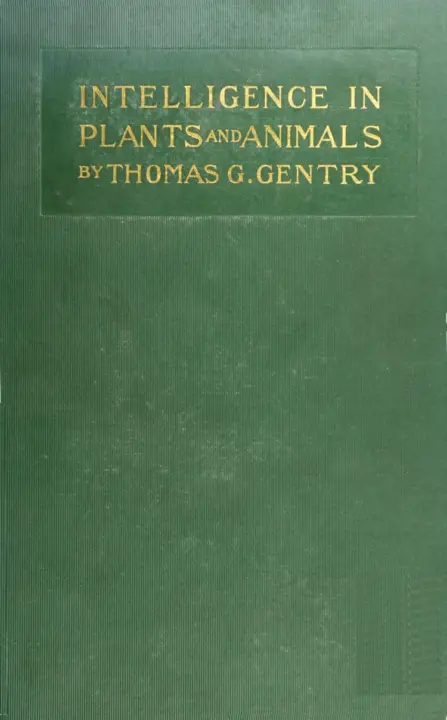
"Intelligence in Plants and Animals" by Thomas G. Gentry is a scientific publication likely written in the late 19th century. The work explores the characteristics and behaviors of various organisms within the plant and animal kingdoms, emphasizing the concept of intelligence and consciousness in both groups. Gentry's focus appears to extend to the philosophical implications of life and intelligence, suggesting a deep interconnection between all forms of life. At the start of the work, the author sets the stage for a comprehensive exploration of the nature of life by detailing the distinctions between minerals, plants, and animals. Gentry articulates the significance of understanding natural phenomena, positing that all living beings possess some form of intelligence or capability that should not be overlooked, including plants that display reactive behaviors. The opening chapters lay the groundwork for discussions on various species, outlining their unique characteristics and how they interact with the environment, setting an intriguing tone for the subsequent sections.
Introduction adapted from the source catalogue; source summaries may be automatically generated.
Free to read · English · 148,914 words · No account needed
MAKE TIME FOR A GOOD BOOK
On by default. Untick to stop anonymous reading totals. Each page counts after 10 seconds in view. How this works.
Anonymous counting is on unless you have switched it off.
Bishop Butler, in his “Analogy of Religion,” undoubtedly believed the lower animals capable of a future life. In speaking of them in this connection in the opening of his work, he says: “It is said these observations are equally applicable to brutes; and it is thought an insuperable difficulty that they should be immortal, and by consequence capable of everlasting happiness. And this manner of expression is both invidious and weak; but the thing intended by it is really no difficulty at all, either in the way of natural or moral consideration.” Referring then to the undeveloped powers and capacities of the so-called brutes, the Bishop could perceive no reason why they should not attain their development in an existence beyond the earth-life. It was in pursuance of this same train of thought that Rev. J. G. Wood was led to show in a work, entitled “Man and Beast Here and Hereafter,” that the lower animals do possess those mental and moral characteristics--the attributes of reason, language, memory, moral responsibility, unselfishness and love--which we admit in man as belonging to the immortal spirit, rather than to the perishable body. Having previously cleared away the difficulties which certain passages in the Old Testament seemingly interposed, and proved that the Scriptures do not deny futurity of life to lower animals, he very naturally concluded that as man expects to retain these qualities in the future life there is every reason to suppose that they may share his immortality in the Hereafter as in the Now they are partakers of his mortal nature.
Few minds, unswayed by thoughts materialistic, can study the living works of God, whether vegetal or animal, and fail to be convinced that they, as living exponents of Divine conceptions, are as needful in the world of spirit as in the world of matter. While many are disposed to believe that man will share the future life with beast, bird, insect and such like, yet but few, if any, can be found who believe that tree and shrub and flower will be there to continue the life begun on earth and reach out to higher and fuller development. In announcing this belief, the author but expresses a conviction as deep as any that could occupy a human mind. The possession of soul and spirit can be predicated no less of plants than of man and the lower animals. They have all one breath or life and one spirit, and as such are living souls, living, breathing frames or bodies of life. From being living, breathing frames, and endowed with the same life and spirit as man and the lower animals, they have all one destiny, for “all go unto one place; all are of the dust, and all turn to dust again.” But of the new life which Christ came down to earth to proffer to man that he might inherit the kingdom of God. While to man it was only offered, and had for its purpose the uplifting and improvement of his earth-life by the promise of something higher and better to those who are accounted worthy, yet there can be no doubt that it was equally intended through his uplifting to place all the creatures of the earth over which he was given dominion by God upon a more elevated and nobler plane, so that those which had been profited in the earth-life by his beneficent influence should become partakers with him in the new life, when Christ shall “transfigure the body of our humiliation, that it may become of like form with the body of His glory, by the power of that which enables Him even to subdue all things to Himself.” As all existence is a unit, which the author has taken especial pains through the body of this book to impress upon the minds of his readers, it can hardly be conceived that an all-wise God, who is infinite in love, mercy and justice, would look to the preservation in a future state of but a very small part of the life which He has been instrumental in placing upon this earth. It would be more consistent with His attributes, and with the scheme of development of life upon our planet, whereby life has been progressive, the fittest only being allowed to survive, to have provided in the grand plan of redemption, not merely the salvation of the highest of earth-life, but of all life, the purest and the best, that would represent in the heaven-life, in spiritualized form, the highest living exponents of Divine ideas. No other belief accords so well with the teachings of science and philosophy. In its acceptance, for it makes all life related to the Divine life, can there be any hope of escape from materialism, that curse of the age.
Your reading position is saved on this browser. Take it to another device with a library code. Reading pages adapt to text, rather than matching a printed edition.
BEHIND THE BOOK
This eBook is for the use of anyone anywhere in the United States and most other parts of the world at no cost and with almost no restrictions whatsoever. You may copy it, give it away or re-use it under the terms of the Project Gutenberg License included with this eBook or online at www.gutenberg.org. If you are not located in the United States, you will have to check the laws of the country where you are located before using this eBook. Read the source licence.
The original source file, including credits and licence, is retained by this library. Request an original-format copy at no charge. Please include the book title and Project Gutenberg identifier #64550.
KEEP YOUR CURIOSITY GOING

David Patterson (Spirit) Hatch
Cécile Tormay

Moritz Busch
Coulson Kernahan
John L. Ransom

Ralph Waldo Emerson