
The Writing of News A Handbook with Chapters on Newspaper Correspondence and Copy Reading
Charles G. (Charles Griffith) Ross
THE CLASSIC COLLECTION · 1885
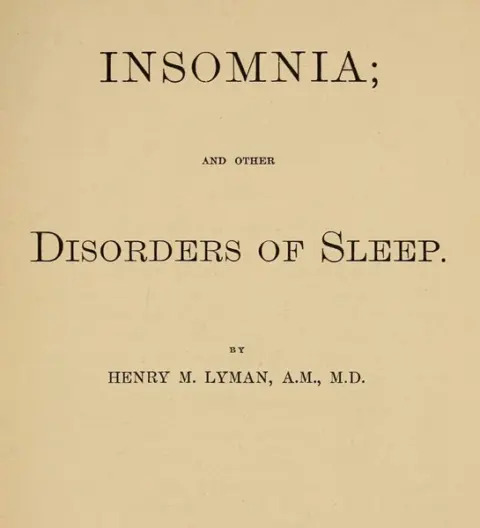
"Insomnia; and Other Disorders of Sleep" by Henry M. Lyman is a scientific publication written in the late 19th century. This work delves into the physiological and pathological aspects of sleep, examining conditions such as insomnia, dreams, and various disorders of sleep. It aims to provide a comprehensive understanding of sleep, discussing physiological functions, causes of sleep and wakefulness, and potential treatments for related disorders. The opening of this publication introduces the subject of sleep as a fundamental physiological process, likening its natural occurrence to vital functions like breathing and circulation. Lyman emphasizes the significance of sleep in restoring energy and the complexities surrounding its mechanisms. He discusses the prelude to sleep, identifying the hypnagogic state that precedes unconsciousness, and begins to outline how sleep differs from other states like coma and lethargy. This establishes a foundation for the subsequent exploration of insomnia, its causes, and its treatments, indicating that the text will focus on both the scientific and therapeutic perspectives of sleep disorders.
Introduction adapted from the source catalogue; source summaries may be automatically generated.
Free to read · English · 65,703 words · No account needed
MAKE TIME FOR A GOOD BOOK
On by default. Untick to stop anonymous reading totals. Each page counts after 10 seconds in view. How this works.
Anonymous counting is on unless you have switched it off.
Another experience may serve to illustrate the fact that dreams are greatly intensified by illness, and that their duration may be exceedingly brief. Suffering, one night, from an attack of intestinal colic, marked by a rapid succession of painful paroxysms, between which, however, I fell asleep without the aid of medicine, I dreamed in one of these snatches of slumber that I was walking with my brother on the road to the volcano of Kilauea. In my hand were four diamond shirt buttons. They were white, and were covered with fine asbestos wool. My brother’s wife expressed serious doubts regarding their value; but I at once reminded her that the Emperor of China had given to the English Ambassador, for presentation to the Queen of England, a number of diamonds which were so rough and so cheap in appearance that the ambassador, who was also a marquis, could not suppress his contempt as he received the gift. But, when carried to London, and cut by the royal jewelers, their brilliance had astonished everyone. I now desired to deposit my diamonds with a jeweler, for safe-keeping. My brother recommended a house near the volcano, but I had seen another, a few squares further up the road, and accordingly resorted thither. Not finding any satisfactory evidence of business, I retraced my steps to the place first recommended. Entering the door, I found myself in a narrow room, with a long, low counter on one side. Behind this were several men, and several cases filled with jewelry. I handed my buttons to a large, good-looking fellow, who was bustling around in his shirt-sleeves. He immediately put one of the jewels into his mouth, when I heard something crack, as if either his teeth or the diamond had split. Consoling myself with the recollection that, if broken, a diamond could be mended with cement, I asked for a certificate of deposit. While this was being written, the entire building slipped away from over us, and glided down the slope of the mountain, towards the ocean, leaving us, and all that had been within the house, uncovered in the open air. This did not disconcert any one. The jeweler finished his writing; I pocketed the receipt, and with my brother pursued our walk through the mountain forests beyond the crater of the volcano. Presently we arrived at an eminence from which we could look down upon the ocean, and could see the line of the coast prolonged for many miles on either side of a cape of land. The western coast was very grand--mountain promontories rising behind each other as far as the eye could reach. Having feasted our eyes with this magnificent panorama of earth and sea and sky, we turned away in the direction of a grove, in which was visible a large building of stone, with castellated walls, and turrets with pointed roofs at the corners. My brother informed me that this was a German settlement, called Little Clacius. Approaching the castle, we were received in a magnificent hall by a beautiful woman who offered to conduct us through the building. She led us through a series of lofty rooms, splendidly painted, gilded, frescoed, and furnished with inlaid tables and polished chairs. On either side were ranged large vases, in which grew what I seemed instinctively to recognize by the name of the Lace Mimosa--each plant consisting of a flat sheet of green lace-work, like a coralline, studded with lovely pale yellow blossoms. Passing through three such rooms, we entered a fourth, across the floor of which our fair guide whirled herself with a pirouette into the presence of a young woman clad in a richly figured dressing-gown, drawn lightly around her form as she sat in an easy chair, nursing her baby. We were formally introduced to this lady, who received us with the most evident indifference, a circumstance which gave us no concern, for the view from the open window at once engrossed my attention. Directly before me was a shining river, pouring down the mountain side and falling about fifteen feet into a deep dark pool that widened beneath the window from which I gazed. High banks, covered with magnificent trees, sloped down into the water, and cast their shadows across its rippling surface, forming a most charming landscape. The breadth of the scene, the depth of the coloring, the perfection and the multiplicity of all the details that pressed upon the attention, could not have been surpassed in vividness by any real existence. I was admiring the view, and was beginning to feel surprised that so large a river could exist in such a place, when I was suddenly awakened by a renewal of the intermittent pain.
Your reading position is saved on this browser. Take it to another device with a library code. Reading pages adapt to text, rather than matching a printed edition.
BEHIND THE BOOK
This eBook is for the use of anyone anywhere in the United States and most other parts of the world at no cost and with almost no restrictions whatsoever. You may copy it, give it away or re-use it under the terms of the Project Gutenberg License included with this eBook or online at www.gutenberg.org. If you are not located in the United States, you will have to check the laws of the country where you are located before using this eBook. Read the source licence.
The original source file, including credits and licence, is retained by this library. Request an original-format copy at no charge. Please include the book title and Project Gutenberg identifier #43415.
KEEP YOUR CURIOSITY GOING
Charles G. (Charles Griffith) Ross
Hannah Webster Foster

Emily Lawless
Edwin Hamlin Carr

Charles De Lano Hine
Andrew Ure