
The Writing of News A Handbook with Chapters on Newspaper Correspondence and Copy Reading
Charles G. (Charles Griffith) Ross
THE CLASSIC COLLECTION · 1885
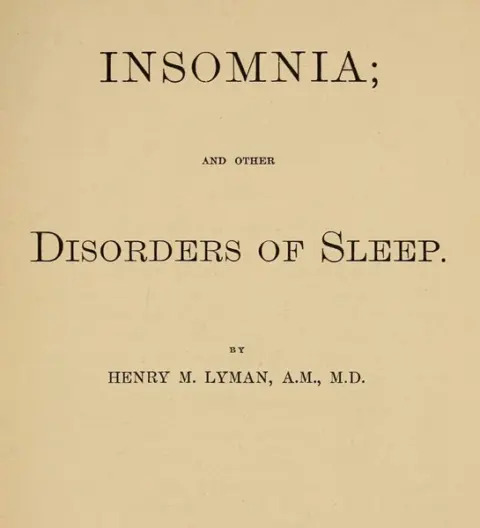
"Insomnia; and Other Disorders of Sleep" by Henry M. Lyman is a scientific publication written in the late 19th century. This work delves into the physiological and pathological aspects of sleep, examining conditions such as insomnia, dreams, and various disorders of sleep. It aims to provide a comprehensive understanding of sleep, discussing physiological functions, causes of sleep and wakefulness, and potential treatments for related disorders. The opening of this publication introduces the subject of sleep as a fundamental physiological process, likening its natural occurrence to vital functions like breathing and circulation. Lyman emphasizes the significance of sleep in restoring energy and the complexities surrounding its mechanisms. He discusses the prelude to sleep, identifying the hypnagogic state that precedes unconsciousness, and begins to outline how sleep differs from other states like coma and lethargy. This establishes a foundation for the subsequent exploration of insomnia, its causes, and its treatments, indicating that the text will focus on both the scientific and therapeutic perspectives of sleep disorders.
Introduction adapted from the source catalogue; source summaries may be automatically generated.
Free to read · English · 65,703 words · No account needed
MAKE TIME FOR A GOOD BOOK
On by default. Untick to stop anonymous reading totals. Each page counts after 10 seconds in view. How this works.
Anonymous counting is on unless you have switched it off.
Such, then, are the principal characteristics of somnambulism--a state in which dreams are supplemented by more or less complete and appropriate action; ordinarily without subsequent recollection of either dream or action. The somnambulic dream usually occurs during or soon after the period of deepest sleep, when the influences of the external world are most completely suppressed. Released from the control of its sensory portion, the remainder of the brain awakens, and becomes aroused to a condition of relative exaltation. No longer distracted by the solicitations of external sense, the attention is concentrated upon the hallucinations which constitute the dream. In the simpler forms of noctambulism only the automatic locomotive apparatus is awakened, and the sleeper moves in accordance with the impressions derived from habit, aided by actual exaltation of the muscular and tactile senses. But, in some of the more complicated cases, a certain amount of special sensibility seems to exist. The patient is capable of exercising just that amount of perception which is necessary to accomplish his purpose, though blind and deaf and insensible to every other impression. The more complete the waking of the sense-organs, the closer the resemblance to the condition of ordinary life, or even to the condition of ecstasy, in which cerebral exaltation is the prominent feature, and in which the power of recollection generally persists. Accordingly, it sometimes happens that the somnambulist can recall the events of his paroxysm. In such cases the power of recollection is due to the same conditions that control the recollection of our ordinary dreams. But the phenomena of ordinary somnambulism are as completely as possible removed from all connection with the mental actions which arise directly from the operation of the senses. By reason of such isolation the ordinary association of ideas affords no help to the memory, and the dream remains in oblivion. Alfred Maury expresses the opinion[90] that the principal cause of forgetfulness of the events of somnambulism consists in the exhaustion of the cerebral elements through the intensity of the excitement to which they have been subjected during the paroxysm. Doubtless this, in certain cases, may contribute to the loss of memory, but it should be remembered that the excitement may be relative rather than absolute. Certain elements wake while others are asleep; and these waking cells may be aroused to a degree far in excess of what is usual during the sleep of the brain without attaining to the level of their diurnal activity. The mind, undisturbed by external impressions, gives its attention to the operation of these waking organs, and a dream with all its consequences, somnambulic or otherwise, is the result. In other words, the plane of consciousness, so to speak, is lowered in sleep to the level of these molecular vibrations. But when the entire brain has been completely reawakened, the residual vibrations of those elements which yielded the physical basis of the dream, and which, had they originally occurred during the waking state, might have persisted with energy sufficient to furnish a groundwork for recollection of the ideas which they had first suggested, are no longer sufficiently forcible to be felt in consciousness. Recollection of mental states thus generated must necessarily be impossible under such conditions. Sometimes, however, the somnambulist who, while awake, had forgotten all the incidents of his somnambulic experience, can remember, in a subsequent paroxysm, all that occurred during the preceding attack. Facts of this kind have been observed in the waking life of certain hysterical persons, but the apparent doubling of their personality is connected with the waking state, or with its semblance, while in ordinary somnambulism it is only during sleep that the alternations of memory and forgetfulness occur. A similar recollection of previous visions is sometimes experienced in dreams, showing a close relationship between the dreams of sleep and of somnambulism. The bond of association between events thus isolated in time must be sought in a renewal of like conditions of the brain during the successive periods of somnambulic exaltation. We must suppose that the molecules which were in a state of excitement during the first paroxysm are again aroused in a similar manner after a period of waking quiescence. If, during sleep, their movements, though of an exalted character, have only just sufficed to arouse consciousness in the form of a dream, it is scarcely probable that during the phase of comparative inactivity which supervenes when the whole brain is awake, their residual motion could disturb the sphere of consciousness. Hence the time occupied by their somnambulic vigor must remain a blank in memory during the waking state. But, when the original state of relative exaltation has been reproduced by a second paroxysm of disorder, if the same molecular movements be in any way renewed, the conditions of memory are fulfilled; consciousness is once more aroused as before, and the patient remembers the dream or the events of the previous attack.
Your reading position is saved on this browser. Take it to another device with a library code. Reading pages adapt to text, rather than matching a printed edition.
BEHIND THE BOOK
This eBook is for the use of anyone anywhere in the United States and most other parts of the world at no cost and with almost no restrictions whatsoever. You may copy it, give it away or re-use it under the terms of the Project Gutenberg License included with this eBook or online at www.gutenberg.org. If you are not located in the United States, you will have to check the laws of the country where you are located before using this eBook. Read the source licence.
The original source file, including credits and licence, is retained by this library. Request an original-format copy at no charge. Please include the book title and Project Gutenberg identifier #43415.
KEEP YOUR CURIOSITY GOING
Charles G. (Charles Griffith) Ross
Hannah Webster Foster

Emily Lawless
Edwin Hamlin Carr

Charles De Lano Hine
Andrew Ure