
The Writing of News A Handbook with Chapters on Newspaper Correspondence and Copy Reading
Charles G. (Charles Griffith) Ross
THE CLASSIC COLLECTION · 1885
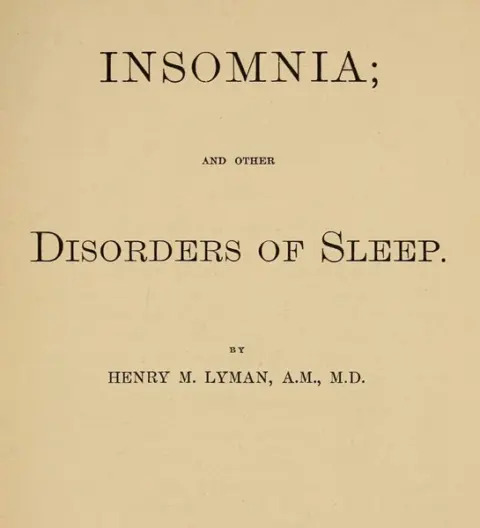
"Insomnia; and Other Disorders of Sleep" by Henry M. Lyman is a scientific publication written in the late 19th century. This work delves into the physiological and pathological aspects of sleep, examining conditions such as insomnia, dreams, and various disorders of sleep. It aims to provide a comprehensive understanding of sleep, discussing physiological functions, causes of sleep and wakefulness, and potential treatments for related disorders. The opening of this publication introduces the subject of sleep as a fundamental physiological process, likening its natural occurrence to vital functions like breathing and circulation. Lyman emphasizes the significance of sleep in restoring energy and the complexities surrounding its mechanisms. He discusses the prelude to sleep, identifying the hypnagogic state that precedes unconsciousness, and begins to outline how sleep differs from other states like coma and lethargy. This establishes a foundation for the subsequent exploration of insomnia, its causes, and its treatments, indicating that the text will focus on both the scientific and therapeutic perspectives of sleep disorders.
Introduction adapted from the source catalogue; source summaries may be automatically generated.
Free to read · English · 65,703 words · No account needed
MAKE TIME FOR A GOOD BOOK
On by default. Untick to stop anonymous reading totals. Each page counts after 10 seconds in view. How this works.
Anonymous counting is on unless you have switched it off.
While under treatment in the Saint Antoine Hospital, this patient was carefully studied by Dr. Mesnet and by Alfred Maury, the celebrated author. They found that by means of impressions upon his tactile sensibility it was possible during any one of his paroxysms to suggest certain modes of action which were reproduced whenever he was again placed in the same conditions. Thus, “he was promenading in the garden, under a grove of trees, when some one put back into his hand the cane which he had let fall a few moments previously. He felt of it, turned his hand several times around the curved handle of the cane, became attentive, seemed to listen, and suddenly cried out, ‘hurry!’ then, ‘there they are! there are at least twenty of them, to the two of us! we shall get the better of them!’ and then, carrying his hand behind his back, as if to get a cartridge, he went through the movements of loading his musket, crouched at full length in the grass, concealing his head behind a tree, in the posture of a sharp-shooter, and following with his gun at his shoulder all the movements of the enemy whom he seemed to see close at hand. This scene often repeated in detail during the course of the observations, has seemed to each of us the most complete expression of an hallucination called up by an illusion of touch, which, giving to a cane the properties of a gun, awakened in this person remembrances of his last campaign, and reproduced the struggle in which he was so grievously wounded.”
On another occasion the patient was at the end of a corridor, near a door that was locked; he “passed his hands over this door, found the knob, grasped it, and attempted to open it; failing to accomplish this, he sought for the keyhole, then for the key, which, however, was not there; then, passing his fingers over the screws which secured the lock, he endeavored to seize them and turn them for the purpose of detaching the lock. This entire series of actions bears witness to an effort of his mind connected with the object before him. He was on the point of leaving the door and turning towards another room, when I held up before his eyes a bunch of seven or eight keys; he did not see them; I jingled them loudly at his ear; he did not notice them; placing them in his hand, he immediately took hold of them, and tried them one by one in the keyhole, without finding the single one which could fit; he then left the place, and went into one of the wards, taking in his passage various articles with which he filled his pockets; at length he came to a little table used for the records of the wards. He then passed his hands over the table, but it was empty; in feeling of it, however, he came across the handle of a drawer; opening it, he took up a pen, and all at once this pen suggested to him the idea of writing; for at that moment he began to ransack the drawer, taking out and placing on the table several sheets of paper, and also an inkstand. He then sat down and commenced a letter, in which he recommended himself to his commanding officer for his good conduct and bravery, and made application for the military medal. This letter was written with many mistakes in it, but these were identical as regards expression and orthography with all that we have seen him make in his healthy state. While the patient was writing, he aided us in an experiment that encouraged to immediately examine in what degree the sense of sight assisted in the performance of this action. The facility with which he traced his letters, and followed the lines upon the paper, left no doubt concerning the exercise of vision upon the writing; but, in order to make the proof satisfactory, we have several times interposed a thick plate of sheet-iron between his hands and his eyes when he was writing; and, although all the visual rays were intercepted, he did not immediately break off the line he had begun; he still continued to trace a few words written in an almost illegible manner with the letters entangled in each other; then finally he stopped without manifesting either discontent or impatience. The obstacle removed, he finished the uncompleted line, and began another. The sense of sight was therefore in full activity, and essential to the written expression of the patient.” Other observations showed that the sense of sight was only roused at the instance of touch, and that its exercise remained limited to those objects alone with which it was actually connected by the touch.
Your reading position is saved on this browser. Take it to another device with a library code. Reading pages adapt to text, rather than matching a printed edition.
BEHIND THE BOOK
This eBook is for the use of anyone anywhere in the United States and most other parts of the world at no cost and with almost no restrictions whatsoever. You may copy it, give it away or re-use it under the terms of the Project Gutenberg License included with this eBook or online at www.gutenberg.org. If you are not located in the United States, you will have to check the laws of the country where you are located before using this eBook. Read the source licence.
The original source file, including credits and licence, is retained by this library. Request an original-format copy at no charge. Please include the book title and Project Gutenberg identifier #43415.
KEEP YOUR CURIOSITY GOING
Charles G. (Charles Griffith) Ross
Hannah Webster Foster

Emily Lawless
Edwin Hamlin Carr

Charles De Lano Hine
Andrew Ure