
The Writing of News A Handbook with Chapters on Newspaper Correspondence and Copy Reading
Charles G. (Charles Griffith) Ross
THE CLASSIC COLLECTION · 1885
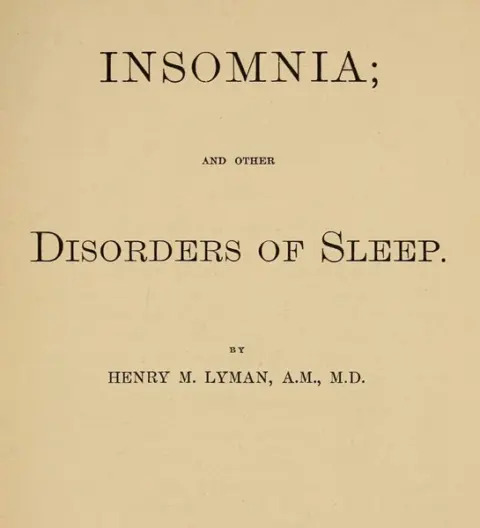
"Insomnia; and Other Disorders of Sleep" by Henry M. Lyman is a scientific publication written in the late 19th century. This work delves into the physiological and pathological aspects of sleep, examining conditions such as insomnia, dreams, and various disorders of sleep. It aims to provide a comprehensive understanding of sleep, discussing physiological functions, causes of sleep and wakefulness, and potential treatments for related disorders. The opening of this publication introduces the subject of sleep as a fundamental physiological process, likening its natural occurrence to vital functions like breathing and circulation. Lyman emphasizes the significance of sleep in restoring energy and the complexities surrounding its mechanisms. He discusses the prelude to sleep, identifying the hypnagogic state that precedes unconsciousness, and begins to outline how sleep differs from other states like coma and lethargy. This establishes a foundation for the subsequent exploration of insomnia, its causes, and its treatments, indicating that the text will focus on both the scientific and therapeutic perspectives of sleep disorders.
Introduction adapted from the source catalogue; source summaries may be automatically generated.
Free to read · English · 65,703 words · No account needed
MAKE TIME FOR A GOOD BOOK
On by default. Untick to stop anonymous reading totals. Each page counts after 10 seconds in view. How this works.
Anonymous counting is on unless you have switched it off.
Ordinarily the memory is not impressed by the events of the somnambulic dream, but we have already learned that it is sometimes affected precisely as in common dreaming. One of my little acquaintances could not find her night-dress when she went to bed one night. She was therefore obliged to wear a gown that was old and ragged. Later in the evening her sister discovered the missing garment, and laid it over a chair in the bed-room. In the morning the night-dresses had changed place, and the ragged one occupied the chair. This occasioned considerable surprise, until the child remembered that during the night she had dreamed that two of her playmates had come to sleep with her, and that she felt so mortified at being seen in a ragged dress that she got out of bed and changed her night-gown. Sometimes the events of a somnambulic paroxysm are remembered during a subsequent attack, though they are forgotten during the interval, as in a case, reported by Macario, of a young girl who had been violated during somnambulic sleep. On awaking she had no idea of anything that had occurred, but during a subsequent paroxysm she told her mother all that had happened.[81] In certain cases a dim recollection of some particular incident may be retained, as in the case of my patient who was for eight weeks in the somnambulic state. On recovery, the only thing that she could remember was a momentary glimpse of some one who was holding up his fingers before her eyes. Meeting the physician, subsequently to her recovery, who had thus attempted to arouse her attention, she recognized in his countenance the features which had momentarily impressed her consciousness during the period of somnambulic life.
It is seldom observed that somnambulism is attended with dangerous tendencies, yet they are sometimes present. One of my patients once took by mistake ninety grains of chloral at a single dose. While under its effects she got out of bed, walked into her sister’s room, shook her fist in her face, and swore furiously at her. On awaking, next morning, she was greatly shocked by the account of this dreadful behavior, so utterly at variance with her usual temper and character. Another somnambulic patient one night rushed into her mother’s room, violently accusing her of stealing her pocket-book, and threatening vengeance if it were not returned. Such patients sometimes mislay the articles with which they occupy themselves during a paroxysm, and on waking they erroneously infer that they have been robbed. Sometimes, as in the celebrated case related by Mesnet, the natural propensities of the individual seem to be released from all restraint, and brutal instincts guide the actions of the somnambulist, who then steals, or eats and drinks with the voracity of a savage. Ball and Chambard (loc. cit.) have collected a number of examples in which impulses to suicide or other forms of violence were manifested under such circumstances. Obviously, where the moral sense is asleep, and where the affection is the result of causes beyond the control of the patient, he cannot be held morally responsible for the consequences of such actions. His condition closely resembles that of the victim of epileptic mania who delivers himself during a paroxysm to all degrees of furious and homicidal violence, without retaining the slightest recollection of the fact after its conclusion. The closeness of the parallel between these two disorders is rendered further apparent by the circumstance that although all memory of the events of epileptic mania is usually abolished, it does sometimes persist after the termination of the attack. Thus, one of my epileptic patients for a time manifested symptoms of insanity after every fit. During one of these paroxysms he imagined that the sparrows on the housetop were all singing a particular tune which had attracted his attention shortly before the convulsion. Then it seemed to him that the breathing of his sleeping child whispered the same tune. Placing his hand upon the bosom of his wife, her breathing assumed the same musical character. Calling upon his family to listen to the wonderful music, they all asserted that they too could hear it. It was a considerable time after his recovery before he could be convinced that this vividly remembered experience was a pure illusion. The members of his family had been cautioned against contradicting their father during his paroxysms; consequently, when he asked if they could hear the melody which delighted him, they answered affirmatively, and thus confirmed him in his delusion. To the ordinary form of epileptic mania such paroxysms sustain a relation similar to that subsisting between ordinary dreams and the somnambulic experience.
Your reading position is saved on this browser. Take it to another device with a library code. Reading pages adapt to text, rather than matching a printed edition.
BEHIND THE BOOK
This eBook is for the use of anyone anywhere in the United States and most other parts of the world at no cost and with almost no restrictions whatsoever. You may copy it, give it away or re-use it under the terms of the Project Gutenberg License included with this eBook or online at www.gutenberg.org. If you are not located in the United States, you will have to check the laws of the country where you are located before using this eBook. Read the source licence.
The original source file, including credits and licence, is retained by this library. Request an original-format copy at no charge. Please include the book title and Project Gutenberg identifier #43415.
KEEP YOUR CURIOSITY GOING
Charles G. (Charles Griffith) Ross
Hannah Webster Foster

Emily Lawless
Edwin Hamlin Carr

Charles De Lano Hine
Andrew Ure