
The Writing of News A Handbook with Chapters on Newspaper Correspondence and Copy Reading
Charles G. (Charles Griffith) Ross
THE CLASSIC COLLECTION · 1885
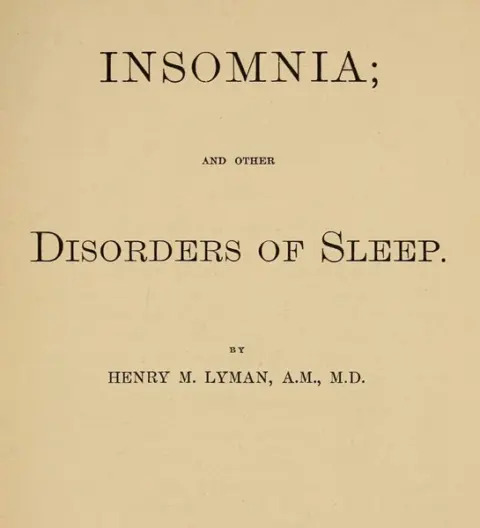
"Insomnia; and Other Disorders of Sleep" by Henry M. Lyman is a scientific publication written in the late 19th century. This work delves into the physiological and pathological aspects of sleep, examining conditions such as insomnia, dreams, and various disorders of sleep. It aims to provide a comprehensive understanding of sleep, discussing physiological functions, causes of sleep and wakefulness, and potential treatments for related disorders. The opening of this publication introduces the subject of sleep as a fundamental physiological process, likening its natural occurrence to vital functions like breathing and circulation. Lyman emphasizes the significance of sleep in restoring energy and the complexities surrounding its mechanisms. He discusses the prelude to sleep, identifying the hypnagogic state that precedes unconsciousness, and begins to outline how sleep differs from other states like coma and lethargy. This establishes a foundation for the subsequent exploration of insomnia, its causes, and its treatments, indicating that the text will focus on both the scientific and therapeutic perspectives of sleep disorders.
Introduction adapted from the source catalogue; source summaries may be automatically generated.
Free to read · English · 65,703 words · No account needed
MAKE TIME FOR A GOOD BOOK
On by default. Untick to stop anonymous reading totals. Each page counts after 10 seconds in view. How this works.
Anonymous counting is on unless you have switched it off.
The publication of this remarkable story led to its correction in several important particulars. From the North China Herald (August, 1884) it appears that not only was Sir Edmund’s memory defective in connection with several of the minor details of the narrative, but he had also been either wholly misinformed, or was quite forgetful regarding the actual time of the editor’s death. That person was, in fact, alive and in his usual health at the time of his supposed apparition in the judge’s chamber, and did not die till between eight and nine o’clock on the same morning. He had “attended a temperance committee meeting the night before, and had left about half-past ten in good health and excellent spirits.... He slept at home, rose shortly before eight, and visited his office to arrange some matter for that day’s paper. He then returned to his room to dress, and in a few minutes afterward was found dead upon the floor.”
Between these conflicting witnesses it is of course impossible to decide. But for our purpose that is quite unnecessary. It is clear that Sir Edmund believed that the visible image of an acquaintance had appeared before him in his chamber at night. It is also evident that the judge was a man whose nerves had been damaged, probably by tobacco--for he was a “light sleeper”--waking often, and indulging in the luxury of a cigarette during the course of the night. If we may credit the writer in the Herald, his brain was in a process of deterioration, proved by the decidedly treacherous character of his memory. The whole story, therefore, becomes exceedingly instructive as an illustration of the manner in which a belief in apparitions may be originated. The most probable explanation of the incident is found in the hypothesis of a dream excited in an irritable brain that had been aroused by the preparation of the manuscript which had occupied the thoughts of the judge immediately before retiring for the night. The course of this dream was so vivid that the sleeper awoke, but continued, like some other dreamers similarly awakened, to witness the evolution of his vision in the form of a genuine hallucination. A remarkable example of a similar production of hallucination through disease of the brain is related by the late Dr. E. H. Clarke.[70] One of his patients, a vigorous old gentleman, of eighty years, a great lover of music, and a frequent attendant at operas and concerts, retired one night at the usual hour, and in his usual health. He soon fell asleep, “and slept well till about two A. M., when he was awakened by the sound of music, which seemed to come from the street near his house. Thinking a serenade was going on, he got up to ascertain where it was, but discovered nothing. The sound ceased when he arose. On returning to bed, he heard the sound of music again, and was at the same time surprised by the appearance of three persons, standing near each other in his chamber, opposite the foot of his bed. It was his habit to sleep with the gaslight burning feebly, near the head of his bed. He turned the gas on to its full power, and inspected the intruders. They appeared to be musicians, who were humming and singing, as if in preparation for a musical performance. He rang a bell, which summoned his man servant. John soon arrived, and was ordered to put the strangers out. ‘There is nobody here, sir,’ was John’s reply to the order. For a moment Mr. A. was not only amazed, but alarmed. ‘What!’ he exclaimed, ‘do you see no one there?’ ‘No one,’ said John. ‘Go where those chairs are, and move them,’ was Mr. A.’s next direction. John did so. The strangers stepped aside, but did not go out. By this time Mr. A. had gathered his wits about him, and was satisfied that he was the victim of a hallucination; and he determined to observe its phenomena carefully. Accordingly, he bade his servant depart, and prepared to watch his visitors. But they were so life-like and human, that he was again staggered, and recalling John, told him to go for the house-keeper. She soon came, and on being interrogated, confirmed John’s statements that there were no strangers in the chamber and no sounds to be heard. Convinced by the testimony of two witnesses, Mr. A. yielded to the decision of his reason, and again resolved to go on with the investigation of the strange phenomena. The musicians had now resumed their position, near the window and opposite the foot of the bed. Mr. A. turned the light of the gas full upon them. He looked at his watch, which marked the hour of half-past two. He then arranged his pillows, so as to sit almost upright in bed, and waited for the next scene of the play. He was able to note the size, form, dress, and faces of the performers. One was a large man, who bore some resemblance to Brignoli. The two others were of less size, and shorter stature than their companions. All were habited in dress coats, with white waist coats, and wore white cravats and white gloves. After a little time spent in coughing and clearing their throats, they began to sing. They sang at first a few simple airs, ‘Sweet Home’ among others. They then attempted more difficult music, and gave selections from Beethoven and Mozart. Between the pieces they chatted with each other in a foreign language, which Mr. A. took to be Italian, but they did not address him. Occasionally they changed their position, turned in various directions, and part of the time sat down. Mr. A. said the singing was excellent; he had rarely heard better. After the first feeling of surprise and amazement had passed away, he enjoyed the music exceedingly. The performance continued in this way for some time, when it suddenly came to an end. The singing ceased, and the singers vanished. He looked at his watch, and found that the time was four o’clock. The concert in his brain had lasted nearly an hour and a half, almost the length of an ordinary concert. He reflected for a while upon this strange occurrence, but not being able to arrive at any satisfactory explanation of it, he turned his gas down and went to sleep. The next morning he called at my office, as previously stated, to ascertain if possible what pranks his brain had been playing, and if he should regard them as warning of his approaching departure.”
Your reading position is saved on this browser. Take it to another device with a library code. Reading pages adapt to text, rather than matching a printed edition.
BEHIND THE BOOK
This eBook is for the use of anyone anywhere in the United States and most other parts of the world at no cost and with almost no restrictions whatsoever. You may copy it, give it away or re-use it under the terms of the Project Gutenberg License included with this eBook or online at www.gutenberg.org. If you are not located in the United States, you will have to check the laws of the country where you are located before using this eBook. Read the source licence.
The original source file, including credits and licence, is retained by this library. Request an original-format copy at no charge. Please include the book title and Project Gutenberg identifier #43415.
KEEP YOUR CURIOSITY GOING
Charles G. (Charles Griffith) Ross
Hannah Webster Foster

Emily Lawless
Edwin Hamlin Carr

Charles De Lano Hine
Andrew Ure