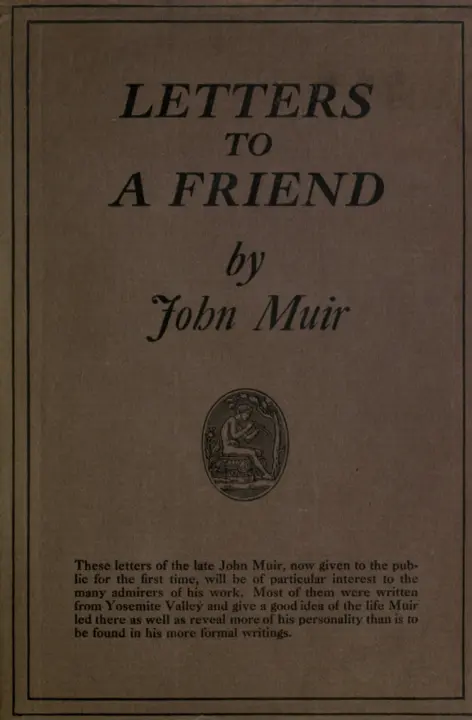
Letters to a Friend, Written to Mrs. Ezra S. Carr, 1866-1879
John Muir
THE CLASSIC COLLECTION · 1830
"Insect Architecture" by James Rennie is a scientific publication written in the late 19th century. The book explores the fascinating construction techniques employed by various insects, detailing the complexity and ingenuity behind their architectural endeavors. With nearly two hundred illustrations, it serves as an informative resource for anyone interested in entomology or the intricate designs found in nature. The opening of the text establishes the significance of studying insects and their habitats, emphasizing the rich opportunities for observation that exist all around us. Rennie discusses the fundamental importance of understanding not just the insects themselves, but also their roles in the ecosystem and the creative strategies they employ for survival and reproduction. He delves into the mechanics of insect architecture, hinting at examples such as the nests of mason-bees and the protective structures crafted by wasps, all while inviting readers to ponder the intricate relationship between these small creatures and the broader aspects of natural history.
Introduction adapted from the source catalogue; source summaries may be automatically generated.
Free to read · English · 135,063 words · No account needed
MAKE TIME FOR A GOOD BOOK
On by default. Untick to stop anonymous reading totals. Each page counts after 10 seconds in view. How this works.
Anonymous counting is on unless you have switched it off.
If it be granted that making discoveries is one of the most satisfactory of human pleasures, then we may without hesitation affirm, that the study of insects is one of the most delightful branches of natural history, for it affords peculiar facilities for its pursuit. These facilities are found in the almost inexhaustible variety which insects present to the curious observer. As a proof of the extraordinary number of insects within a limited field of observation, Mr. Stephens informs us, that in the short space of forty days, between the middle of June and the beginning of August, he found, in the vicinity of Ripley, specimens of above two thousand four hundred species of insects, exclusive of caterpillars and grubs,--a number amounting to nearly a fourth of the insects ascertained to be indigenous. He further tells us, that, among these specimens, although the ground had, in former seasons, been frequently explored, there were about one hundred species altogether new, and not before in any collection which he had inspected, including several new genera; while many insects reputed scarce were in considerable plenty.[A] The localities of insects are, to a certain extent, constantly changing; and thus the study of them has, in this circumstance, as well as in their manifold abundance, a source of perpetual variety. Insects, also, which are plentiful one year, frequently become scarce, or disappear altogether, the next--a fact strikingly illustrated by the uncommon abundance, in 1826 and 1827, of the seven-spot lady-bird (Coccinella septempunctata), in the vicinity of London, though during the two succeeding summers this insect was comparatively scarce, while the small two-spot lady-bird (Coccinella bipunctata) was plentiful.
There is, perhaps, no situation in which the lover of nature and the observer of animal life may not find opportunities for increasing his store of facts. It is told of a state prisoner, under a cruel and rigorous despotism, that when he was excluded from all commerce with mankind, and was shut out from books, he took an interest and found consolation in the visits of a spider; and there is no improbability in the story. The operations of that persecuted creature are among the most extraordinary exhibitions of mechanical ingenuity; and a daily watching of the workings of its instinct would beget admiration in a rightly-constituted mind. The poor prisoner had abundant leisure for the speculations in which the spider's web would enchain his understanding. We have all of us, at one period or other of our lives, been struck with some singular evidence of contrivance in the economy of insects, which we have seen with our own eyes. Want of leisure, and probably want of knowledge, have prevented us from following up the curiosity which for a moment was excited. And yet some such accident has made men naturalists, in the highest meaning of the term. Bonnet, evidently speaking of himself, says, "I knew a naturalist, who, when he was seventeen years of age, having heard of the operations of the ant-lion, began by doubting them. He had no rest till he had examined into them: and he verified them, he admired them, he discovered new facts, and soon became the disciple and the friend of the Pliny of France"[B] (Réaumur). It is not the happy fortune of many to be able to devote themselves exclusively to the study of nature, unquestionably the most fascinating of human employments; but almost every one may acquire sufficient knowledge to be able to derive a high gratification from beholding the more common operations of animal life. His materials for contemplation are always before him. Some weeks ago we made an excursion to West Wood, near Shooter's Hill, expressly for the purpose of observing the insects we might meet with in the wood: but we had not got far among the bushes, when heavy rain came on. We immediately sought shelter among the boughs of some thick underwood, composed of oak, birch, and aspen; but we could not meet with a single insect, not even a gnat or a fly, sheltered under the leaves. Upon looking more narrowly, however, into the bushes which protected us, we soon found a variety of interesting objects of study. The oak abounded in galls, several of them quite new to us; while the leaves of the birch and the aspen exhibited the curious serpentine paths of the minute mining caterpillars. When we had exhausted the narrow field of observation immediately around us, we found that we could considerably extend it, by breaking a few of the taller branches near us, and then examining their leaves at leisure. In this manner two hours glided quickly and pleasantly away, by which time the rain had nearly ceased; and though we had been disappointed in our wish to ramble through the wood, we did not return without adding a few interesting facts to our previous knowledge of insect economy.[C]
Your reading position is saved on this browser. Take it to another device with a library code. Reading pages adapt to text, rather than matching a printed edition.
BEHIND THE BOOK
This eBook is for the use of anyone anywhere in the United States and most other parts of the world at no cost and with almost no restrictions whatsoever. You may copy it, give it away or re-use it under the terms of the Project Gutenberg License included with this eBook or online at www.gutenberg.org. If you are not located in the United States, you will have to check the laws of the country where you are located before using this eBook. Read the source licence.
The original source file, including credits and licence, is retained by this library. Request an original-format copy at no charge. Please include the book title and Project Gutenberg identifier #45496.
KEEP YOUR CURIOSITY GOING
John Muir
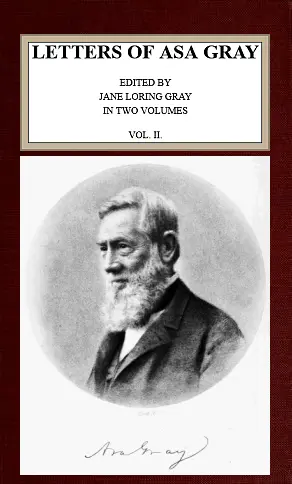
Asa Gray
Asa Gray
Florence Nightingale
Elizabeth Robins Pennell
Denison Olmsted