
Letters to a Friend, Written to Mrs. Ezra S. Carr, 1866-1879
John Muir
THE CLASSIC COLLECTION · 1914
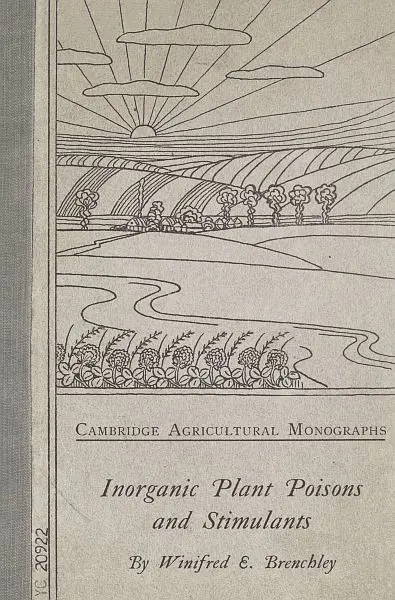
"Inorganic Plant Poisons and Stimulants" by Winifred Elsie Brenchley is a scientific publication written in the early 20th century. The work investigates the effects of various inorganic substances, specifically focusing on their toxic and stimulating actions on plant growth and development. It aims to provide a comprehensive analysis and correlation of existing research related to these substances, delving into their applicability in agricultural practices. The opening of the work begins with a preface outlining the significant changes in agricultural practices over the previous century, highlighting the use of artificial fertilizers and the conflicting evidence surrounding inorganic substances as potential plant nutrients. Brenchley sets the stage for further exploration by discussing the historical context of plant nutrition and the classification of substances based on their effects on plant growth. In particular, she emphasizes the complexity of understanding how certain inorganic compounds can exhibit both toxic and beneficial effects, depending on their concentrations and combinations with other nutrients, thereby inviting future investigation into the nuanced interactions between plants and these chemicals.
Introduction adapted from the source catalogue; source summaries may be automatically generated.
Free to read · English · 41,390 words · No account needed
MAKE TIME FOR A GOOD BOOK
On by default. Untick to stop anonymous reading totals. Each page counts after 10 seconds in view. How this works.
Anonymous counting is on unless you have switched it off.
KAHLENBERG, L. and TRUE, R. H. On the toxic action of dissolved salts and their electrolytic dissociation. Bot. Gaz. XXII, 81–124. (1896) 19, 22, 68
KANDA, M. Studien über die Reizwirkung einiger Metallsalze auf das Wachstum höheren Pflanzen. Journ. Coll. Sci. Tokyo, XIX, Art. 13, 1–37. (1904) 28, 46, 47
KANE, R. Researches on the composition and characters of certain soils and waters belonging to the flax districts of Belgium and on the chemical constitution of the ashes of the Flax plant. Proc. Roy. Dublin Soc. LXXXIII, 153–172. (1847) 78
KELLEY, W. P. Manganese in some of its relations to the growth of pineapples. Journ. Ind. Eng. Chem. I, 533–8. (1909) 83
KLOPSCH. Ueber die Aufnahme von Zink durch die Pflanzen. Kulturtechniker, 223–6. (1908) 38, 47
KNOP, W. Ueber die Aufnahme verschiedener Substanzen durch die Pflanze, welche nicht zu den Nährstoffen gehören. Jahresb. Agrik. Chem. VII, 138–40. (1884) 24, 53, 62, 67, 81
KRAUCH, C. Ueber Pflanzenvergiftungen. Journ. Landw. XXX, 271–91. (1882) 39, 43
LABAND. Zur Verbreitung des Zinkes im Pflanzenreiche. Zeitschr. Nahrungs- und Genussmittel, IV, 489–92. (1901) --
LECHARTIER, G. et BELLAMY, F. Sur la présence du Zinc dans le corps des animaux et dans les végétaux. Compt. rend. LXXXIV, 687–90. (1877) 37
LECLERC, M. A. Dosage du manganèse dans les sols et dans les végétaux. Compt. rend. LXXV, 1209–14. (1872) --
LEHMANN, K. B. Hygienische Studien über Kupfer. 1. Die Bestimmung kleiner Kupfermengen in organischen Substanzen. Arch. Hyg. XXIV, 1–83. (1895) 16
LEHMANN, K. B. Ibid. 4. Der Kupfergehalt von Pflanzen und Thieren im kupferreichen Gegenden. Arch. Hyg. XXVII, 1–7. (1896) 16
LE RENARD. Du chémauxisme des sels de cuivre solubles sur le Penicillium glaucum. Journ. Bot. XVI, 97–107. (1902) --
LIEBIG, J. Die Chemie in ihrer Anwendung auf Agricultur und Physiologie. (1840) 1
LINDSAY, J. The elimination of Algae in lochs and ponds. Trans. Edinburgh Field Nat. Micros. Soc. VI, Part 5, 422–31. (1913) 35
LIPPMAN, E. O. von. Ueber einiger seltenere Bestandtheile der Rübenasche. Ber. Deut. chem. Gesell. XXI, 3492–3. (1888) 16, 65
LOEB, J. The toxic and antitoxic effects of ions as a function of their valency and possibly their electrical discharge. Amer. Journ. Physiol. VI, 411–33. (1902) 44
LOEW, O. Sind Arsenverbindungen Gift für pflanzliches Protoplasma? Pflüger Arch. Physiol. XXXII, 111–3. (1883) 62
LOEW, O. Bemerkung über die Giftwirkung des distillirten Wassers. Landw. Jahrb. XX, 235. (1891) 10
LOEW, O. Ueber die physiologischen Functionen der Calcium- und Magnesiumsalze im Pflanzenorganismus. Flora, LXXV, 374. (1892) 76
LOEW, O. On the treatment of crops by stimulating compounds. Bull. Coll. Agric. Tokyo, VI, No. 2, 161–75. (1904) --
LOEW, O. ASŌ, K. und SAWA, S. Ueber die Wirkung von Manganverbindungen auf Pflanzen. Flora, XCI, 264–73. (1902) --
LOEW, O. und HONDA, S. Ueber den Einfluss des Mangans auf Waldbäume. Bull. Coll. Agric. Tokyo, VI, No. 2, 125–30. (1904) 79, 88
LOEW, O. and SAWA, S. On the action of manganese compounds on plants. Bull. Coll. Agric. Tokyo, V, No. 2, 161–72. (1902) 81, 85, 87, 90
MALAGUTI et DUROCHER. Sur la répartition des éléments inorganiques dans les principales familles du règne végétal. Ann. Chim. Phys. LIV, 257–97. (1858) 78
Your reading position is saved on this browser. Take it to another device with a library code. Reading pages adapt to text, rather than matching a printed edition.
BEHIND THE BOOK
This eBook is for the use of anyone anywhere in the United States and most other parts of the world at no cost and with almost no restrictions whatsoever. You may copy it, give it away or re-use it under the terms of the Project Gutenberg License included with this eBook or online at www.gutenberg.org. If you are not located in the United States, you will have to check the laws of the country where you are located before using this eBook. Read the source licence.
The original source file, including credits and licence, is retained by this library. Request an original-format copy at no charge. Please include the book title and Project Gutenberg identifier #48008.
KEEP YOUR CURIOSITY GOING
John Muir

Asa Gray
Asa Gray

Florence Nightingale
Elizabeth Robins Pennell
Denison Olmsted